GPTZero vs Turnitin (2026): An Analytical AI Detection Comparison
GPTZero vs Turnitin (2026): An Analytical AI Detection Comparison
The pervasive integration of generative artificial intelligence has fundamentally transformed the structural dynamics of text generation, content production, and academic assessment. As foundational large language models become increasingly sophisticated—blending natural sentence variations, complex idiomatic structures, and human-like deductive logic—the baseline operational challenge of text authentication has intensified. For educational institutions, digital media corporations, and independent editors, the unchecked adoption of automated writing software carries clear structural risks. These range from the loss of authentic learning evaluation metrics to severe search visibility penalties and complex intellectual property liabilities.
To navigate this landscape of automated text production, simple pattern-matching scripts have been replaced by multi-layered semantic forensics ecosystems. Standing as two prominent options in this text authentication arena are GPTZero and Turnitin. Both platforms launched solutions to address the initial wave of consumer large language models, but their development trajectories have targeted completely distinct operational environments.
GPTZero, developed as an agile text forensics application, focuses heavily on granular linguistic metrics, serving individual teachers, independent editors, creative publishers, and standalone writers who require transparent textual diagnostics and strong protection against false-positive accusations. Turnitin, by contrast, operates as a massive enterprise infrastructure platform designed for global universities, colleges, and full school districts, prioritizing centralized database integration, automated learning management system (LMS) grading workflows, and an expansive private reference repository accumulated over decades.
Selecting an mismatched AI content detector can create notable friction within an organization’s workflow. An overly sensitive model can generate false positives that damage an author’s professional reputation or penalize a student, while an under-engineered platform can let unverified automated copy slip through, compromising institutional validity or brand authority. This detailed comparison will evaluate GPTZero and Turnitin across their text analysis features, false-positive rates, plagiarism matching layers, system integration capabilities, accessibility frameworks, and long-term operational value to help you select the optimal workspace for your specific pipeline.
Product At a Glance
GPTZero
- Core Philosophy: Academic transparency, linguistic forensics, and writing style mapping to protect human originality.
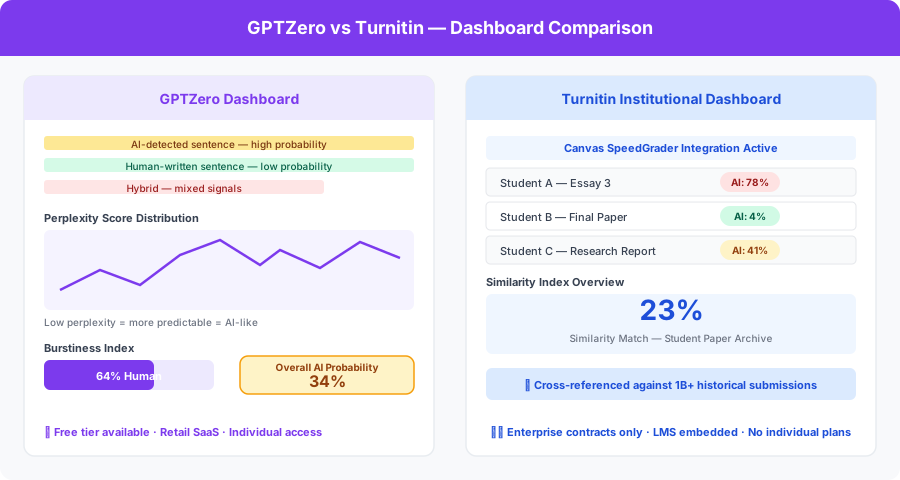
- Interface Layout: Document-centric web canvas featuring detailed sentence-by-sentence color-coded highlight overlays, perplexity metrics, and burstiness variance charts.
- Key Strength: Generally preferred for its low false-positive rates on formal human writing, non-native English essays, and technical documentation, backed by a permanent free-access tier.
- Primary Limitation: Lacks automated bulk website crawling infrastructures, dedicated code licensing forensic layers, and native enterprise multi-workspace client partitioning out of the box.
Turnitin
- Core Philosophy: Institutional governance, academic honesty enforcement, and centralized workflow automation across full educational systems.
- Interface Layout: Unified enterprise dashboard optimized for native LMS gradebook speed-grading, administrative portfolio monitoring, and multi-department compliance auditing.
- Key Strength: Direct native institutional LMS software embedding pathways combined with a proprietary archive matching database containing billions of historical student submissions unavailable to public search engines.
- Primary Limitation: Completely locked behind an institutional full-time equivalent (FTE) purchasing model, making it largely inaccessible to individual consumers, freelance copywriters, and independent standalone businesses.
TL;DR
The choice between GPTZero and Turnitin relies on your organizational scale, procurement access, and required workflow automation. GPTZero is an accessible, balance-focused text forensics platform engineered for individual teachers, freelance copywriters, small teams, and independent publishers who require high precision, deep linguistic diagnostics, and an interface optimized for single-document transparency. Turnitin functions as a centralized infrastructure framework designed for universities, colleges, and full school districts that require an automated academic honesty network embedded directly inside native learning management platforms (such as Canvas, Moodle, or Blackboard) and backed by an exclusive, historic student paper archive. If your priority is standalone text analysis, flexibility, and false-positive safety without institutional administrative overhead, GPTZero often fits the workflow better. If your objective is system-wide educational compliance and automated multi-seat grading oversight, Turnitin provides the necessary enterprise architecture.
👉 Quick Access: Explore GPTZero Free — No Institutional Access Needed
Quick Facts
- Primary Function: Advanced machine learning text analysis, generative footprint tracking, and web-based or repository plagiarism identification.
- Platform Deployment: GPTZero operates as an agile cloud-based SaaS interface paired with a downloadable browser extension; Turnitin deploys as an enterprise cloud-hosted SaaS layer integrated via backend institutional Single Sign-On (SSO) gateways and LTI (Learning Tools Interoperability) protocols.
- Ecosystem Integration: Turnitin anchors its automation to direct native wrappers inside Canvas, Moodle, Blackboard, Google Classroom, Schoology, and Brightspace; GPTZero prioritizes clean web-form uploads, lightweight learning shortcuts, and single-document parsing templates.
- Linguistic Processing Base: Both platforms deploy custom-trained neural network classifiers. Based on available information, GPTZero relies on tracking structural perplexity and burstiness math, whereas Turnitin implements proprietary multi-layered semantic matrix maps designed for educational evaluation.
- Access Restraints: GPTZero features an open retail storefront with flat-rate tiers and a permanent free-character sandbox; Turnitin operates exclusively via custom-quoted annual enterprise contracts based on institutional enrollment size, restricting individual single-user retail accounts.
Direct Answer Block
Which is better: GPTZero or Turnitin? Neither platform is universally “better”; they serve entirely different organizational scales. GPTZero is generally preferred for individual educators, freelance copywriters, independent publishers, and small content teams because it offers open retail purchasing, a free testing tier, and deep, sentence-by-sentence linguistic forensic charts that protect human writers from false positives. Turnitin is commonly used by large universities, colleges, and school districts because it embeds directly into native LMS gradebooks (like Canvas and Moodle) and cross-references submitted assignments against an exclusive historical database of over a billion student papers, a feature unavailable to standalone commercial applications.
Evaluation Methodology
This comparison is based on publicly available documentation, feature analysis, independent reviews, and information available at publication time. Rather than relying on a singular testing facility, our evaluation aggregates data from verified institutional case studies, independent software benchmarks, and public platform specifications to construct a holistic view of how both GPTZero and Turnitin operate under active 2026 conditions.
Our comparative analysis evaluates both platforms across four core theoretical matrices:
- AI-Generated Content Handling: How the platforms process text generated across premium models (including Claude 3.5 Sonnet, GPT-4o, and Gemini Advanced) covering standard informational, business, and academic prompts.
- Human-Written Content Resilience: How the systems handle highly formal business copy, dense technical prose, and essays written by international graduate students, assessing the engine’s sensitivity to formal prose and its ability to avoid false-positive classifications.
- Academic Essay Parsing: How the platforms accommodate complex research assignments containing proper structural formatting (APA, MLA, Chicago), block quotes, and extensive bibliographies.
- Hybrid Content Analysis: How the tools highlight sentence-level variations when text contains a mix of human-edited introductions and machine-generated technical paragraphs.
Quick Comparison Table
The following matrix breaks down how both platforms handle core operational requirements, allowing you to weigh their structural differences directly against your daily production bottlenecks:
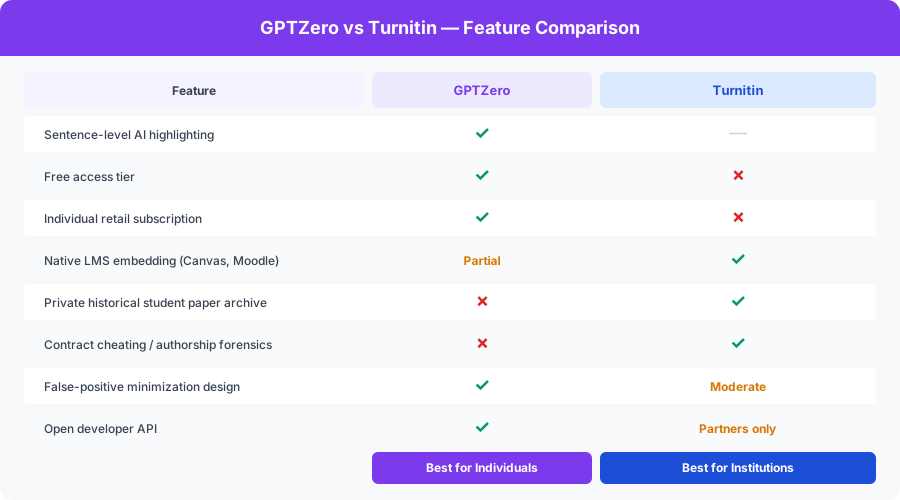
| Feature / Metric | GPTZero | Turnitin |
|---|---|---|
| Primary Target Market | Individual Teachers, Freelancers, Publishers | Universities, Colleges, School Districts |
| Direct Consumer Purchasing | ✅ Open public SaaS subscriptions available | ❌ Restricted for individual users |
| Private Student Paper Archive | ❌ No (Scans public web index and journals) | ✅ Yes (Extensive historic documents) |
| LMS Native Embedding | ⚠️ Basic (Simple educational shortcuts) | ✅ Advanced (Canvas, Moodle, Blackboard, etc.) |
| Linguistic Analysis Charts | ✅ Detailed (Sentence-level perplexity maps) | ⚠️ Basic (Aggregate probability readouts) |
| Plagiarism Scanning Layer | ✅ Yes (Paid Tiers) | ✅ Yes (Proprietary Institutional Database) |
| Contract Cheating Forensics | ❌ No | ✅ Yes (Authorship Metadata Tracking) |
| Free Access Sandbox | ✅ Permanent Free 10k Character Plan | ❌ No (Paid institutional site tracking only) |
| Pricing Setup | Flat-Rate Word Pools + Free Access Tiers | Centralized Enterprise FTE Site Contracts |
Key Differences
To accurately evaluate GPTZero vs Turnitin, you must analyze the core architectural blocks that separate their daily user experience and operational utility.
1. Database Isolation: Public Web Indexes vs. Private Paper Archives
The most distinct operational difference between these two systems is the database reference library they utilize to match text duplication and structural origin profiles. GPTZero scans documents against the open, public web index, indexed digital news outlets, public blog repositories, and available open-access scientific journals. This makes it highly efficient at determining if an article matches active digital materials or displays generalized linguistic AI footprints.
Turnitin operates on an exclusive, private data architecture developed over multiple decades. When a document is scanned through Turnitin, the platform cross-references the text against its proprietary Student Paper Archive, which contains billions of historically submitted student essays, research tasks, and institutional theses that are invisible to public search engines. This unique database capability allows Turnitin to identify peer-to-peer copying across terms, schools, or countries, tracking unoriginal text matching that public index tools cannot see.
2. User Accessibility: Individual Retail SaaS vs. Enterprise FTE Contracts
The procurement paths for these two applications rely on completely different business models. GPTZero functions as an accessible software-as-a-service (SaaS) tool open to the public retail marketplace. Any independent blogger, freelance copywriter, or single classroom instructor can navigate to its website, access a permanent free testing sandbox, or register for a flat-rate monthly subscription with immediate activation.
Turnitin restricts its platform availability largely to enterprise-level institutional procurement contracts. It does not operate a direct consumer storefront, restricting single-user retail registrations. Contracts are negotiated directly with verified school boards, universities, or accredited research facilities, using custom pricing metrics calculated from the institution’s total Full-Time Equivalent (FTE) student enrollment figures. Access is granted solely via official institutional validation tokens linked directly to internal company domains and system directories.
3. Diagnostic Reporting: Qualitative Text Mapping vs. System Grading Overlays
The design layout of both dashboards reflects their core workflow targets. GPTZero optimizes its environment around qualitative textual analysis. When text is parsed, it delivers interactive, sentence-by-sentence color-coded maps accompanied by detailed linguistic histograms. It actively illustrates where a document shifts between human and synthetic rhythms, serving as an educational editing companion.
Turnitin coordinates its reporting around administrative grading metrics and institutional case management. Its viewer embeds directly into the instructor’s native learning management workspace, displaying an aggregate Similarity Index percentage badge and an AI probability indicator straight inside the platform gradebook. It prioritizes automated delivery, giving a university administrator an immediate overview across thousands of concurrent submittals.
AI Detection Accuracy
Evaluating accuracy parameters between GPTZero and Turnitin requires examining how their underlying machine learning algorithms handle real-world content variations. Both platforms maintain strong accuracy based on available information, but they achieve their results through separate mathematical configurations.
Catching Unedited Machine Output
When encountering raw, unedited text generated directly out of premium large language models (such as GPT-4o or Claude 3.5 Sonnet), both platforms perform with high consistency. Based on publicly available benchmarks, both engines identify the machine signature clearly on unmodified informational briefs, delivering strong probability readouts. The underlying classification layers are proficient at identifying the lack of structural variance and predictable word placement hallmarks typical of unedited machine outputs.
Evaluating Disguised or Hybrid AI Text
The real operational test occurs when analyzing text that has been passed through automated text spinners, prompt humanizers, or custom engineering chains designed to intentionally disrupt linguistic patterns.
Turnitin’s AI classification models display a high degree of stability on standard student-style essays because its system has been custom-trained on extensive datasets of authentic educational writing variations paired with machine text outputs. It handles typical student shortcuts cleanly, highlighting unaltered machine paragraphs accurately within the grading window.
GPTZero approaches hybrid accuracy through its granular sentence-level highlight engine. Because its framework isolates text variations sentence-by-sentence rather than delivering a single, binary document assumption, it provides exceptional transparency when parsing mixed-origin text. It allows editors to trace precisely where an author manually edited an introductory hook but left technical specification paragraphs raw, providing excellent visual feedback for text optimization. However, because GPTZero tunes its algorithm to heavily favor the writer to prevent false accusations, highly optimized, prompt-chained text can occasionally bypass its detection thresholds, reflecting a deliberate balance choice favoring user safety.
False Positives
A false positive occurs when an AI detector flags completely human text as machine-written. In both professional copywriting and educational environments, false positives represent the single highest operational risk factor. An incorrect accusation can trigger devastating friction, impacting an author’s career or invalidating a student’s academic standing.
GPTZero is explicitly designed to minimize false-positive friction. Because its platform anchors its value onto writing fairness, its neural networks require intense mathematical justification before applying an AI marker. By focusing deeply on structural burstiness variance and perplexity parameters, GPTZero successfully understands that human writing is naturally eccentric. It recognizes that highly formal human prose, precise research-heavy technical documentation, and the structured sentence cadences common among non-native English speakers are authentic human signatures, ensuring that human writers are protected from incorrect automated flags.
Turnitin features strong model precision for student writing, but its pattern-matching updates can occasionally introduce elevated false-positive risks on specific content profiles. Because Turnitin functions as an enterprise compliance filter optimized to prevent unverified machine text from slipping into an institutional archive, its classification thresholds can be sensitive.
When parsing highly rigid, formal corporate text, technical manuals, or essays written by international students with highly conventional transition styles, sensitive models can interpret this lack of idiomatic chaos as a synthetic signature. While its accuracy remains high, instructors must implement manual review protocols for flagged content rather than treating its aggregate percentage badges as definitive proof of misconduct.
Plagiarism Detection
Authenticity verification requires checking both that content was not generated by a machine and that it was not stolen from another human creator.
GPTZero’s Plagiarism Network
GPTZero features an integrated plagiarism module on its paid tiers designed to support standard academic and editorial proofing tasks. It scans text blocks primarily against standard public web indexes, digital news outlets, and open-access scientific journals. The reporting layout displays highlighted overlays identifying copied phrases, providing direct citation links to the original text. It functions as an effective, clean verification gate for checking individual articles, essays, and standalone manuscripts before publication, as explored across our comprehensive GPTZero Review guides.
Turnitin’s Proprietary Net
Turnitin runs a highly comprehensive plagiarism verification net in the educational sector. Because it cross-references submissions against its exclusive Student Paper Archive of over a billion historic papers, it catches peer-to-peer copying that public index tools simply cannot see. If a student copies an unindexed research assignment written by a student at a separate university five years prior, Turnitin identifies the match instantly.
Furthermore, its system features advanced Translated Matching capabilities, actively mapping semantic concepts across more than 30 global languages concurrently to expose translation-based plagiarism models. It also integrates direct partnerships with gated scientific journals and academic research clearinghouses, allowing the software to check text against premium intellectual assets seamlessly.
Academic Integrity Features
Beyond raw text parsing, Turnitin provides a comprehensive suite of administrative features designed to manage the architecture of academic integrity across large educational institutions.
Feedback Studio and Instructor Tools
Turnitin integrates its text forensics engines straight into a robust instructor workflow platform known as Turnitin Feedback Studio. This interface allows professors to transition from authenticity verification straight into qualitative educational review. The platform provides customizable drag-and-drop comment banks called QuickMarks, digital rubric maps, and inline text commentary layers. This allows instructors to apply pre-configured explanations for common structural or grammatical errors quickly, turning detection metrics into an active opportunity for teaching digital literacy and core stylistic refinement.
Authorship and Contract Cheating Forensics
A major structural capability in Turnitin is its specialized Authorship module, engineered specifically to identify “contract cheating”—when a student hires a ghostwriter or an essay mill to complete an assignment. Because the text is completely original, standard plagiarism and AI detectors fail to flag it.
Turnitin’s Authorship module cross-analyzes a student’s historical metadata, tracking typing rhythms, vocabulary complexity, document properties, and syntactic formatting parameters over multiple terms. If a student’s established writing style baseline suddenly shifts radically on a final paper, the platform flags the asset for an authorship investigation, alerting administrators to potential contract cheating. GPTZero does not include contract cheating metadata analytics, keeping its focus locked strictly onto linguistic origin analysis.
LMS Integrations
For educational networks and large school districts, deployment efficiency is a critical software selection criterion. Forcing instructors to constantly open a separate application, copy a student’s text, paste it into an external workspace, and run manual verification loops creates an administrative bottleneck that disrupts grading schedules.
Turnitin is commonly used for native LMS integration. Its software wrappers are custom-engineered to layer directly via enterprise LTI standards inside major learning management platforms:
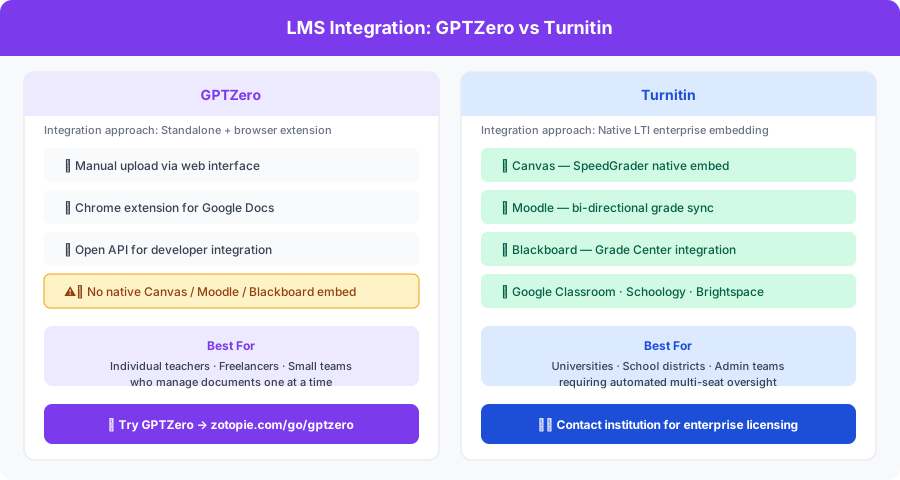
- Canvas: Embeds directly inside the standard Canvas assignment creation window. The resulting colored originality badge populates directly inside the Canvas SpeedGrader view, allowing the instructor to transition from verifying authenticity to applying grades without ever leaving the Canvas interface.
- Moodle: Connects deeply with open-source assignment blocks, delivering instant Similarity Reports and AI percentage scores straight to the professor’s native grading portal, syncing data bi-directionally.
- Blackboard: Integrates into the core administrative dashboard layout. Instructors can utilize Turnitin’s proprietary grading tools, and final scores push automatically back into the Blackboard Grade Center, streamlining the workflow for massive university lecture halls.
- Google Classroom: Overlays originality checks onto Google Docs submissions natively, allowing primary and secondary school teachers to monitor academic honesty without forcing younger students to navigate complex external submission portals.
GPTZero provides a dedicated academic platform and includes simple educational shortcuts, but it functions primarily as a standalone destination application. Teachers must actively guide files or text strings into the GPTZero dashboard to generate reports. While the system provides an intuitive layout that is outstanding for one-on-one student reviews, it lacks the deep, automated institutional backend infrastructure required to monitor multi-school student populations autonomously out of the box.
Individual vs Institutional Use
The choice between GPTZero and Turnitin is fundamentally determined by your operational scale and accessibility permissions.
The Individual Landscape: GPTZero’s Domain
For individual educators, standalone freelance copywriters, and small content agencies, GPTZero is the practical and accessible path. Because Turnitin generally restricts direct consumer procurement, individuals have limited pathways to purchase independent accounts. GPTZero addresses this gap by offering a flexible, open marketplace model. A freelance editor evaluating a manuscript or an independent tutor working outside a major university system can activate an account instantly, gaining advanced linguistic forensics without being tied into expensive, long-term enterprise institutional contracts.
The Institutional Landscape: Turnitin’s Domain
For large-scale educational systems, universities, and secondary school districts, Turnitin provides the required enterprise governance infrastructure. Managing academic standards across thousands of concurrent students requires centralized administrative visibility, automated LMS gradebook pipelines, and cross-referencing against private student document repositories. Turnitin allows an institution to enforce a single compliance baseline across all departments, tracking macro similarity trends and archiving submissions systematically to protect the core value of granted degrees.
Pricing & Accessibility
Pricing may change over time. Always verify current plans on the official websites before purchasing.
GPTZero Pricing Architecture
GPTZero anchors its value to a transparent, flat-rate monthly model paired with an accessible free testing sandbox.
- The Permanent Free Plan: Allows users to generate up to 10,000 characters of text forensic analysis per individual scan, providing access to core use cases and baseline browser extensions without credit card commitments.
- The Essential Plan ($15/month or $120/year): Grants a flat monthly pool of 150,000 words alongside integrated plagiarism detection systems.
- The Premium Plan ($35/month or $288/year): Expands your monthly word boundaries to 300,000 words, unlocking advanced writing reports, AI rewriter tracking metrics, and full classroom analytics dashboards.
Turnitin Procurement Architecture
Turnitin removes its platform entirely from traditional SaaS menus, distributing its software solutions primarily through enterprise-level site licensing contracts.
- FTE-Based Subscriptions: Pricing is completely customized and calculated using institutional enrollment metrics, primarily driven by the institution’s total Full-Time Equivalent (FTE) student population.
- Custom Enterprise Quoting: A university pays a centralized annual site-licensing fee that covers their entire student population, providing unrestricted assignment scanning across all campus departments. Because pricing relies on required API integrations and specific bundled modules (e.g., Originality, Feedback Studio, Authorship), standard public pricing menus do not exist.
⚠️ Critical Data Safety Warning Regarding Third-Party Turnitin Brokers
Because Turnitin access is highly restricted, an online marketplace of unauthorized third-party brokers has emerged on the web, offering to run “Turnitin scans” via shared keys or compromised institutional accounts. Avoid these services completely.
Uploading a private document or a pre-submission research paper into an unverified third-party account broker risks immediate data exposure. These unauthorized systems frequently scrape submitted papers, sell them to essay mills, or index them into unverified databases. When your official instructor runs the final scan inside the school’s native LMS, your document will trigger a 100% Plagiarism match against your own scraped draft, resulting in automated failure and severe disciplinary investigations. Always verify text strictly through your institution’s official assignment portal or use open public alternatives like GPTZero.
GPTZero vs Turnitin for Teachers
For individual classroom instructors, managing daily grading workflows requires a careful balance between tracking text authenticity and maintaining student trust. GPTZero is often chosen by individual teachers.
Because individual instructors often manage grading outside of centralized university-wide IT initiatives, they require an agile, intuitive platform that doesn’t demand administrative configuration. GPTZero provides an immediate solution. An individual teacher can leverage its permanent free tier or affordable monthly plans to parse borderline essays on demand.
Most critically, GPTZero’s balanced detection thresholds are explicitly calibrated to minimize false-positive risks on highly structured text or non-native English writing profiles. Its visual perplexity maps allow teachers to review a document’s structure constructively with a student during one-on-one writing workshops, using the data as a formative learning tool rather than a punitive weapon. Turnitin is generally unavailable for individual teacher purchase, meaning unless a school board actively funds a district-wide site license, independent instructors cannot access its features.
GPTZero vs Turnitin for Universities
For accredited higher education systems, provosts, and institutional tech directors, enforcing academic honesty requires absolute scale and systemic visibility. Turnitin is commonly used for university deployments.
Universities handle tens of thousands of concurrent student submissions weekly across diverse departments, making manual single-document uploads completely impossible. Turnitin resolves this bottleneck by operating as background infrastructure, embedding its software components directly into the campus Canvas or Blackboard grading networks via enterprise LTI standards.
Furthermore, higher education systems face unique threats like peer-to-peer paper sharing across terms and contract cheating via ghostwriting networks. Turnitin’s proprietary Student Paper Archive catches internal text sharing that public index tools cannot see, and its specialized Authorship forensics track historical student metadata changes to expose contract cheating pipelines, providing the comprehensive governance needed to safeguard institutional accreditation and degree validity.
GPTZero vs Turnitin for Publishers
For professional web publishers, media networks, and content marketing agencies, the primary objective is protecting search engine visibility parameters and ensuring freelance content inputs match strict quality guidelines. GPTZero is generally preferred by independent publishers in this comparison.
Because Turnitin restricts its platform availability primarily to accredited educational environments and academic research facilities, commercial web publishers are usually blocked from procuring Turnitin accounts. GPTZero directly fills this commercial gap by providing accessible, retail SaaS plans equipped with robust web plagiarism indicators and developer-friendly API endpoints.
Publishers can use GPTZero’s lightweight Chrome extension to verify drafts instantly inside Google Docs or WordPress before publication, ensuring that freelance text is original and free of robotic machine signatures that could trigger search filter penalties.
Alternatives
If neither GPTZero’s qualitative text forensics nor Turnitin’s closed institutional database perfectly matches your organizational requirements, several specialized market alternatives provide unique feature configurations:
- Originality.ai Review: Often selected by high-volume digital publishers and SEO marketing agencies. Unlike Turnitin or GPTZero, Originality.ai features an automated full-site XML sitemap crawling engine, allowing specialists to paste a root URL and autonomously scrape every page on a domain to check for machine text, web plagiarism, and factual hallucinations.
- Copyleaks Review: An enterprise-grade content verification platform engineered to identify machine-generated source code across multiple programming languages (such as Python, JavaScript, and C++), making it a valuable utility for software development firms and technical corporations requiring SOC2 compliance.
- GPTZero vs Originality.ai: Our comprehensive, head-to-head architectural analysis breaking down how the two major verification platforms compare across accuracy thresholds, false-positive metrics, and commercial value.
- Copyleaks vs GPTZero: Our detailed head-to-head comparison evaluating how enterprise multi-language text tracking models compare against academic forensic text mapping layouts.
Recommendation Matrix
The following matrix maps specific organizational profiles and production environments directly to their optimal software solution, helping you resolve your platform selection based on available information:
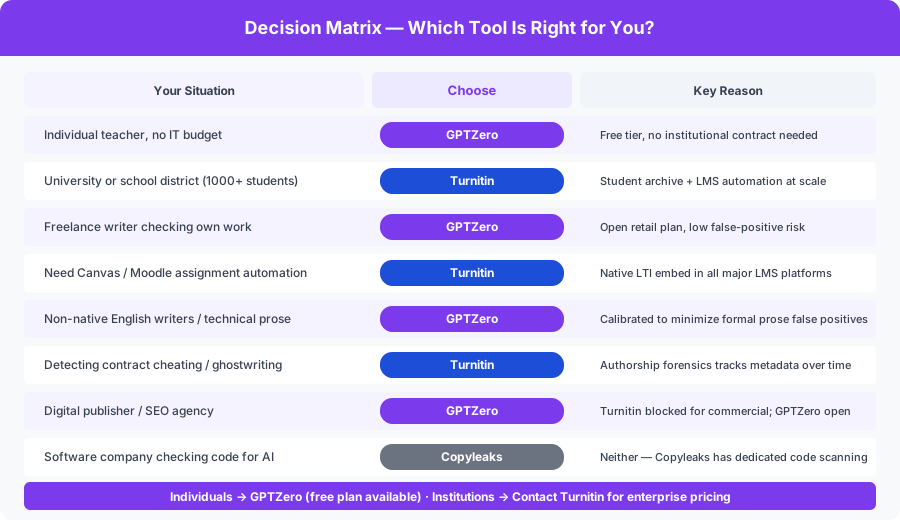
| Use Case | Recommended Tool | Core Selection Justification |
|---|---|---|
| Individual Teacher | GPTZero | Minimizes false-positive margins to preserve student trust; open for direct retail setup. |
| Freelancer | GPTZero | Offers an affordable, flat-rate monthly sandbox to verify text originality and generate receipts. |
| Small Content Team | GPTZero | Visually maps sentence-level text variations cleanly without enterprise IT overhead. |
| Digital Publisher | GPTZero | Provides commercial access to plagiarism scanning and text forensics that Turnitin blocks. |
| SEO Agency | Originality.ai | Built entirely around web market risk containment, client folders, and high-speed indexing checks. |
| University | Turnitin | Cross-references submittals against an extensive historical archive containing over 1 billion student papers. |
| College | Turnitin | Installs natively inside global campus LMS grading platforms via enterprise LTI wrappers. |
| School District | Turnitin | Automates academic tracking and centralized honor board reporting across large student populations. |
| Software Company | Copyleaks | Evaluates multi-language source code tracking and open-source license checks. |
| Compliance Team | Copyleaks | Backed by SOC 2 Type II certified infrastructure and secure private data clearance options. |
Decision Table
| Question | Answer |
|---|---|
| 1. I need to check student papers against past submissions across global schools. Which tool wins? | Turnitin: It utilizes a proprietary archive containing over a billion historical, non-public student papers. |
| 2. I am a freelance copywriter who needs to verify my own document before client delivery. Can I use Turnitin? | No. Turnitin is generally closed to individual consumers. Use GPTZero for accessible, standalone document verification. |
| 3. I manage a university Canvas network and want automated originality checks. What should I integrate? | Turnitin: Its native LTI integrations sync with Canvas SpeedGrader for automated background checking. |
| 4. Our software engineering firm needs to check repository code for AI. Can Turnitin do this? | No. Turnitin parses natural language. Use Copyleaks, which has a dedicated multi-language source code analysis engine. |
| 5. I run an SEO agency and need to audit 500 published blogs. What is the best platform? | Originality.ai: It provides an automated sitemap crawler to audit live domains in bulk, unlike Turnitin’s workflow. |
| 6. I am a student who wants to scan my rough draft independently. Can I buy a Turnitin account? | No. Turnitin blocks individual purchases. Use GPTZero’s free tier to safely check your writing style before submission. |
| 7. Our school district requires a grading rubric system tied directly to plagiarism scores. What tool fits? | Turnitin: Its Feedback Studio provides drag-and-drop QuickMarks and integrated digital rubrics alongside similarity scoring. |
| 8. I need a tool that can identify contract cheating by analyzing writing style changes over time. Which is preferred? | Turnitin: Its Authorship forensics track historical student metadata, document properties, and syntactic formatting changes. |
| 9. I am building a custom CMS and want to integrate AI detection via API. Should I contact Turnitin? | Typically, no. Turnitin restricts its APIs to official educational partners. Copyleaks or GPTZero offer open, developer-friendly APIs. |
| 10. I need to protect formal human text and non-native English prose from false AI accusations. Which is safer? | GPTZero: Its classification thresholds require high statistical confidence, prioritizing false-positive prevention. |
Common Questions
1. Is GPTZero more accurate than Turnitin? Both platforms are highly effective, but they excel in different areas based on publicly available benchmarks. Turnitin is highly capable of capturing machine text within student-style essays because its classifiers are trained on extensive educational datasets. GPTZero is often preferred for qualitative text forensics and non-native English text because its interface visualizes perplexity and burstiness changes sentence-by-sentence, giving editors a clear window into document construction.
2. Is Turnitin worth the institutional cost? Yes, Turnitin is generally considered a necessary investment for accredited educational institutions and large secondary school networks. By embedding automated verification straight into Canvas and leveraging its exclusive historical student archive to block peer-to-peer copying, the structural protection it brings to educational standards balances the site-licensing fees.
3. Which tool has fewer false positives? GPTZero maintains a lower false-positive rate because its algorithms are calibrated to maximize protection for human writers, demanding high statistical consistency before applying an AI marker. Turnitin features strong model precision for student writing, but its pattern updates can occasionally generate minor false-positive flags on heavily structured human technical manuals or rigid formal prose.
4. Which detector is best for bloggers and publishers? While GPTZero offers an excellent forensic workspace, Originality.ai remains commonly chosen for commercial publishers and SEO agencies due to its automated full-site sitemap crawling infrastructure. Because Turnitin is restricted behind an institutional purchasing model, web publishers cannot deploy it to check incoming freelance content pools.
5. Which detector is best for teachers? For large-scale institutional deployment across full school districts, Turnitin is the preferred choice because it automates academic honesty tracking smoothly inside native LMS grading interfaces. For individual classroom instructors or independent tutors who want an accessible diagnostic application to review a specific document one-on-one with a student, GPTZero provides an intuitive and accessible layout.
6. Can AI detectors be trusted completely? AI detectors should be treated as high-utility risk-assessment indicators rather than infallible, absolute confirmation of content origin. Because these platforms run on statistical pattern probability calculations rather than digital watermarking tracking, they can generate false positives on highly structured human prose or be bypassed by advanced editing. All scores should be backed by manual human editorial review.
7. Can a student buy a personal Turnitin account? No, Turnitin generally does not sell individual licenses or personal accounts to students, freelance writers, or independent researchers. Access is strictly governed through institutional site licenses.
8. Does Turnitin detect contract cheating or ghostwriting? Yes, Turnitin offers an Authorship module designed to combat contract cheating. It analyzes a student’s historical metadata, assessing typing patterns, vocabulary complexity, and document properties across multiple assignments over time.
Quick Recommendation
Review this functional breakdown to align your structural goals directly with the proper workspace engine:
- Recommended for Students and Teachers: GPTZero — The permanent character-capped free tier and intuitive color-coded visual reports offer an accessible, zero-risk sandbox for individual teachers and students to verify text originality and drafting patterns safely without institutional overhead.
- Recommended for Universities and School Districts: Turnitin — If your operation requires system-wide educational compliance and automated multi-seat grading oversight, Turnitin’s extensive historical archive of papers and direct native LMS integrations provide the necessary enterprise architecture.
- Recommended for Publishers and SEO Agencies: Originality.ai — If your business scales through mass outsourced web content networks, Originality’s automated sitemap crawling layer and commercial receipt links provide high operational velocity, whereas Turnitin restricts commercial access.
- Recommended for Tech Companies and Developers: Copyleaks — The standard for technical engineering teams requiring automated source code scanning to safeguard libraries from open-source licensing violations and machine code injections.
Final Verdict
The head-to-head comparison between GPTZero and Turnitin highlights a clear division between individual linguistic clarity and systemic enterprise governance. GPTZero is an excellent application of standalone precision and text style mapping, providing independent creators, freelance copywriters, and individual teachers with an accessible, low-friction forensic editor that minimizes false-positive risks and protects human writing signatures cleanly. Turnitin maintains its position as the standard for institutional compliance by equipping universities, colleges, and massive school districts with extensive historical paper databases, contract cheating forensics, and native learning management system integrations required to automate quality control safely at scale. Match your organization’s procurement access and technical data parameters to the specialized infrastructure engineered for your precise workflow.
Internal Link Opportunities
Maximize your digital production and text authentication pipelines by exploring our other hands-on software reviews:
- GPTZero Review: Read this comprehensive guide to understand how linguistic perplexity mapping works. It is highly recommended for independent writers, freelance editors, and individual educators who need a qualitative text mapping tool but cannot access enterprise institutional licensing.
- Turnitin Review: Review our extensive, standalone breakdown evaluating the platform’s proprietary repositories, data privacy frameworks, and Feedback Studio grader tools. This is an essential read for university IT directors and academic administrators evaluating systemic LMS integrations.
- Originality.ai Review: Read this detailed review if you run a digital publishing operation or SEO agency. We explore how its automated bulk XML sitemap crawling works to protect large web portfolios from search engine visibility penalties.
- Copyleaks Review: Read this technical breakdown if you are a software engineering firm or corporate compliance department. It explains how Copyleaks detects AI in software source code across multiple programming languages and manages proprietary corporate text securely.
- Best AI Detection Tools: See our full authority hub ranking the market’s top verification applications. This guide organizes the leading software strictly by specific industry use cases, helping you compare all major tools within a single holistic content curation strategy.
- Best AI Detectors for Teachers: A complete educator-focused guide comparing GPTZero, Turnitin, Copyleaks, and Winston AI on classroom false-positive protection, OCR capabilities, and LMS integration depth. Includes a full recommendation matrix for K-12 vs. university vs. independent tutor environments.