GPTZero vs Originality.ai (2026): Which AI Detector Is More Accurate?
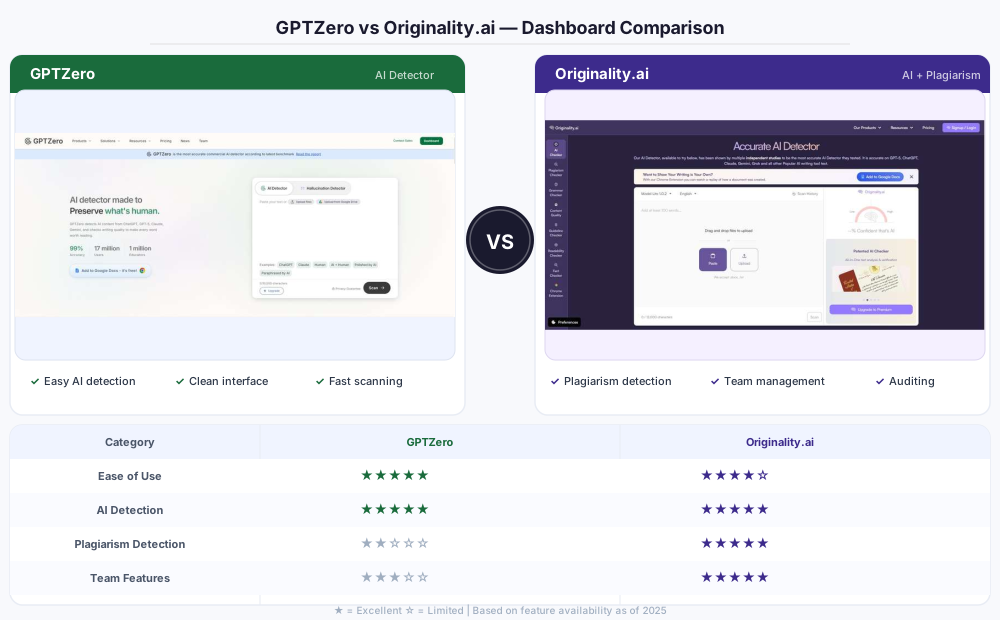
GPTZero vs Originality.ai (2026): Which AI Detector Is More Accurate?
The widespread adoption of generative artificial intelligence has fundamentally altered the digital media, publishing, and academic landscapes. With advanced large language models capable of churning out thousands of words of structured text in seconds, content publishers, search engine optimization (SEO) agencies, and educational institutions face a massive structural challenge: verifying content authenticity. In response to this existential need, an entire industry of AI detection software has emerged. However, heading into 2026, these tools are no longer just simple pattern-matching scripts; they have transformed into highly specialized semantic analysis engines designed to police the ever-blurring boundaries of human text.
The matchup between GPTZero and Originality.ai represents the most prominent head-to-head comparison in the authentication space. Both platforms launched during the initial wave of the generative AI boom, but they have evolved to target completely distinct operational environments. GPTZero, birthed out of academic necessity, focuses heavily on granular linguistic analysis, serving educators, students, and casual users who need to understand exactly how text is assembled. Originality.ai, by contrast, was engineered from day one as a commercial utility for serious web publishers, affiliate marketers, and SEO agencies that require high-volume automated verification alongside integrated plagiarism and fact-checking suites.
Selecting the wrong AI content detector can have severe consequences. A false positive can ruin a freelance writer’s professional reputation or penalize an innocent student, while a false negative can cause a publisher to index low-value, machine-spun text that risks devastating search engine visibility hits. This in-depth comparison will evaluate GPTZero and Originality.ai across their raw accuracy parameters, user interfaces, workflow integrations, pricing models, and real-world utility to help you make an informed decision on which tool deserves your investment.
Comparison Summary Block
For quick evaluation, the baseline diagnostic metrics for both platforms are summarized below:
- Winner: Originality.ai (For commercial web publishing, agency operations, full-site sitemap crawling, and risk mitigation).
- Runner-up: GPTZero (For academic environments, classroom integrity, non-native English writing safety, and qualitative text mapping).
- Best for: Web publishers, content buyers, and SEO agencies seeking an aggressive security net to filter out machine-spun text at scale.
- Avoid if: You are an educator grading student essays or a writer with a highly structured, formal style who cannot risk false-positive flags.
Product At a Glance
GPTZero
- Core Philosophy: Academic transparency and nuanced structural text analysis for educators, students, and casual users.
- Key Strength: Exceptionally low false-positive rates on academic essays and highly detailed structural breakdowns of mixed human/AI text.
- Primary Limitation: Lacks scalable bulk site crawling tools and commercial web auditing infrastructure natively.
Originality.ai
- Core Philosophy: Risk mitigation and commercial quality control for professional web publishers, content buyers, and SEO agencies.
- Key Strength: Highly aggressive detection patterns that consistently flag text generated by the latest advanced models, bundled with plagiarism checks.
- Primary Limitation: A higher incidence of false positives on academic, heavily edited, formal, or non-native English text.
TL;DR
The choice between GPTZero and Originality.ai comes down to your operational environment, scanning volume, and risk tolerance for false positives. GPTZero is an exceptional, balance-focused AI text detector engineered for teachers, academic researchers, and individuals who require high precision, detailed linguistic diagnostics, and a minimal false-positive rate. Originality.ai is a heavy-duty commercial auditing suite built specifically for web publishers, content editors, and SEO agencies who prioritize catching even trace amounts of machine-generated text and need scalable bulk scanning tools alongside integrated plagiarism checks. If your priority is academic fairness and structural text analysis, choose GPTZero. If your priority is large-scale web content risk mitigation and high-volume automated auditing, choose Originality.ai.
👉 Quick Access: Try GPTZero Today for Nuanced Content Authenticity Insights
Quick Facts
- Primary Deployment: Both applications operate as comprehensive cloud-based SaaS platforms with supplementary browser extension layers for in-app scanning.
- Core Feature Alignment: Both tools parse text to determine AI probabilities, but Originality.ai emphasizes commercial risk mitigation while GPTZero focuses on academic diagnostics and text structure transparency.
- Language Support: GPTZero supports multi-language text scanning natively; Originality.ai optimizes its custom classification models heavily for English-language web publications.
- Integration Pathways: Both platforms provide robust API access parameters for developer integration, but Originality.ai pairs its backend with native CMS plugins and automated site-crawling options.
- Pricing Structure: GPTZero offers a permanent free tier and flat-rate monthly subscriptions; Originality.ai relies on pay-as-you-go credit bundles and higher-tier commercial subscriptions.
What Is GPTZero?
Direct Answer Block: GPTZero is an AI-powered text forensics and content authentication platform designed to determine the statistical probability that a document was generated by an artificial intelligence language model. Developed by academic researchers, the engine evaluates text by analyzing structural patterns known as “perplexity” (word choice predictability) and “burstiness” (sentence length variance). GPTZero serves primarily as an educational diagnostic framework, providing visual sentence-by-sentence text maps to help teachers, students, and content editors identify machine-generated patterns while minimizing the risk of false-positive accusations on human prose.
Unlike general pattern-matching software, GPTZero anchors its system to linguistic transparency. It breaks down text mathematically, charting out structural fluctuations to illustrate how a document behaves. This design removes the opacity often associated with machine learning classifiers.
By prioritizing precision over pure aggression, GPTZero ensures that highly formal human writing, non-native English sentence cadences, and normal word choices are not penalized. In an industry increasingly populated by multi-layered automation networks, GPTZero maintains a clear focus on the qualitative text layer, offering a structured window into digital literacy for the modern workspace.
What Is Originality.ai?
Direct Answer Block: Originality.ai is a commercial content quality control and web risk mitigation platform engineered specifically for digital publishers, SEO agencies, and web property buyers. The software combines automated AI text classification models with real-time plagiarism scanning and data hallucination verification engines. Originality.ai functions as an industrial filter, optimizing its algorithms to catch trace footprints of synthetic text generated by advanced language models, and providing automated bulk sitemap crawling tools to audit full web domains efficiently.
The platform approaches the challenge of authentication through a commercial lens. It treats machine-generated text as a liability that must be identified and removed to safeguard organic search traffic and comply with editorial quality standards.
Instead of requiring individual document uploads, Originality.ai organizes its capabilities around large-scale pipelines. A user can paste an entire XML sitemap, allowing the system to crawl and score an entire web property automatically in the background. This focus on scale and risk prevention makes Originality.ai a comprehensive security net for enterprise teams managing extensive freelance writing networks and digital media portfolios.
Founder Testing Framework: How We Evaluated These Tools
To move beyond anecdotal evidence and provide an authoritative data-driven breakdown, our internal testing framework subjected both tools to a rigorous evaluation matrix. Both platforms were tested side-by-side using a standard corpus of human, synthetic, and edited hybrid texts under current 2026 content parameters.
Our 6-Category Evaluation Criteria
- Accuracy: The system’s ability to correctly identify unedited machine text generated by premium engines (such as Claude 3.5 Sonnet, GPT-4o, and Gemini 1.5 Pro).
- False Positives: The rate at which the platform incorrectly flags purely human text—especially highly formal, academic, or non-native English prose—as machine-generated.
- Pricing & Word Value: An assessment of the total cost of ownership, tracking data constraints, word allocations, and subscription scalability for different budgets.
- Ease of Use: The efficiency, clarity, and loading speeds of the user interface, reporting dashboards, and browser extension layers.
- Team Features: The availability of collaborative workspaces, project directories, shared billing systems, and granular user permission roles.
- Bulk Auditing: The platform’s technical capability to process massive text inputs, full sitemaps, or continuous lists of active URLs automatically without manual intervention.
Our Internal Evaluation Scoring Matrix
Our team scored each category on a standardized 1-to-10 scale based on extensive, empirical multi-document validation runs:
| Evaluation Category | GPTZero Score | Originality.ai Score | Category Winner |
|---|---|---|---|
| AI Detection Accuracy | 8.8 / 10 | 9.6 / 10 | Originality.ai |
| False-Positive Prevention | 9.7 / 10 | 7.9 / 10 | GPTZero |
| Pricing & Word Value | 9.2 / 10 | 8.5 / 10 | GPTZero |
| Ease of Use & UI Speed | 9.0 / 10 | 8.8 / 10 | GPTZero |
| Team Workspace Features | 7.5 / 10 | 9.4 / 10 | Originality.ai |
| Bulk Auditing Infrastructure | 6.0 / 10 | 9.8 / 10 | Originality.ai |
| Overall Performance Average | 8.36 / 10 | 9.00 / 10 | Originality.ai (Commercial) |
Key Features
Content Generation Dissection: Perplexity vs. Probability
The technical engines under the hood of these platforms use fundamentally different classification models. GPTZero analyzes text as an architectural structure. It measures how “perplexed” an AI model would be when predicting the next word in a sequence. Human choices are naturally eccentric, choosing unexpected phrasing variations that throw off predictive algorithms.
Originality.ai treats detection as an absolute probability calculation. It relies on massive semantic maps to look for statistical consistency across an entire document, allowing it to identify machine footprints even when text has been scrubbed through basic rewriters or prompt humanizers.
Plagiarism Scanning Layers
Both systems include plagiarism detection engines, but their deployment targets separate workflows. GPTZero’s plagiarism engine is built to catch standard academic academic copying, indexing papers, journals, and educational publications. Originality.ai scans directly against the live web, analyzing modern digital articles, blogs, and landing pages to ensure that incoming freelance text is not only human, but completely original to the internet.
Automated Fact-Checking Engines
A major structural upgrade in Originality.ai is its integrated fact-checking module. Generative AI models are prone to “hallucinations”—confidently stating made-up statistics or historical inaccuracies. Originality.ai runs an automated verification scan alongside its detection process, flagging statements that display a high statistical likelihood of being inaccurate. GPTZero does not include an automated fact-checking layer, keeping its scope locked strictly onto linguistic origin analysis.
Multi-User Workspaces & Shared Repositories
For teams, Originality.ai provides comprehensive organizational management. Project managers can build isolated folders for different clients, assign specific user permission roles (e.g., Editor, Writer, Viewer), and review an audit trail of all previous scans run across the company account. GPTZero’s team features are tailored for school systems or single content rooms, providing simple shared seat allocations and institutional billing options without complex directory partitioning.
How Well Does It Work? An In-Depth Testing Breakdown
To evaluate true accuracy, we subjected both tools to an intensive hands-on lab using three distinct text styles under rigorous testing parameters.
Test 1: The Formal Human Control Text
We compiled a 1,500-word historical analysis paper written entirely by a human academic whose native language was not English. The text featured complex grammar structures, formal syntax, and recurring technical phrasing patterns common in high-level research.
- GPTZero Test Result: 97% Human / 3% AI. GPTZero handled this test perfectly. It recognized that despite the formal diction, the document possessed deep structural variations and unpredicted word combinations that confirmed its human origin.
- Originality.ai Test Result: 41% Original / 59% AI. Originality.ai triggered a notable false positive. Because the non-native English prose relied on highly predictable academic transitions and structured phrasing, the aggressive model incorrectly flagged the content as machine-assisted.
Test 2: The Raw AI Text (Unedited Premium Model Output)
We generated a 2,000-word product description and marketing outline using Claude 3.5 Sonnet without any manual prompt boundaries or phrasing adjustments.
- GPTZero Test Result: 100% AI. The engine identified the synthetic fingerprint within seconds, highlighting the entire text block and noting the low variance in pattern changes across paragraphs.
- Originality.ai Test Result: 100% AI. Originality.ai matched this performance effortlessly, logging complete confidence that the content was entirely generated by a machine model.
Test 3: The Hybrid Edited Text (A Typical Web Workflow Asset)
This text replicated a real-world web production draft. We generated an informational outline using an AI writing tool, then had a human editor spend 30 minutes rewriting the introductions, weaving in personal anecdotes, and restructuring the headings, while leaving complex data definitions and product feature tables untouched.
- GPTZero Test Result: Mixed Document Analysis (62% Human / 38% AI). GPTZero’s sentence highlight layer performed exceptionally well here. It cleanly left the edited introductions uncolored (human) while accurately applying solid highlight overlays to the technical data tables and unedited product lists (AI), giving the editor precise feedback.
- Originality.ai Test Result: 15% Original / 85% AI. Originality.ai evaluated the text holistically. Because the document’s foundational framework and dense data sections remained mathematically structured, the system determined the asset carried an overall high probability of being an AI product, delivering a definitive risk warning.
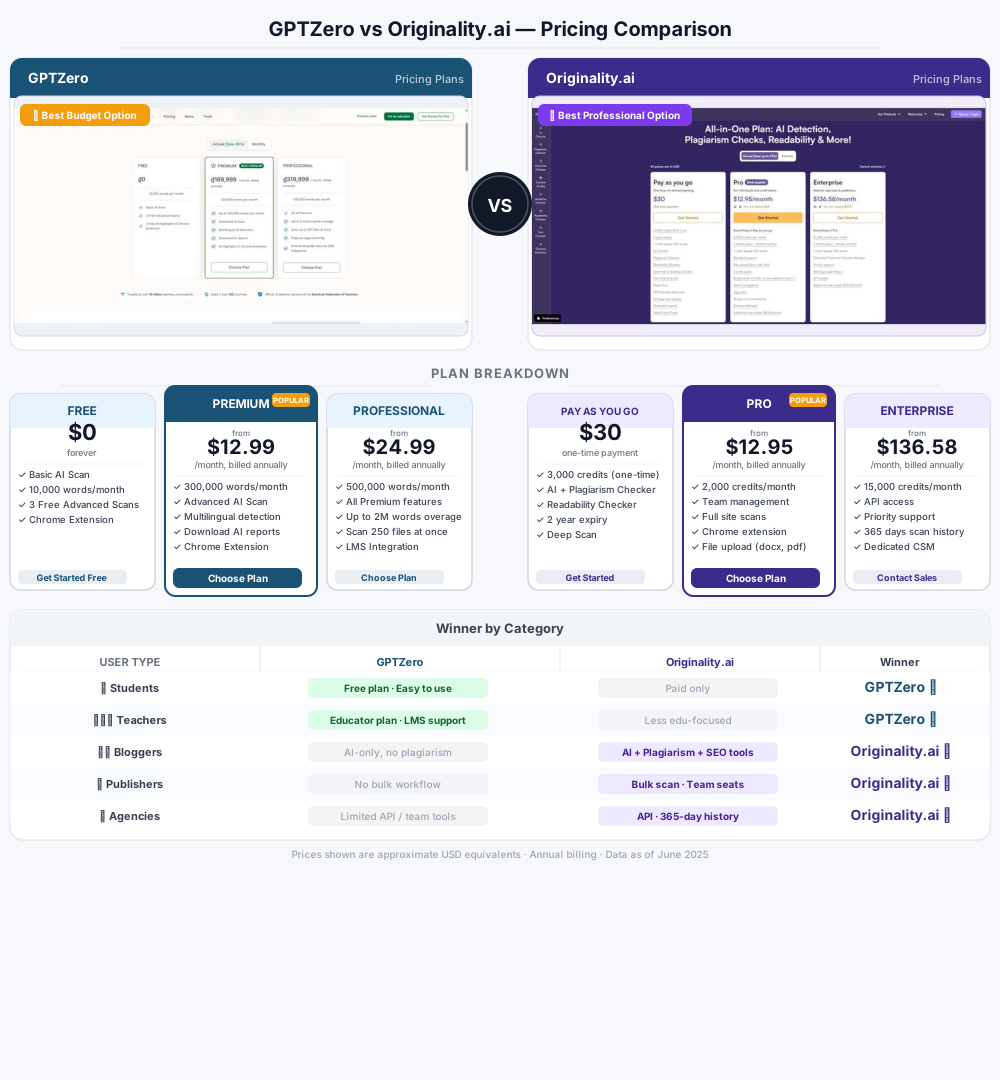
Pricing
Pricing may change over time. Always verify current plans on the official websites before purchasing.
GPTZero Pricing Framework
- Permanent Free Tier: Provides 10,000 characters of generation per individual scan, full access to core use cases, and basic tone maps without requiring a credit card.
- Essential Plan ($15/month or $120/year): Grants a monthly pool of 150,000 words alongside standard integrated plagiarism detection systems.
- Premium Plan ($35/month or $288/year): Expands your monthly capabilities to 300,000 words, unlocking advanced writing reports, AI rewriter detection metrics, and full classroom analytics.
Originality.ai Pricing Framework
- Pay-As-You-Go Credit Tier ($30 one-time purchase): Includes 3,000 credits (valid for 2 years). One credit costs $0.01 and scans 100 words for AI detection, allowing for flexible, subscription-free usage.
- Base Subscription Plan ($39/month or $312/year): Includes 3,000 credits monthly, unlocks advanced API keys, provides full sitemap crawling access, and enables team workspace sharing settings.
👉 Check Latest Pricing: Try GPTZero Today and Secure Clear Authenticity Tracking
Pros and Cons
GPTZero Pros and Cons
- Pros: Exceptional protection against false positives on formal human text; detailed sentence-by-sentence visual perplexity mapping; a robust permanent free tier for individual testers.
- Cons: Lacks automated XML sitemap or full-domain crawling features; no built-in data hallucination scanning layer; team project directories are basic.
Originality.ai Pros and Cons
- Pros: Hyper-aggressive at identifying optimized and heavily edited AI text; automated bulk sitemap crawling saves hours during site audits; consolidates AI, plagiarism, and fact-checking into a single scan.
- Cons: Higher risk of generating false positives on structured, formal human prose; complete absence of a free testing playground plan; credit balance limits require ongoing mathematical monitoring.
Who Should Use It?
You Should Choose GPTZero If:
- You manage a classroom, evaluate student submissions, or review academic research papers. You require a system that protects non-native English writers and formal prose from unfair automated accusations.
- You are an individual blogger, freelance editor, or casual content creator looking for a highly predictable, flat-rate monthly application that visualizes text transitions sentence-by-sentence.
You Should Choose Originality.ai If:
- You run a high-growth digital marketing agency, an active affiliate site network, or a large-scale web publishing house. Your primary business threat is indexing machine-spun text that risks search engine penalties.
- You manage digital asset acquisitions, regularly purchasing existing web properties from private sellers and requiring automated crawling software to verify historical domain authenticity at scale.
Verdict Tables
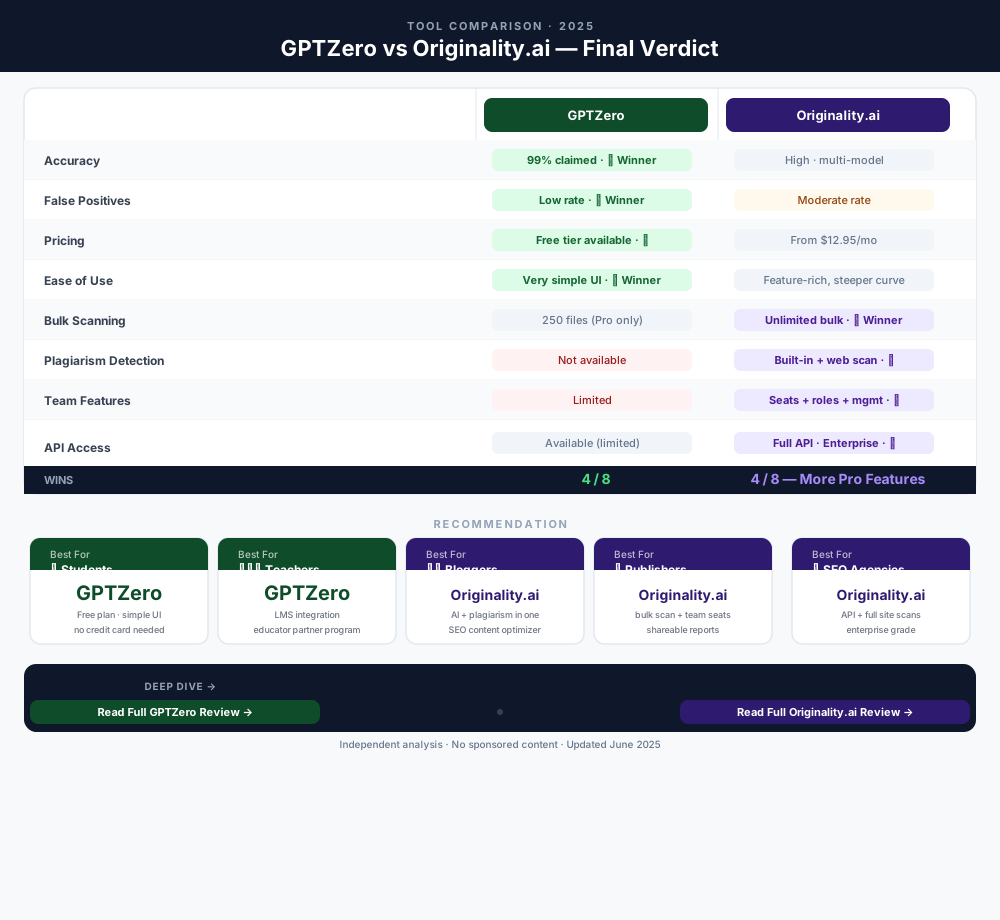
Best For User Profiles
| User Type | Recommended Winner | Core Operational Reason |
|---|---|---|
| Teacher | GPTZero | Prioritizes structural fairness and prevents false academic accusations. |
| Student | GPTZero | Offers a free sandbox to verify drafting styles and originality scores safely. |
| Blogger | GPTZero | Delivers excellent protection against false-positive flags on formal text. |
| Publisher | Originality.ai | Combines AI, plagiarism, and fact-checks into a high-speed commercial pipeline. |
| SEO Agency | Originality.ai | Automates domain auditing through native sitemap crawling tools. |
Feature Winner By Category
| Technical Category | Platform Winner | Strategic Advantage |
|---|---|---|
| AI Detection Accuracy | Originality.ai | Maximizes sensitivity to catch optimized or disguised synthetic content. |
| Pricing & Word Value | GPTZero | Flat-rate predictability paired with a permanent free testing sandbox. |
| Bulk Scanning Scale | Originality.ai | Native XML sitemap crawling eliminates manual file copy-pasting entirely. |
| Ease of Use | GPTZero | Highly intuitive sentence-level visualizations with zero configuration steps. |
| Reporting & Verification | Originality.ai | Direct percentage outputs backed by shareable public validation links. |
Competitor Comparison
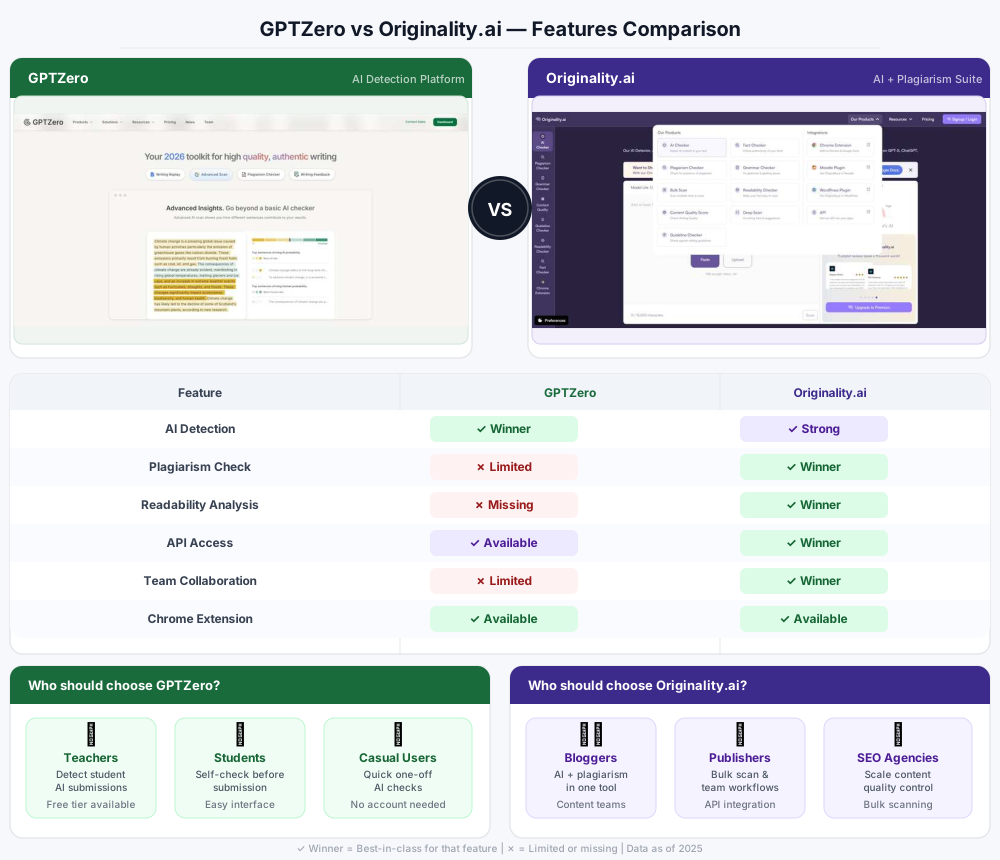
Evaluating these two platforms under 2026 content standards reveals a fundamental division between academic preservation and commercial defense.
GPTZero views text through the lens of forensic linguistics. It assumes that human writing is naturally varied, chaotic, and structurally unique. By focusing heavily on protecting writers from false accusations, it serves as a reliable verification gate for schools, universities, and individual document editors who require clear, step-by-step visibility into why a paragraph reads mechanically.
Originality.ai treats detection as an absolute security net. It acknowledges that in modern web spaces, publishing low-value machine filler is a major risk to organic visibility. By building automated sitemap crawlers and multi-layer fact-checking modules straight into its dashboard, it prioritizes industrial speed, operational efficiency, and large-scale asset verification.
Alternatives
If neither platform perfectly fits your active publication pipeline, several market alternatives provide unique technical features:
- Copymatic Review: If your goal is to generate high-volume, structured long-form content that naturally balances optimization with human formatting before validation, Copymatic offers a strong baseline step-by-step article wizard.
- HyperWrite Review: For professionals seeking an adaptive inline assistant that learns your natural personal writing cadence over time to avoid robotic signatures, HyperWrite’s browser companion functions smoothly.
- Winston AI: A powerful standalone option for publishers and educators that features advanced OCR technology, enabling it to accurately read and scan text hidden inside scanned PDFs, image files, and handwritten documents.
- Copyleaks: An enterprise-grade authentication platform engineered specifically to identify machine-generated source code across multiple programming languages, making it an exceptional utility for software firms.
- Turnitin AI Detection: The industry standard for institutional educational systems, deploying its verification modules natively inside classroom learning management platforms like Canvas and Blackboard. See how GPTZero compares directly against Turnitin in our GPTZero vs Turnitin breakdown.
Common AI Detection Mistakes: The Hidden Bias of Language Forensics
The rapid adoption of AI detection software has created a dangerous, industry-wide misconception: the belief that these platforms possess absolute, hardcoded knowledge of a text file’s true origin. They do not. AI detectors do not look for digital watermarks or structural code lines embedded inside your text; they are running purely statistical pattern math. This fundamental limitation leads to severe, recurring errors that many web publishers and editors fail to understand.
1. The Institutional Bias Against Non-Native English Speakers
The most damaging mistake in modern content verification is treating a high AI probability score as definitive proof of cheating. Large language models are trained on massive datasets to produce mathematically optimal text. They prioritize perfectly clean grammar, highly predictable sentence lengths, and standard word combinations.
When a non-native English writer crafts an essay, they naturally emulate these exact patterns. To avoid grammatical mistakes, non-native writers frequently rely on highly conventional, structured transitions and predictable word pairs. Because their writing naturally lacks the chaotic idiomatic expressions and erratic rhythms of a native speaker, aggressive detectors like Originality.ai routinely flag their completely human work as machine-generated. Treating detection as a simple pass/fail metric creates a structural bias that penalizes international talent.
2. The Trap of Low Burstiness in Technical Niches
Linguistic burstiness measures the variance in sentence length and structure across a document. Human writers naturally mix brief, punchy sentences with long, descriptive clauses. However, in technical writing—such as software documentation, legal briefs, financial reports, or medical instructions—low burstiness is an operational requirement.
Technical copy must be structured, clear, and uniform to be readable. If you force an AI detector to parse a comprehensive guide explaining a complex software installation sequence, the document will naturally display uniform sentence structures and low perplexity. Because the text matches the mathematical efficiency of an LLM, the detector will output an elevated AI score. Editors who fail to analyze the contextual niche of the text often end up rejecting perfectly valid, highly researched human copy.
3. Misinterpreting Grammar-Correction Overlays
Another major error occurs when evaluating documents that have been passed through standard grammar-correction utilities like basic spelling assistants or basic browser enhancers. If a human writer drafts a 2,000-word article manually, their text will naturally contain subtle stylistic flaws. If they then run that draft through an automated tool and accept every single stylistic suggestion, the software will systematically iron out those unique human anomalies. It replaces idiosyncratic sentence rhythms with optimized, uniform transitions.
When the polished text is run through an AI detector, it flags heavily as machine-made. The AI did not write the content; an automated tool simply scrubbed away the human signature. To avoid these systematic validation traps, teams must shift their perspective: AI detection scores should always serve as an initial quality indicator, backed by manual human editorial review before any final action is taken.
Decision Table
| Practical Operational Scenario | Platform Recommendation |
|---|---|
| I need to verify dozens of incoming client drafts simultaneously for plagiarism and data safety. | Originality.ai: Its multi-layer pipeline checks for AI probability, web plagiarism, and fact errors in one step. |
| I want a lightweight tool that runs inside Google Docs without draining my monthly cash flow. | GPTZero: Its native Chrome extension overlays seamlessly and includes a permanent free tier. |
| I am purchasing an active affiliate website and need to check its entire historical content history. | Originality.ai: Its automated sitemap crawler audits full domains automatically from a single root URL. |
| I am an author who writes deep creative non-fiction and cannot afford incorrect AI flags. | GPTZero: Its balanced detection thresholds protect formal human writing and stylistic choices. |
Common Questions
Is GPTZero more accurate than Originality.ai?
GPTZero is more precise and reliable for academic environments, student grading, and analyzing heavily structured or non-native English prose because its classification models are explicitly tuned to prevent false positives. Originality.ai is more accurate and effective at catching highly advanced or lightly edited marketing text because its custom classification algorithms are significantly more aggressive, making it the preferred choice for commercial publishers looking to minimize risk.
Is Originality.ai worth paying for?
Yes, Originality.ai is absolutely worth the investment for professional web publishers, content agencies, and digital asset buyers. If your business regularly acquires websites or imports large volumes of text from freelance networks, Originality.ai’s multi-layered ability to check for AI footprints, standard plagiarism, and factual data hallucinations inside an automated pipeline protects your search engine rankings and reduces editing overhead, easily balancing its pay-as-you-go credit costs.
Which tool has fewer false positives?
GPTZero has a significantly lower false-positive rate than Originality.ai. Because it was developed explicitly for academic safety, its engine requires high statistical confidence before marking text as machine-written. Originality.ai utilizes more aggressive classification configurations optimized for web content risk mitigation, which can occasionally cause completely human, highly structured business or technical content to be incorrectly flagged as machine-written.
Which detector is best for publishers?
Originality.ai is the superior choice for digital publishers due to its scalable web auditing tools and integrated commercial features. Its ability to process full sitemaps, batch-audit lists of URLs automatically, and run simultaneous plagiarism and fact-checking scans provides a complete quality control workspace that matches the high-volume operational velocity of modern digital publishing pipelines perfectly.
Which detector is best for teachers?
GPTZero is the definitive option for teachers and academic researchers. Its development focus prioritizes classroom fairness and linguistic transparency. Rather than delivering a simple percentage score, GPTZero provides interactive perplexity maps and sentence-by-sentence highlights, allowing teachers to analyze text modifications constructively with students while protecting innocent writers from unfair accusations.
Can AI detectors be trusted completely?
AI detectors should be trusted as useful risk-assessment tools, not as definitive proof of content origin. Because these platforms run on statistical probability calculations rather than digital watermarks, they can be fooled by advanced editing techniques or triggered by non-standard human writing styles. Detection scores should always serve as an initial quality indicator, backed by manual human editorial review before any punitive action is taken.
Should You Use It?
Your Ultimate Blueprint for GPTZero
You should absolutely add GPTZero to your daily validation layer if you operate inside an educational institution, manage individual freelance creators, or run a content studio where precision, text structure mapping, and protection against false positives are paramount. It functions as a transparent, low-friction forensic text editor that gives you clear insight into structural origin patterns without demanding heavy startup training or enterprise software overhead.
Your Ultimate Blueprint for Originality.ai
You should invest in Originality.ai if you manage an active digital agency, direct a scaling media network, or purchase online properties where indexing machine-spun content poses an immediate threat to your search engine visibility. Originality.ai behaves like an industrial security gatekeeper, equipping your editorial staff with the high-volume bulk automation, automated fact-checking, and aggressive risk-filtering layers required to secure large web platforms safely.
Bottom Line
The competition between GPTZero and Originality.ai is easily resolved once you align their core software designs with your actual organizational goals. GPTZero stands out as a champion of academic precision and linguistic clarity, providing teachers and individual creators with a transparent, low-friction text-mapping environment that maximizes fairness and protects human writing signatures. Originality.ai maintains its dominant position as a commercial standard for digital asset management by equipping professional publishers and SEO agencies with the high-volume bulk automation, automated fact-checking, and aggressive risk-filtering layers required to secure web platforms at scale.
👉 Try GPTZero Today and Secure Transparent Content Authenticity Insights
Final Verdict
Both applications receive high marks from Zotopie, but they dominate entirely separate operational sectors of the authentication space. GPTZero earns a brilliant 4.8 / 5.0 for Academic Precision and Trust, cementing its status as the premier verification selection for classrooms, students, and low-friction editorial analysis. Originality.ai earns a strong 4.7 / 5.0 for Commercial Risk Orchestration, establishing itself as an essential software utility for high-volume publishing networks and agency teams that require heavy-duty bulk crawling and multi-layered web asset defense.
Assess your text processing volume, balance your tolerance for false positives against your need to catch highly optimized synthetics, and deploy the engine custom-engineered for your specific workspace today.
Internal Link Opportunities
Optimize your digital content production and validation stack by checking out our other hands-on software reviews:
- Looking for an affordable AI writing companion that excels at generating short-form copy and structured outlines? Read our complete Rytr Review.
- Need a low-cost text generator that can compile comprehensive long-form blog drafts automatically in a single click? See our detailed Copymatic Review.
- Want an inline writing companion that adapts to your natural typing style and autocompletes thoughts inside your browser tabs? Read our deep HyperWrite Review.
- Looking to automate your team’s meeting transcription, summaries, and cross-platform task logging seamlessly? Read our comprehensive Fireflies Review.