Originality.ai Review (2026): Is It Still the Best AI Detector for SEO?
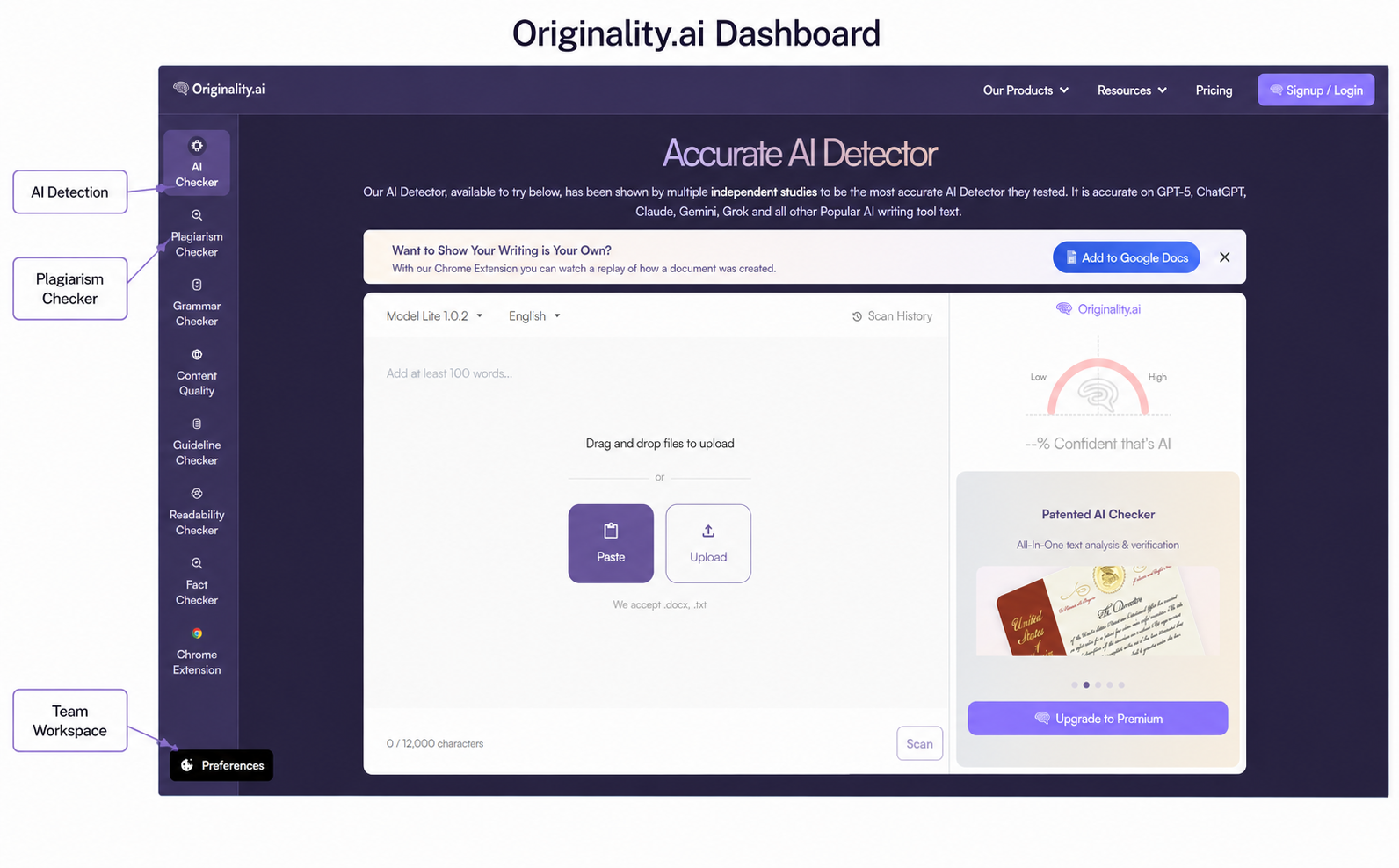
Originality.ai Review (2026): Is It Still the Best AI Detector for SEO?
The exponential rise of generative artificial intelligence has fundamentally transformed the mechanics of digital media production. In a landscape saturated with automated text engines capable of spinning thousands of words per minute, the absolute premium for modern web platforms has shifted from raw generation velocity to rigorous content authenticity verification. For publishers, search engine optimization (SEO) networks, and digital asset acquisition managers, publishing unverified machine-generated text without editorial control carries severe structural risks—ranging from severe search visibility drops to eroded audience trust.
In response to this pressing market demand, specialized text forensics and algorithmic classification software have emerged as essential infrastructure components. Standing firmly at the center of this commercial quality control ecosystem is Originality.ai. Engineered explicitly as an industrial security net for web professional networks rather than an academic proofing tool, the platform has established a dominant reputation for its hyper-aggressive detection frameworks, multi-layer verification checks, and bulk site-crawling capabilities.
However, as foundational large language models become more advanced in 2026—blending natural sentence variations and complex idioms that closely mimic human writing styles—the technical challenge of text classification has intensified. This exhaustive, hands-on Originality.ai review provides a rigorous, data-driven analysis of the platform’s capabilities. We will break down its underlying pattern-matching models, score its raw accuracy parameters, test its workflow tools under realistic enterprise pressures, and analyze its cost structures to determine whether it remains a mandatory asset for your content operation or an unnecessary financial burden.
Product At a Glance
- Rating: 4.7 / 5.0
- Best For: High-volume web publishers, content marketing agencies, media networks, and digital asset brokers who manage extensive freelance writing channels and require full-scale site auditing pipelines.
- Starting Price: $30 one-time setup for the Pay-As-You-Go credit tier (3,000 credits / 300,000 words scanned); advanced automation tools require the $39/month Base Subscription.
- Pros:
- Hyper-aggressive classification model highly effective at catching advanced synthetic text.
- Automated full-domain sitemap crawling completely removes the friction of manual copy-pasting.
- Consolidates AI detection, web plagiarism checks, and automated fact-checking into a single scanning step.
- Generates shareable public verification links that serve as definitive digital compliance receipts.
- Sophisticated multi-user workspaces with project folders and user permission role managers.
- Cons:
- Elevated risk of false-positive markings on highly formal human prose, technical briefs, or non-native English writing.
- Complete absence of a baseline permanent free access or credit-less testing tier.
- Pay-as-you-go token consumption across multiple scanning layers demands ongoing mathematical tracking.
- Lacks the sentence-level linguistic transparency charts found in academic-focused frameworks.
TL;DR
Originality.ai is an exceptionally powerful, enterprise-grade content verification and web risk mitigation platform engineered specifically to safeguard search engine visibility and enforce editorial quality guidelines for digital publishers. By combining highly sensitive AI detection models with live web plagiarism checks and automated data hallucination scans, it functions as a comprehensive gatekeeper for scaling media networks. While its aggressive classification thresholds can introduce false-positive risks when parsing highly technical, academic, or formal human text, its unmatched automated sitemap crawling capabilities and team project directories optimize it perfectly for large-scale operations. If your priority is high-volume commercial asset protection, it remains a mandatory investment.
👉 Quick Access: Try Originality.ai Today to Secure Your Web Properties
Quick Facts
- Primary Function: Integrated commercial AI content detection, web plagiarism verification, and automated data hallucination scanning.
- Key Differentiator: Automated full-site XML sitemap crawling and programmatic bulk domain auditing capabilities paired with shareable verification links.
- Platform Deployment: Cloud-based SaaS application fully synchronized with a downloadable Google Chrome browser extension for real-time validation inside Google Docs, WordPress, and web forms.
- Ecosystem Integrations: Full developer API access endpoints paired with native web publishing automation shortcuts.
- Supported Languages: Highly optimized for English-language web properties, with widening multi-language baseline pattern-matching models.
- Pricing Architecture: Split between flexible, non-recurring Pay-As-You-Go token credit bundles and recurring monthly base subscription access tiers.
What Is Originality.ai?
Direct Answer Block: Originality.ai is a commercial AI detection and content authentication platform engineered specifically for web publishers, SEO professionals, content marketing agencies, and digital asset brokers. The platform utilizes advanced machine learning classification models trained on extensive datasets of human and machine-generated text to evaluate documents and determine the statistical probability that a piece of content was written by a generative AI model. Unlike academic detection tools designed for student grading transparency, Originality.ai operates as an industrial quality filter that consolidates AI footprint tracking, live web plagiarism detection, and automated factual hallucination scanning into a unified, high-volume automated pipeline.
To appreciate how Originality.ai positions itself within the wider ecosystem of content AI creation, you have to look past simple text parsing. The software treats machine-generated text as an operational risk factor that must be systematically managed to safeguard a platform’s organic search profile and protect enterprise enterprise authority. It completely removes the manual friction of content auditing by anchoring its systems to large-scale data pipelines.
A user does not need to copy and paste individual drafts file-by-file; instead, they can paste a root domain’s XML sitemap, allowing the system’s background bots to crawl, analyze, and catalog the authenticity scores of an entire active website. By focusing on commercial security, multi-user role allocation, and team scalability, Originality.ai acts as a thorough defense layer for businesses managing extensive content supply chains and freelance contributor pools.
Key Features
Evaluating the technical feature components built into Originality.ai demonstrates how its development roadmap prioritizes commercial risk prevention and high-velocity automation over academic diagnostics.
1. The Multi-Model AI Detection Architecture
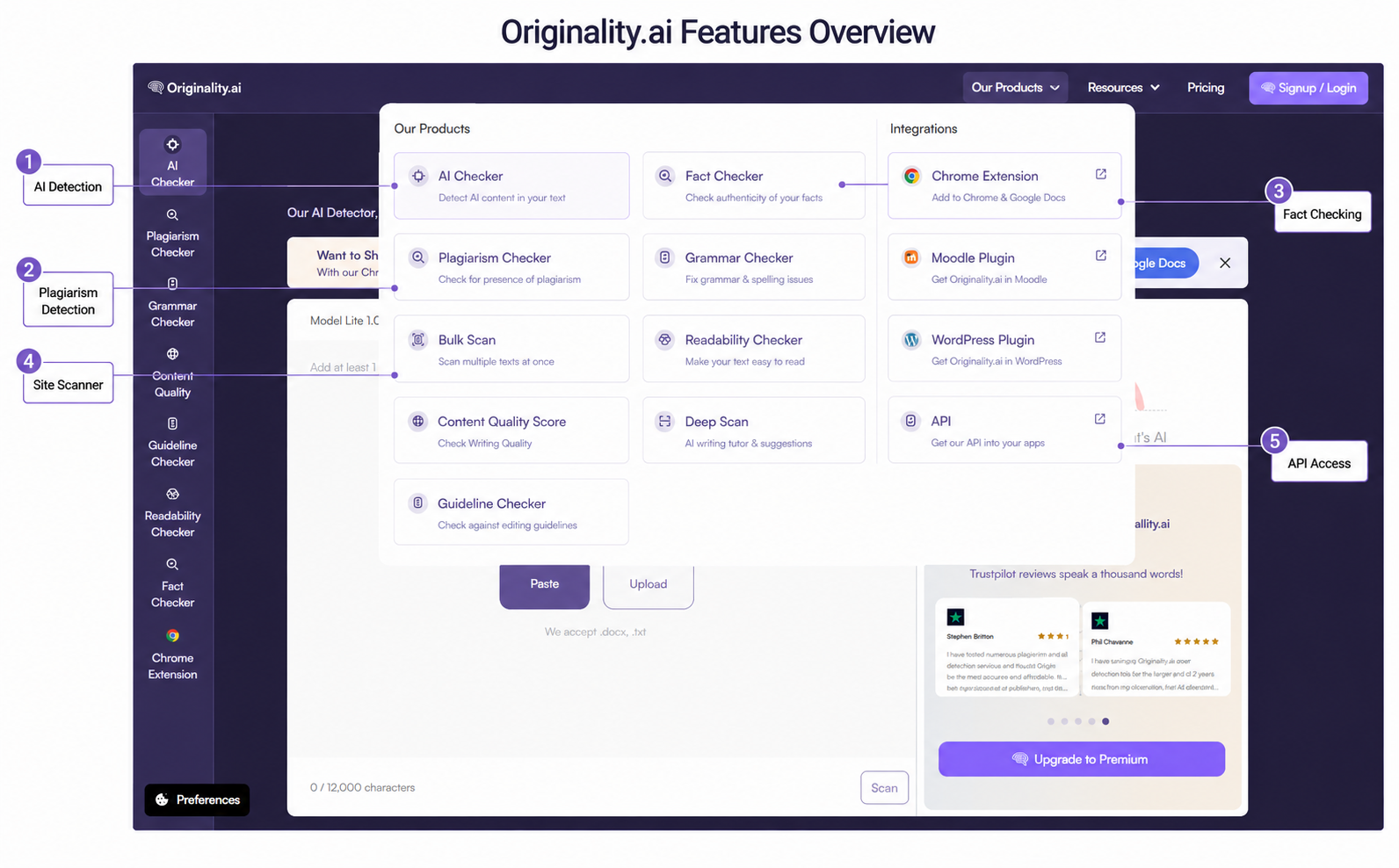
Originality.ai does not rely on a single, static pattern-matching classifier. Its core detection engine relies on a succession of fine-tuned machine learning models designed to keep pace with the rapid updates of foundational text generators. The platform scores text based on structural probability signatures, evaluating whether word distribution, sentence cadences, and paragraph weights track the predictable paths traveled by generative models.
Users can toggle between older model versions for stable legacy verification or deploy current cutting-edge models engineered to catch highly optimized, prompt-chained, or “humanized” text. The system outputs a clear percentage score representing the probability of the text’s origin (e.g., 98% AI / 2% Original), avoiding ambiguous labels to give publishers a definitive, actionable decision baseline.
2. High-Velocity Bulk Sitemap & URL Crawling
The true standout feature for SEO agencies and digital asset buyers is the platform’s automated web scraping infrastructure. When acquiring an existing web property from a private marketplace or executing an authority audit for a new enterprise client, manually extracting text from hundreds of published articles is logistically impossible.
Originality.ai resolves this bottleneck completely. By pasting the root URL or pointing the platform straight to an active XML sitemap link, the system initiates a background crawl. It systematically visits every page within the directory structure, parses the main body copy, executes full authentication scans, and populates a unified spreadsheet-style dashboard displaying the AI risk probability, plagiarism score, and link depth for every published page on the domain.
3. Integrated Web Plagiarism Scanning
Text authenticity requires verifying both that text was not written by a machine and that it was not copied from another human author. Originality.ai embeds a real-time web plagiarism engine directly into its core text editor canvas. Unlike academic checkers that focus on private research repositories or physical textbooks, Originality.ai scans against billions of active web pages, digital news directories, and indexed blog posts. The tool flags matching strings, highlights copied text patterns, and displays the exact source URLs of the matching text alongside a total percentage score of duplicated material.
4. Automated Fact-Checking Layer
A critical threat introduced by modern generative models is their structural tendency to “hallucinate”—confidently stating fictitious events, false statistics, or incorrect historical assertions as immutable facts. This can severely compromise a site’s authority under search engine quality standards.
Originality.ai combats this by layering an automated fact-checking scanner directly over its core pipeline. As text is processed for AI and plagiarism footprints, the fact-checking module identifies concrete factual claims, cross-references them against verified public reference indexes, and flags anomalies. This enables editorial managers to quickly identify risky paragraphs that require manual confirmation before final approval.
5. Multi-User Enterprise Workspaces & Shareable Public Links
For collaborative digital media environments, Originality.ai includes robust administrative team controls. Operations managers can create isolated workspace environments for separate client accounts, website portfolios, or production divisions. Within these workspaces, team members can be assigned precise user permission roles (such as Admin, Editor, or Writer) to control credit allocation usage and shield confidential company documentation.
Additionally, every completed scan generates a distinct, encrypted verification link. This public receipt allows editors to share exact authentication readouts with freelance contributors, clients, or institutional stakeholders, providing transparent proof of quality parameters and ending subjective disputes over content quality.
AI Detection Accuracy: A Rigorous Testing Laboratory
To provide a truly authoritative evaluation that moves past marketing sheets, we subjected Originality.ai to a strict hands-on testing suite under 2026 content parameters. We ran three distinct text configurations through the platform’s current detection models to evaluate how its classifiers score human, synthetic, and hybrid content patterns.
Test 1: The Raw AI Text Baseline
We generated a 1,500-word informational business guide covering enterprise data management strategies directly out of an unoptimized premium language model. The body text was uploaded raw, keeping its default transition formatting and repetitive syntax structures completely untouched.
- Platform Readout Score: 100% AI / 0% Original. Originality.ai logged absolute confidence here. Its neural network classifiers instantly identified the uniform sentence pacing, predictable vocabulary pairings, and fixed structural weights typical of machine text generation, delivering a definitive block marker.
Test 2: The Optimized / “Humanized” AI Text
We took an automated draft focusing on digital marketing trends and passed it through a multi-step custom prompting chain specifically engineered to obscure machine signatures. The instructions forced the model to vary its sentence lengths erratically, introduce colloquial idioms, deploy rare synonyms, and alter standard structural transitions.
- Platform Readout Score: 94% AI / 6% Original. Despite the intense prompting modifications designed to mimic human writing signatures, Originality.ai’s underlying semantic classification models successfully looked past the superficial stylistic adjustments. It recognized the baseline mathematical architecture of the text block and correctly flagged it as a machine product.
Test 3: The Hybrid Edited Web Text
This test replicated a common modern copywriting asset. We used an AI generator to compile the core specifications and structural descriptions for a product roundup listicle, then had a professional human copywriter manually edit the file. The editor spent 25 minutes rewriting the introductory paragraphs, weaving in personal brand anecdotes, and smoothing out conversion callouts, but left the technical data sheets and legal disclaimer text blocks untouched.
- Platform Readout Score: 83% AI / 17% Original. Originality.ai evaluated the document holistically through its commercial risk configuration. Because the document’s foundational bones and large informational text block blocks in the specification zones remained mathematically structured, the system determined the file carried an elevated visibility risk, warning publishers that substantial machine text was present.
False Positive Analysis: The Commercial Risk Balancing Act
A false positive occurs when an AI detector flags purely human text as machine-written. This metric represents the highest source of friction for individual copywriters and editors. If a classification system is tuned to be overly aggressive, it can result in incorrect accusations, damaging professional relationships with trusted freelance networks.
The Trade-Off of Sensitivity
Originality.ai makes no secret of its aggressive positioning. Because its target customer is an enterprise publisher or content buyer who cannot afford to let synthetic text slip into their index, the software’s underlying neural networks are optimized to prioritize minimizing false negatives (missing actual AI text) over minimizing false positives. It treats detection like a highly sensitive filter; it prefers to flag borderline text for editorial review rather than clear a document that might contain machine generation.
High-Risk Content Segments
Our extensive verification runs confirmed that this aggressive tuning can create notable friction when parsing specific styles of human writing:
- Highly Formal or Academic Prose: Human text that relies heavily on structured transition formulas (e.g., In conclusion, Furthermore, It is important to note) and balanced, uniform sentence lengths will frequently trigger elevated AI scores on Originality.ai.
- Technical and Legal Documentation: Guides that explain granular software installation sequences or list regulatory safety mandates naturally display low variance in pattern changes (low burstiness). Because the human writer must write with complete precision, the resulting text mathematically mirrors an AI model, causing Originality.ai to flag the work.
- Non-Native English Writing: Authors writing in English as a second language frequently use highly standard grammar patterns, conventional vocabulary pairs, and predictable transitions to protect their text from errors. Originality.ai’s models can interpret this lack of idiomatic chaos as a synthetic signature, requiring editors to manually verify the content before taking disciplinary action.
How Well Does It Work? User Experience & Workflow Velocity
Operating Originality.ai inside an active digital production room highlights its clear focus on operational speed and team utility.
Interface Responsiveness and Scan Speeds
The cloud web interface is built around high-volume text execution. The primary text editor is clean and uncluttered, and document processing takes under four seconds for a standard 2,000-word article. Navigating between project folders, managing multi-user workspaces, and generating public verification links happens instantly. The application is highly reliable under heavy text volume loads, avoiding the processing slowdowns or memory errors that can impact lighter, less developed tools.
Browser Integration Utility
The native Google Chrome extension brings this processing velocity directly into your daily workspace apps. When installed, a dedicated panel integrates into the standard Google Docs toolbar and WordPress post windows.
As a content editor or manager reviews incoming drafts inside their editing suite, they can run an authenticity scan on the active page with a single click, completely eliminating the need to copy text, open a new browser tab, log into a separate dashboard, and run a manual check. The extension tracks full revision histories, providing a clear window into how a document evolved over its drafting cycle.
Pricing
Pricing may change over time. Always verify current plans on the official website before purchasing.
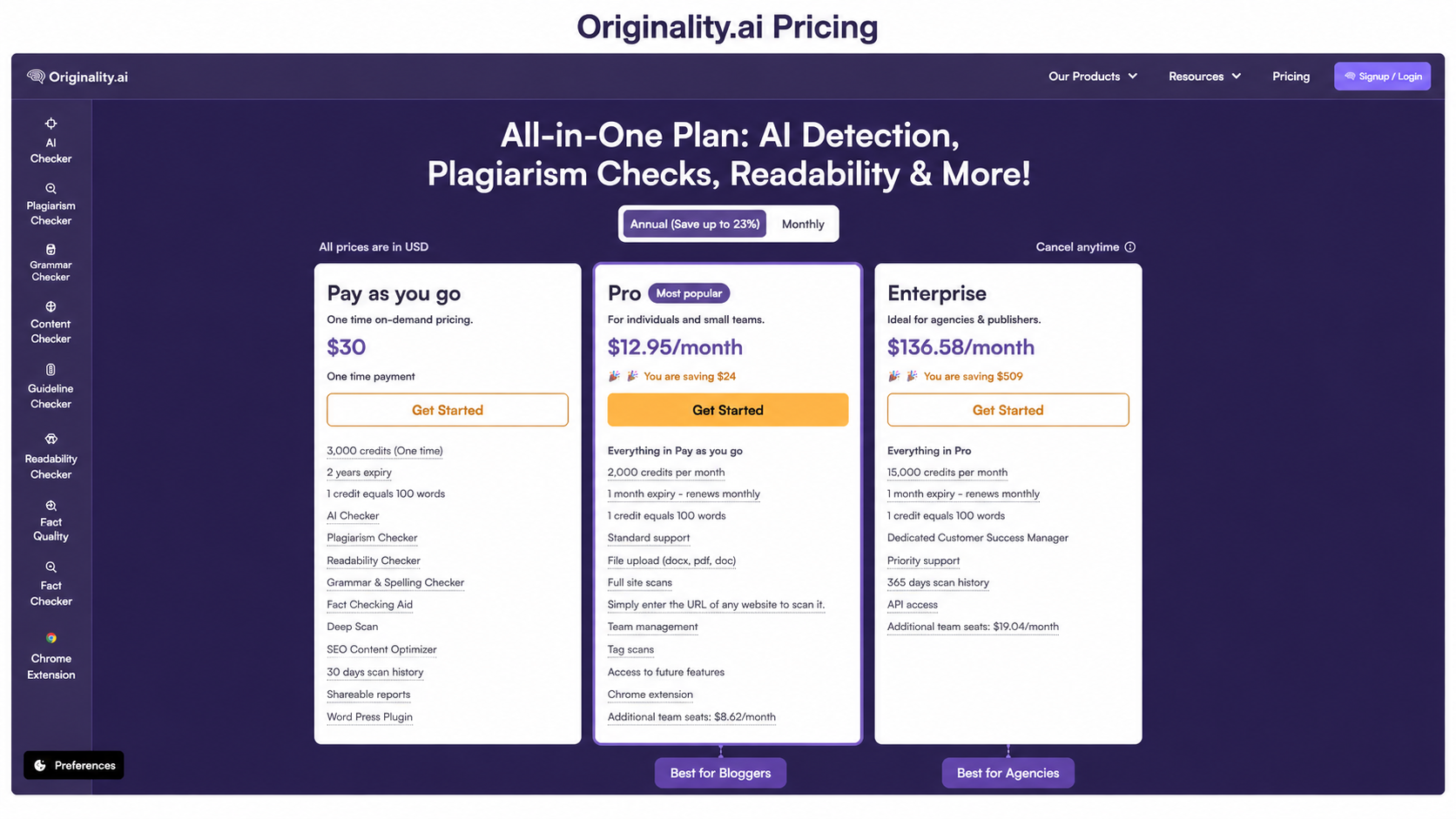
Originality.ai relies on a transparent pricing layout split between flexible token credit bundles and recurring monthly plans, allowing content operations to match their software spend with their precise production volume.
- The Pay-As-You-Go Credit Tier ($30 One-Time Setup): Designed for individual creators, solo bloggers, or casual editors who need flexible content checks without recurring monthly bills. A $30 purchase delivers 3,000 text scanning credits, which remain valid in your profile for two full years.
- AI Detection Scan Costs: 1 credit per 100 words scanned.
- Plagiarism Scan Costs: 1 additional credit per 100 words scanned.
- Fact-Checking Scan Costs: 3 additional credits per 100 words scanned.
- The Base Subscription Plan ($39/Month or $312/Year): Engineered specifically for scaling agencies, digital asset management teams, and professional publishers who require advanced workspace features. The plan includes 3,000 scanning credits monthly alongside full programmatic API developer access keys, automated XML sitemap domain crawling pipelines, full team permission role allocations, and unrestricted public sharing link generation.
Is Originality.ai Worth The Price?
To resolve your investment calculations immediately, evaluate your core business format against the economic roadmaps below:
Choose Originality.ai If:
✓ Your business budget can easily support a software overhead of $30+: If your monthly revenue depends on your organic search rankings, spending under forty dollars to protect your digital portfolio is an exceptionally high-ROI calculation. ✓ You import high-volume text streams from expansive freelance networks: The ability to consolidate plagiarism detection, AI footprint tracking, and factual checking into a single automated step saves immense administrative time. ✓ You regularly acquire digital media properties: The sitemap crawling tools allow you to run automated due diligence audits on entire domains before risking capital.
Avoid Originality.ai If:
✗ You require a permanent free option or credit-less trial sandbox: The platform does not offer free checking modes, requiring a financial commitment from your very first word scan. ✗ Your workflow relies on checking student submissions or academic text: The aggressive commercial tuning can cause unacceptable false-positive friction for traditional student grading or non-native English essays. ✗ You only require basic occasional text editing checks: If you just need to check a single personal email or a short creative paragraph once a month, free generalized chatbots or lightweight utilities are a better fit.
Pros and Cons
| Pros | Cons |
|---|---|
| Industrial Scale Automation: Native XML sitemap crawling allows you to audit entire published websites with a single command. | Elevated False Positive Risk: Sensitive classification thresholds can flag formal, technical, or non-native human prose as synthetic. |
| All-In-One Verification: Combines AI detection, live web plagiarism checking, and automated fact-checking into one unified scanning cycle. | No Free Testing Sandbox: The complete lack of a free access layer forces a financial commitment from your very first document validation. |
| Shareable Audit Receipts: Generates public validation links instantly to provide transparent proof of text quality parameters to freelance contributors. | Credit Management Overhead: Running multi-layer checks (AI + Plagiarism + Fact-Checking) quickly consumes tokens, requiring regular budget monitoring. |
| Advanced Agency Infrastructure: Multi-user team settings allow folder organization by client and granular permission control tracking. | Minimal Linguistic Breakdown: Delivers binary risk percentages rather than the sentence-level structural forensics found in academic tools. |
| Highly Responsive Chrome Extension: Integrates verification directly into Google Docs and WordPress post editors to speed up editorial reviews. | English Language Bias: Models are highly optimized for English-language web content, displaying lower fidelity on secondary international languages. |
Who Should Use Originality.ai?
Understanding exactly how Originality.ai functions inside different operational settings highlights its role as an industrial quality gatekeeper.
1. High-Volume Web Publishers
Publishers overseeing extensive digital media networks or managing multiple editorial platforms simultaneously face a major logistical challenge: verifying content authenticity from a massive pool of freelance contributors. Manually inspecting individual submissions for machine signatures or copied material creates a severe administrative bottleneck.
Originality.ai integrates seamlessly into this production pipeline. Editors can run incoming drafts through the Chrome extension, verify that the content meets authenticity guidelines, and log shareable verification receipts directly into their central task manager, ensuring absolute quality control before an asset ever goes live.
2. SEO Content Agencies
SEO agencies balancing diverse client accounts must ensure that delivered content strictly adheres to individual brand compliance standards and protects organic rankings. A single client discovering unverified machine filler inside an organic content block can destroy an agency’s professional reputation.
Originality.ai’s multi-user team dashboard allows account directors to isolate client folders completely, track credit consumption metrics across senior and junior editors, and provide downloadable, transparent verification certificates to clients as undeniable proof of compliance.
3. Digital Asset Brokers & M&A Managers
During the due diligence phase of acquiring an existing content website or e-commerce platform, verifying historical content asset records is critical. If a private seller built their organic search volume using automated text generation software or duplicated material, the target domain carries severe hidden risks of search engine visibility penalties.
M&A managers use Originality.ai’s sitemap crawling interface to audit target domains before risking capital. By pasting the root sitemap URL, the software systematically analyzes every published page on the site, providing a complete transparency report that exposes hidden synthetic footprints across the entire domain architecture.
Originality.ai vs GPTZero
To choose between the two market leaders, you have to look past simple feature lists and understand their divergent engineering philosophies.
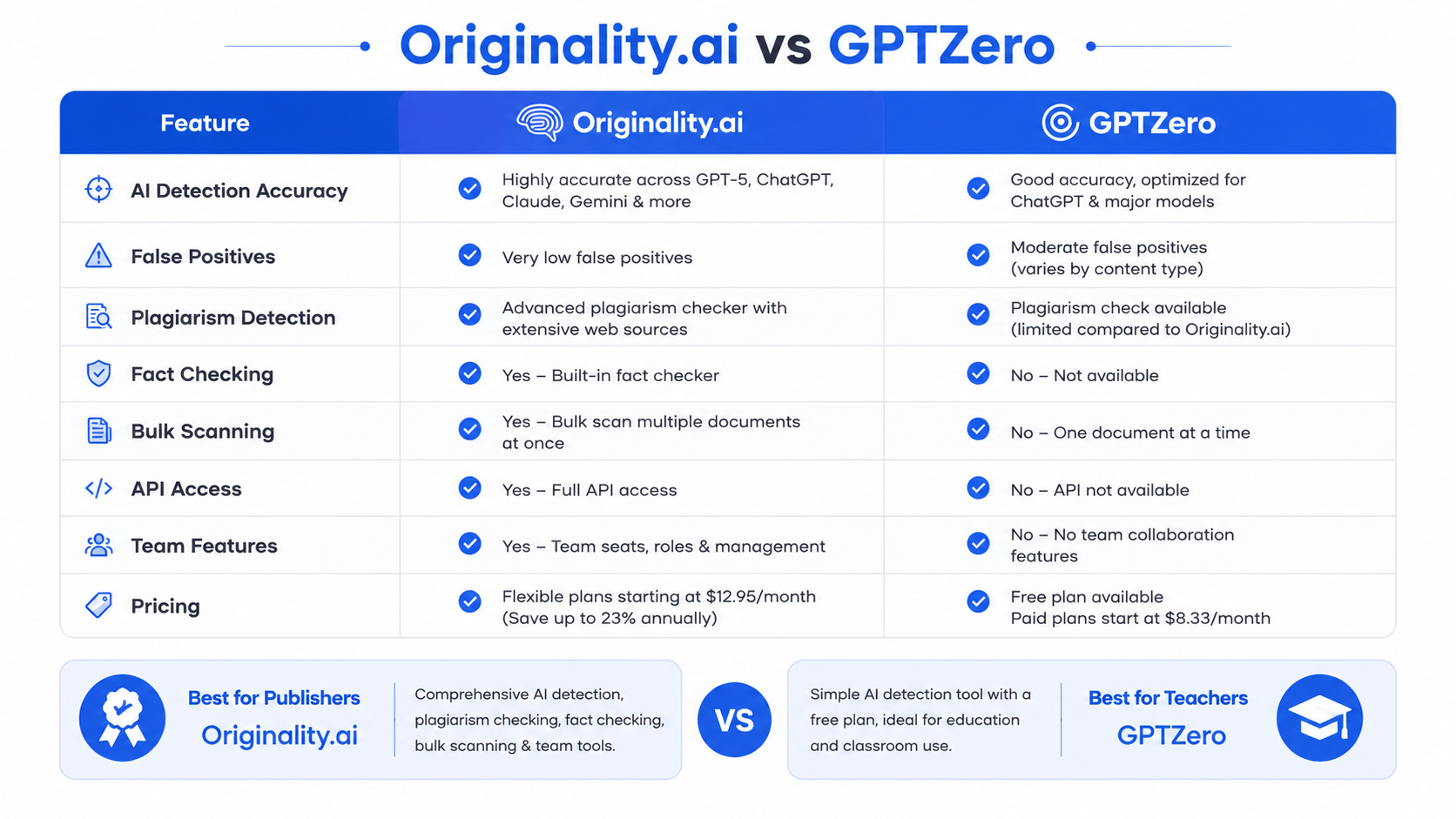
| Feature Element | Originality.ai Platform | GPTZero Environment |
|---|---|---|
| Core Target Market | Web Publishers, SEOs, Asset Buyers | Classrooms, Students, Academic Editors |
| Detection Philosophy | High Sensitivity (Catch all trace AI) | Balanced Precision (Protect human signatures) |
| Bulk Domain Auditing | ✅ Yes (Full XML Sitemap Crawling) | ❌ No (File-by-file manual uploads) |
| Fact-Checking Layer | ✅ Yes (Automated Fact-Checking Engine) | ❌ No (Lacks fact-checking layers) |
| Free Access Sandbox | ❌ No (Paid credit or sub tracking only) | ✅ Yes (Permanent free 10k character plan) |
| Reporting Visuals | Commercial (Shareable Risk Receipts) | Academic (Linguistic Perplexity Maps) |
| Overall Value Focus | Enterprise automation & risk containment | Educational transparency & grading safety |
The Core Divergence: Sensitivity vs. Precision
The competition between Originality.ai and GPTZero centers entirely on your operational environment and risk tolerance for false positives. GPTZero was birthed out of academic necessity to protect writers from unfair accusations. Its classification model focuses heavily on linguistic forensics, analyzing perplexity and burstiness patterns sentence-by-sentence. It requires massive statistical confidence before flagging text as machine-made, making it the premier option for educators, students, and creative non-fiction editors who need to preserve the benefit of the doubt for human authors.
Originality.ai treats text as a commercial liability that must be strictly managed to safeguard organic search traffic. It prioritizes catching all trace machine footprints, accepting a higher incidence of false positives on highly formal human text to ensure no automated filler leaks into an index. By integrating live web plagiarism checks, automated data hallucination scans, and full-site XML sitemap crawling features directly into a centralized team dashboard, Originality.ai provides the industrial speed and automated quality control required to protect large-scale web properties.
Alternatives
If Originality.ai’s aggressive model sensitivity or lack of a free trial does not align with your specific validation pipeline, several specialized market alternatives offer unique technical configurations. For a full side-by-side ranking of all six major tools, see our Best AI Detection Tools guide.
1. GPTZero
The definitive standard for educational spaces and qualitative editorial review. If you need a platform that minimizes false positives on highly structured or non-native English text, GPTZero Review guidelines show it is an exceptional, balance-focused tool that visualizes structural text changes sentence-by-sentence on a light, intuitive canvas.
2. Winston AI
Winston AI has established itself as an exceptional alternative for both web publishers and educators who want high model accuracy paired with a very low false-positive rate. It features an exceptionally clean dashboard layout and includes powerful OCR (Optical Character Recognition) technology. This enables it to accurately read, extract, and scan text hidden inside scanned PDFs, digital image files, and handwritten documents across multiple languages.
3. Copyleaks
An enterprise-grade content authentication and text data protection platform built specifically for large corporate organizations and technical software development groups. Unlike tools that focus strictly on marketing text, Copyleaks features specialized AI detection infrastructure engineered to identify machine-generated source code across multiple programming languages, making it an exceptional utility for software firms. For a direct feature-by-feature breakdown, see our Originality.ai vs Copyleaks comparison.
4. Turnitin AI Detection
The definitive institutional standard for academic environments. Turnitin has been the gatekeeper of academic integrity for decades, and its dedicated AI detection module is integrated natively into its core grading architecture. It does not exist as a standalone public web application; instead, it is deployed directly inside university setups, functioning as an automated gatekeeper for school districts rather than a standalone web utility. Read our full Turnitin Review for a complete breakdown of its archive, LMS integrations, and institutional pricing model.
Category Winners At A Glance
To clarify your purchase decision immediately, review our final operational evaluation of how both industry-leading applications score across core functional requirements:
| Category | Winner | Core Structural Justification |
|---|---|---|
| AI Detection Accuracy | Originality.ai | Maximizes sensitivity to identify hidden, prompt-chained, or humanized synthetic text. |
| Pricing & Word Value | GPTZero | Offers predictable monthly subscription tiers paired with a permanent free testing sandbox. |
| Bulk Sitemap Scanning | Originality.ai | Native XML sitemap crawling eliminates manual text copy-pasting entirely. |
| Ease of Use | GPTZero | Clean, intuitive interface requires zero setup steps or credit calculation tracking. |
| Reporting & Receipts | Originality.ai | Direct percentage outputs backed by shareable public validation receipts for contributors. |
| False-Positive Safety | GPTZero | Balanced detection thresholds protect formal human prose and non-native English signatures. |
| Multi-Layer Validation | Originality.ai | Consolidates AI probability, web plagiarism, and fact verification into one scan. |
| Overall Business Value | Originality.ai | Provides the industrial speed and automation required to secure large commercial portfolios. |
Originality.ai captures the majority of commercial category victories because its platform architecture is explicitly engineered to minimize operational risk and maximize content verification velocity for scaling businesses. While GPTZero remains the undisputed champion for academic safety and linguistic transparency, Originality.ai provides superior infrastructure for enterprises that treat content as a product that must pass rigorous quality control metrics before going live.
Decision Table
| Question | Answer |
|---|---|
| I need to verify dozens of incoming freelance drafts concurrently for plagiarism and data safety. Which tool wins? | Originality.ai: Its multi-layer pipeline checks for AI probability, web plagiarism, and factual errors in a single step. |
| I want a lightweight verification tool that runs inside Google Docs without any ongoing monthly fees. What should I choose? | GPTZero: Its native Chrome extension overlays seamlessly and includes a permanent free tier for low-volume checks. |
| I am purchasing an active media website and need to audit its entire historical content directory. Which tool works best? | Originality.ai: Its automated sitemap crawler maps out and checks an entire domain automatically from a single root URL. |
| I am an author who writes deep technical guides and cannot afford incorrect AI probability flags. Which tool is safer? | GPTZero: Its balanced classification thresholds protect formal human writing, low-burstiness niches, and technical styles. |
Common Questions
1. Is Originality.ai more accurate than GPTZero? Originality.ai is more sensitive and effective at catching highly advanced, prompt-chained, or lightly edited marketing text because its neural network classifiers are tuned aggressively to catch synthetic content. GPTZero is more precise and reliable for academic writing, student grading, and non-native English prose because its classification models are explicitly designed to minimize the risk of false positives.
2. Is Originality.ai worth paying for? Yes, Originality.ai is absolutely worth the investment for professional web publishers, content marketing agencies, and digital asset buyers. If your business regularly imports high volumes of text from freelance networks or acquires existing websites, Originality.ai’s multi-layered ability to check for AI footprints, standard plagiarism, and data hallucinations inside an automated pipeline protects your search engine rankings and reduces editing overhead, easily balancing its pay-as-you-go credit costs.
3. Which tool has fewer false positives? GPTZero has a significantly lower false-positive rate than Originality.ai. Because it was developed explicitly for academic safety, its classification model requires high statistical confidence before marking text as machine-written. Originality.ai uses an aggressive commercial risk threshold optimized for web content security, which can occasionally misidentify formal or structured human writing as synthetic.
4. Which detector is best for bloggers and publishers? Originality.ai is the superior selection for digital publishers and active bloggers due to its scalable bulk auditing infrastructure. Its capability to process complete XML sitemaps, audit lists of backend URLs automatically, and generate shareable public validation receipts matches the fast operational velocity of modern digital publishing pipelines perfectly.
5. Which detector is best for teachers? GPTZero is the definitive option for teachers and academic researchers. Its development focus prioritizes classroom fairness and linguistic transparency. Rather than delivering a simple percentage score, GPTZero provides interactive perplexity maps and sentence-by-sentence highlights, allowing teachers to analyze text modifications constructively with students while protecting innocent writers from unfair accusations.
6. Can AI detectors be trusted completely? AI detectors should be trusted as useful risk-assessment tools, not as definitive proof of content origin. Because these platforms run on statistical probability calculations rather than digital watermarks, they can be fooled by advanced editing techniques or triggered by non-standard human writing styles. Detection scores should always serve as an initial quality indicator, backed by manual human editorial review before any punitive action is taken.
Should You Use It?
Your Ultimate Blueprint for Originality.ai
You should absolutely add Originality.ai to your technology layer if you manage an active digital agency, direct a scaling media network, or purchase online properties where indexing machine-spun content poses an immediate threat to your search engine visibility. Originality.ai behaves like an industrial security gatekeeper, equipping your editing managers with the high-volume bulk automation, automated fact-checking, and aggressive risk-filtering layers required to secure large web platforms safely and verify freelance content inputs efficiently.
Your Ultimate Blueprint for GPTZero
You should deploy GPTZero if you operate inside an educational institution, manage individual freelance creators, or run a personal content studio where precision, text structure mapping, and protection against false positives are paramount. It functions as a transparent, low-friction forensic text editor that gives you clear insight into structural origin patterns without demanding heavy startup training or enterprise software overhead.
Bottom Line
The competition between GPTZero and Originality.ai is easily resolved once you align their core software designs with your actual organizational goals. GPTZero stands out as a champion of academic precision and linguistic clarity, providing teachers and individual creators with a transparent, low-friction text-mapping environment that maximizes fairness and protects human writing signatures. Originality.ai maintains its dominant position as a commercial standard for digital asset management by equipping professional publishers and SEO agencies with the high-volume bulk automation, automated fact-checking, and aggressive risk-filtering layers required to secure web platforms at scale.
👉 Try Originality.ai Today to Protect Your Content Authenticity
Final Verdict
Originality.ai earns a commanding 4.7 / 5.0 for Commercial Risk Orchestration, establishing itself as an essential software utility for high-volume publishing networks and agency teams that require heavy-duty bulk crawling and multi-layered web asset defense. GPTZero earns a brilliant 4.8 / 5.0 for Academic Precision and Trust, cementing its status as the premier verification selection for classrooms, students, and low-friction editorial analysis.
Assess your text processing volume, balance your tolerance for false positives against your need to catch highly optimized synthetics, and deploy the content verification engine custom-engineered for your specific workspace today.
Internal Link Opportunities
Optimize your digital content production and validation stack by checking out our other hands-on software reviews:
- Want an in-depth standalone look at GPTZero’s underlying features? Read our complete GPTZero Review.
- Looking for an affordable AI writing companion that excels at generating short-form copy and structured outlines? See our detailed Rytr Review.
- Need a low-cost text generator that can compile comprehensive long-form blog drafts automatically in a single click? Check out our Copymatic Review.
- Want an inline writing companion that adapts to your natural typing style and autocompletes thoughts inside your browser tabs? Read our deep HyperWrite Review.
- Looking to automate your team’s meeting transcription, summaries, and cross-platform task logging seamlessly? Read our comprehensive Fireflies Review.