GPTZero Review (2026): Is It the Best AI Detector?
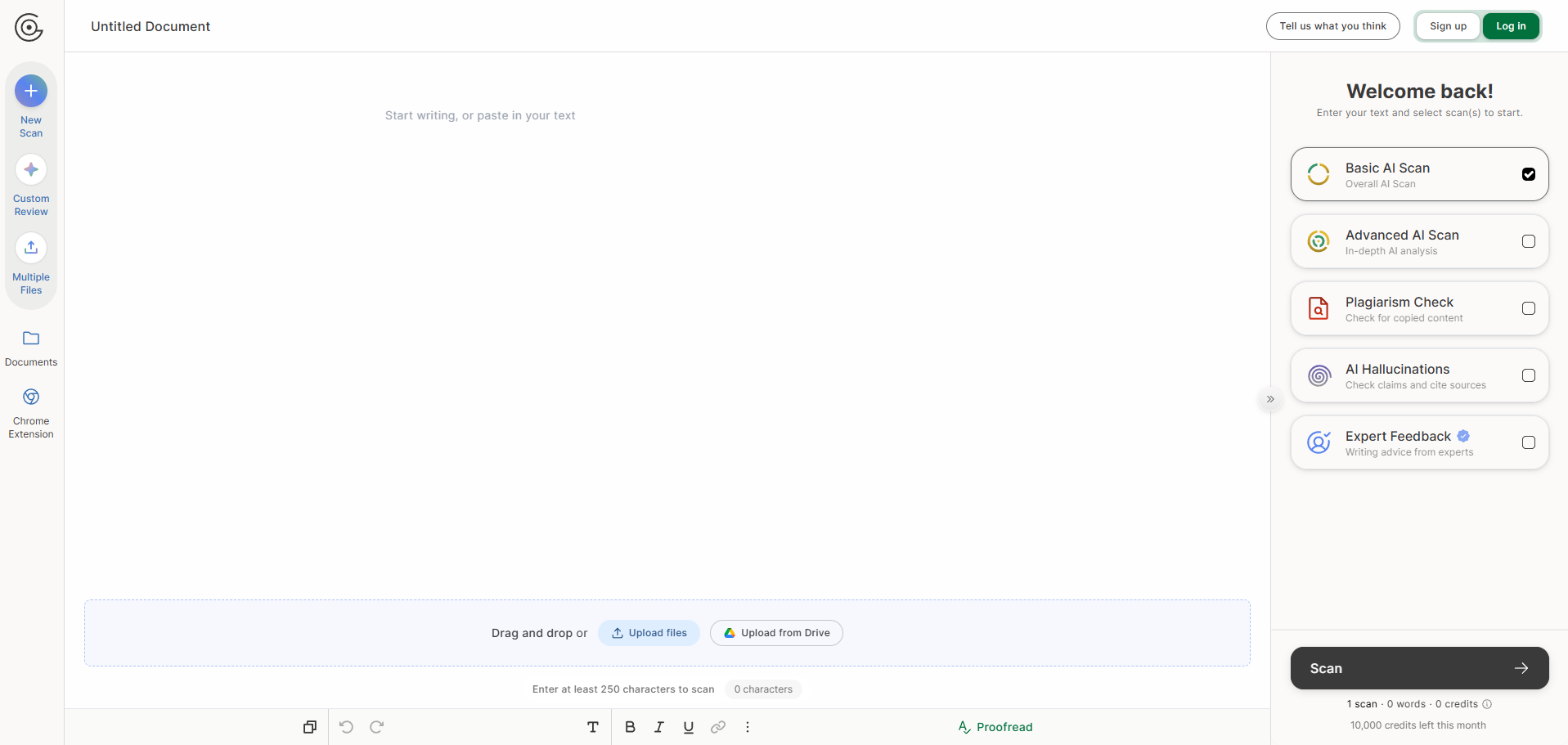
The rapid rise of generative AI has fundamentally altered how digital text is created and indexed. As large language models (LLMs) become increasingly human-like, verifying content authenticity is now a baseline requirement for publishers, educators, and search marketers to maintain authority and avoid algorithmic penalties.
At the epicenter of this verification movement is GPTZero.
Initially built as a viral campus experiment, GPTZero has matured into a sophisticated security layer. However, the generative landscape of 2026 presents challenges: writers use complex humanization software, and false positive flags cause anxiety across freelance networks. In this 2026 GPTZero review, we analyze its core architecture, processing accuracy, pricing limitations, and benchmark it against industry heavyweights to see if it remains the best AI detector available.
GPTZero At a Glance
Before we analyze the underlying predictive metrics, here is a concise high-level synthesis of GPTZero’s current operational standing:
- Best For: Educators, academic administrators, compliance teams, and casual researchers who require high-resolution sentence-by-sentence text breakdowns.
- Pricing: Free basic tier ($0), Essential ($15/month), Premium ($35/month), and custom institutional frameworks.
- AI Detection Score: 4.4 / 5
- Pros: Highly transparent sentence-level highlighting, reliable tracking of standard model outputs, zero-friction document upload queues, and a strong emphasis on user privacy.
- Cons: Vulnerable to advanced humanizer paraphrasers, struggles with highly technical non-fiction texts (spawning false positives), and deep scanning features are heavily metered on standard plans.
TL;DR
Quick Access
Need to verify whether content was written by a human or generated by AI?
Quick Facts
| Attribute | Value |
|---|---|
| Category | AI Content Detector & Text Analytics Software |
| Starting Price | $15 / month (Essential Plan) |
| Free Plan | Yes (10,000 words per month limits) |
| Best Alternative | Originality AI |
| Target Users | Educators, publishers, content marketers, SEO teams, students |
| Founded | 2023 |
What Is GPTZero?
GPTZero is an AI content detection platform that analyzes text patterns and linguistic signals to estimate whether content was written by a human or generated by AI systems such as ChatGPT, Claude, or Gemini.
Company Overview
Launched by computer science student Edward Tian at Princeton University, GPTZero began as a lightweight script to help instructors distinguish student text from early AI outputs. Following explosive global adoption, the company raised institutional venture capital to scale its engineering framework. By 2026, GPTZero has evolved from a basic web application into a comprehensive semantic analytics platform partnering with global universities, publishing houses, and enterprise compliance departments.
Core Functionality
Unlike early-generation scanning applications that rely on simple phrase matching or blacklisted vocabulary indexes, GPTZero uses advanced predictive language metrics. Its primary tracking calculations are broken into two core data methodologies: Perplexity and Burstiness.
Perplexity measures the overall randomness and unpredictability of word sequences within a block of text. Because machine learning tools are engineered to select the statistically most likely next word, text generated by an AI typically exhibits very low perplexity values. Burstiness evaluates the variance and structure of sentences over the lifespan of a full document. Human writers naturally alternate sentence lengths, mixing short, punchy declarative fragments with winding, descriptive compound clauses. AI generation models tend to create highly uniform sentence lengths and predictable rhythms. GPTZero aggregates these specific variances to compute an overall probability rating.
Target Users
- Educators & School Administrators: Instructors verifying that student essays, homework submissions, and master’s theses represent independent human research.
- Digital Publishers & Editors: Managing editors auditing incoming freelance articles to insulate their media assets from low-quality automated text spinning.
- SEO Teams & Content Marketers: Search specialists auditing scaled copy arrays to verify their freelance vendors are delivering humanized, helpful material that aligns with web indexing guidelines.
- Agencies & Freelance Networks: Service operations looking to provide transparent, verifiable proof of original composition to their corporate clients.
Key Features
GPTZero’s development timeline has introduced several major updates to its textual verification stack. Let us review the primary feature modules available within the modern dashboard ecosystem.
AI Detection
The primary dashboard core allows users to paste raw copy or upload documents to analyze them against contemporary model architectures. GPTZero’s engine is trained to catch text signatures across variations of OpenAI’s GPT family, Google’s Gemini iterations, Anthropic’s Claude models, and open-source models like Llama. The system outputs a clean, macro-level percentage index indicating the overall likelihood of synthetic generation.
Sentence Analysis
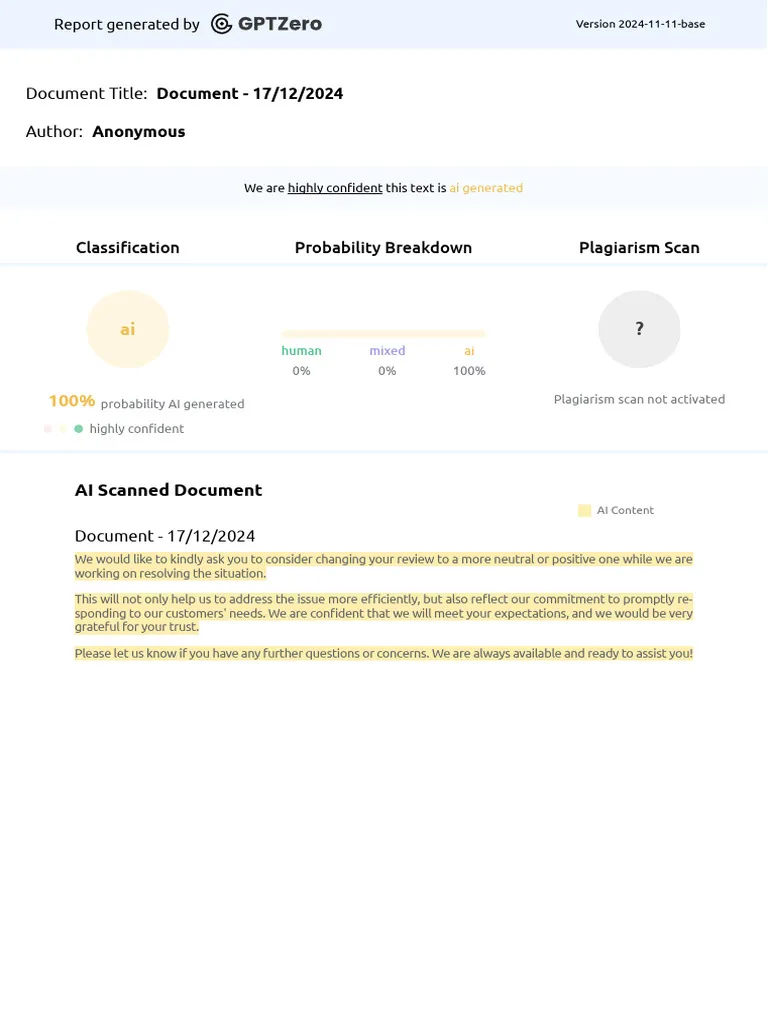
Where many competing checkers simply give a solitary global percentage score, GPTZero includes an intuitive sentence-by-sentence analytical map. The dashboard flags individual text blocks with specific visual color-coding based on localized probability. This targeted analysis is highly beneficial for editors, allowing them to locate precise paragraphs where a writer may have pasted AI-generated bullet points directly into an otherwise human-written piece of investigative journalism.
Probability Scoring
To provide a more accurate evaluation, GPTZero breaks its output metrics into granular, separated components. Instead of a generic score, the interface details the balance between human composition, pure AI creation, and mixed AI-assisted writing (which often denotes text generated by a human but deeply smoothed through automated copy editing tools like Grammarly).
File Uploads
For scaled workflows, manual copy-pasting is an operational bottleneck. GPTZero provides clean, drag-and-drop batch processing. Users can upload various standard file extensions simultaneously, including .pdf, .docx, and .txt files. The system runs the processing queues in parallel, delivering cleanly structured down-funnel alerts.
Educational Use Cases
Recognizing its core enterprise market footprint, GPTZero features deep native integrations with major learning suites like Canvas, Moodle, and Blackboard. Academic users can execute automatic scans as student submissions enter the institutional grading portals. Additionally, the tool includes dedicated Google Docs and Chrome extensions, enabling users to audit the structural edit history of a document to see if blocks of text were written naturally over hours or pasted instantly in one block.
Team Features
The upper plan tiers feature advanced multi-user configuration layers. Administrators can buy centralized enterprise credit bundles, provision distinct access tiers for different editors, audit historical scan records across the whole team, and set up shared workspaces to prevent duplicate scanning of identical articles.
How Accurate Is GPTZero?
The ultimate utility of any social listening or validation script relies entirely on its real-world tracking precision. In the context of 2026, evaluating detection precision is highly nuanced.
Strengths
- Exceptional Baseline Classification: When evaluating raw, unmodified text dropped straight from standard tools (like an unedited paragraph from a default Claude or ChatGPT prompt), GPTZero catches the signature pattern with remarkable consistency.
- Low False Positive Rates on Standard Prose: When processing narrative, highly conversational, and descriptive creative prose, the statistical modeling accurately identifies the natural burstiness rhythms of human writing, minimizing erroneous flags.
- Mixed AI Assistance Detection: The system is highly proficient at distinguishing text that is 100% human from copy that has been edited through algorithmic rewriters, offering a highly helpful middle-ground classification.
Weaknesses & Evasion Vectors
- Vulnerability to Advanced Humanizers: The tool’s primary mechanical weakness lies in its susceptibility to specialized paraphrasing utilities and targeted prompting loops. If an optimization prompt specifically directs an LLM to vary its sentence lengths unpredictably and utilize unusual terminology combinations, GPTZero’s perplexity and burstiness metrics can be successfully manipulated into misclassifying the text as human.
- The Technical Text False Positive Problem: Because scientific documentation, technical software instruction sets, complex legal briefs, and medical logs must utilize uniform, highly structured, and unvarying vocabulary standards by design, they naturally show low mechanical perplexity. This frequently causes GPTZero to flag completely genuine, human-written engineering or academic papers as AI-generated text.
- False Negatives via Language Translation: Running AI-generated copy through translation steps — such as generating text in German and utilizing an independent model to translate it back to English — often strips the predictable linguistic signatures, creating false negative results.
Pricing
Pricing may change over time. Always verify the latest plans and limits on GPTZero’s official website before purchasing.
GPTZero divides its commercial access across distinct monthly subscription tiers, structured to match casual users, high-volume publishers, and large institutional accounts.
GPTZero Pricing Architecture:
- Free Tier: $0/mo (10,000 Total Words / Basic Scan Limits)
- Essential: $15/mo (150,000 Words / Plagiarism Integration)
- Premium: $35/mo (300,000 Words / Advanced Team Workspace)
Free Plan
- Cost: $0 / month.
- Allocations: 10,000 total words allowed per month.
- Feature Scope: Access to standard AI detection models and basic copy-paste text fields. Does not include batch file uploads or deep plagiarism scans.
Essential Plan
- Cost: $15 / month ($10/month if billed annually).
- Allocations: 150,000 total words processed per month.
- Feature Scope: Unlocks batch document processing, access to the Google Docs integration layer, and introduces standard plagiarism scanning tools to check for verbatim copy matches across the web.
Premium Plan
- Cost: $35 / month ($24/month if billed annually).
- Allocations: 300,000 total words checked per month.
- Feature Scope: Designed for multi-user business environments. Unlocks the complete team management portal, provides advanced sentence-level classification algorithms, and includes priority queue execution on processing servers.
Enterprise / Institutional Plan
- Cost: Custom corporate pricing.
- Feature Scope: Geared toward university-wide networks and large media conglomerates. Unlocks custom word-allocation pools, full native API integration frameworks, dedicated account assistance managers, and custom training datasets.
Value for Money
For single bloggers or small web publishers generating fewer than 50 articles a month, the Essential tier offers solid value for money, acting as a reliable sanity check on external freelance copy. However, for large agencies managing thousands of long-form articles, the rigid word caps can become an expensive ongoing line item compared to alternatives offering flat-rate scanning pools.
Start with GPTZero’s Free Plan →
Pros and Cons
To assist teams running multi-channel software audits, here is a breakdown of GPTZero’s primary operational advantages and challenges:
| Pros | Cons |
|---|---|
| Granular Sentence Highlighting: Allows editors to pinpoint the exact paragraphs containing synthetic text signatures. | Strict Word Caps: Standard plans impose clear word-count limits that can hinder high-volume agencies. |
| High Speed Performance: Processes large blocks of text and file uploads in seconds. | Technical False Positives: Frequently flags highly structured, authentic human technical text as AI. |
| Mixed-Writing Recognition: Successfully identifies the nuance between completely automated text and human text modified by tools. | Humanizer Vulnerability: Can be systematically bypassed by advanced text spinning tools and clever prompting layers. |
| Strong Educational Integration: Deep, verified native plug-ins for leading global learning management platforms. | Opaque Enterprise Pricing: Advanced features like API data streams require custom enterprise contracts. |
| Writing History Auditing: Google Docs extension successfully reviews natural typing histories to prove human creation. | Variable Accuracy Across Models: Detection precision dips when evaluating lesser-known open-source language models. |
Who Should Use GPTZero?
Your operational success with GPTZero depends entirely on matching the tool’s specialized detection engine to your specific workflow.
Students
Students should leverage GPTZero as a protective pre-submission validation layer. Even if you write an essay entirely by hand, running your work through GPTZero prior to submitting it to a university portal allows you to see if your writing style triggers a false positive flag. If the software highlights a highly technical paragraph as potentially synthetic, you can proactively rephrase the sentence structure to ensure it passes automated school checks smoothly.
Teachers
For academic instructors and course directors, GPTZero is an essential classroom utility. Rather than relying on simple intuition, it gives teachers a clean, standardized data framework to evaluate suspicious assignments. It works best as an early diagnostic tool — if a paper shows extreme anomalies in burstiness and perplexity, it serves as a reliable prompt for an instructor to hold a face-to-face conversation with the student.
Publishers & SEO Teams
Digital media managers and search engine optimization teams can use GPTZero to enforce quality metrics across external content pipelines. While it should not serve as the sole decider for firing a writer, it is an efficient filter for catching low-effort content production loops before those pages are deployed live to a web domain.
Agencies
For content and digital marketing agencies, GPTZero provides a transparent mechanism to verify original work. Running all client deliverables through the tool and exporting the clean verification report allows account managers to deliver objective proof of human composition alongside their content packages.
How GPTZero Fits in an AI Detection Workflow
For educators and content professionals working with a verification stack, GPTZero functions as a targeted forensic layer that complements other tools at different scales:
- Standalone Detection: For individual teachers and freelancers, GPTZero is the complete solution — paste a document, get a sentence-level analysis, and use the highlighted perplexity map as a constructive starting point for student or editorial review.
- Complement to Turnitin: For institutions already running Turnitin for their official LMS workflow, GPTZero serves as a lightweight supplement for documents submitted outside the LMS or for a second independent forensic opinion.
- Publisher Stack Partner: For content teams managing both AI writing risk and web plagiarism, pairing GPTZero with Originality.ai provides comprehensive coverage — GPTZero handles sentence-level forensic depth while Originality.ai handles automated bulk site crawling across domains.
- Enterprise Complement: For teams that also verify software source code or multilingual documents, Copyleaks integrates alongside GPTZero to cover programming languages and cross-language translation plagiarism that GPTZero does not natively process.
For a complete breakdown of every major platform in this space — including GPTZero, Originality.ai, Copyleaks, Turnitin, Winston AI, and ZeroGPT — see our Best AI Detection Tools guide. If your primary use case is an educational environment, our Best AI Detectors for Teachers covers the educator-specific decision framework in full detail.
GPTZero vs Originality AI
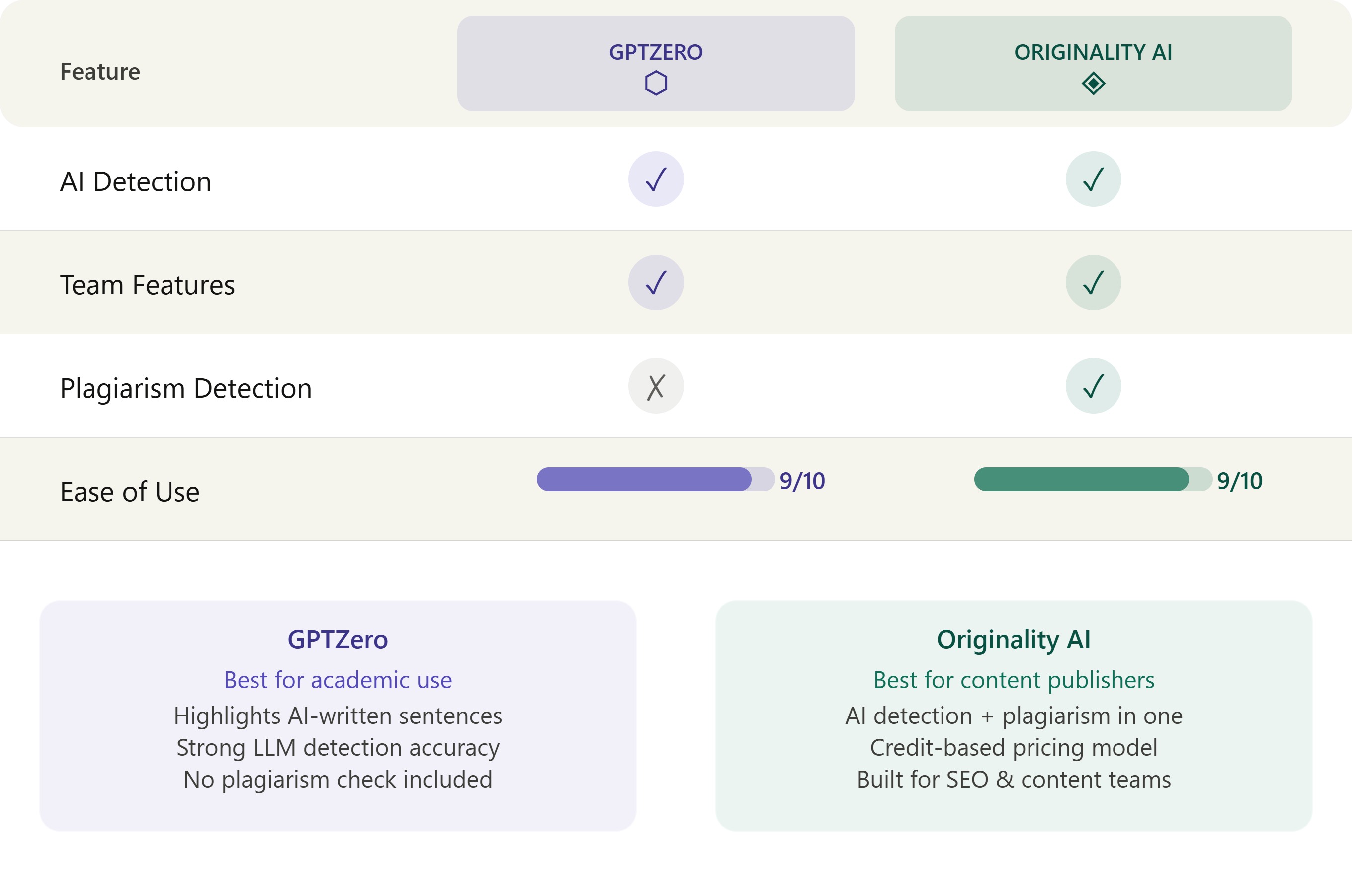
| Feature | GPTZero | Originality AI |
|---|---|---|
| AI Detection | ✅ | ✅ |
| Plagiarism Detection | Limited | Strong |
| Bulk Scanning | Moderate | Strong |
| Education Focus | Strong | Moderate |
| SEO Team Focus | Moderate | Strong |
| Ease of Use | 9/10 | 9/10 |
The commercial detection market is heavily focused on the competition between GPTZero and Originality AI.
- Target Workspace Alignment: GPTZero is fundamentally built for academic structures, educators, and enterprise compliance departments that require transparent sentence highlighting and natural history logging. Originality AI is engineered explicitly for web publishers, affiliate marketers, and SEO agencies who need automated bulk site crawling.
- Detection Mechanics: Our long-form marketplace reviews show that Originality AI updates its detection passes faster to account for new model variants and humanization engines, making it slightly more aggressive at catching optimized AI copy. However, this aggressive approach can result in higher false-positive rates for authentic, technical writing than GPTZero’s more conservative algorithms.
- Pricing Models: GPTZero uses a rigid, recurring monthly word-allocation subscription framework. Originality AI offers a highly flexible pay-as-you-go credit architecture alongside standard memberships, which is often preferred by web developers doing bulk migrations.
- The Verdict: If you operate an academic institution or manage a university classroom, choose GPTZero. If you operate a web publishing company, run an SEO agency, or manage affiliate content pipelines, choose Originality AI.
GPTZero vs Copyleaks
- Feature Integration: Copyleaks combines AI content scanning with an exceptionally robust enterprise plagiarism engine that checks documents against massive databases of licensed academic journals and live web resources. GPTZero’s plagiarism engine is functional but lacks the deep institutional database coverage of Copyleaks.
- Linguistic Processing: Copyleaks is exceptionally strong at processing multilingual document arrays, identifying machine patterns across complex cross-translation files. GPTZero is heavily optimized for English prose, with its accuracy dropping when tracking localized dialect variations.
- The Verdict: Choose Copyleaks if your workflow requires extensive, multilingual scanning across cross-referenced academic databases. Choose GPTZero if your team needs simple, highly visual sentence-level highlighting on standard English articles.
Best GPTZero Alternatives
If GPTZero’s word-count gates or technical false-positives don’t align with your content pipeline, see our full Best AI Detection Tools ranking or explore these top-tier alternatives:
1. Originality AI
The standard choice for professional web publishers and search engine optimization groups. It features integrated site crawling, built-in plagiarism checking, and domain tracking dashboards engineered to protect media networks at scale.
2. Copyleaks
A powerful enterprise analytics application that excels at multi-language text scanning and thorough copyright protection verification, making it a favorite for software development companies and corporate compliance networks.
3. Winston AI
A highly reliable alternative designed for digital creators and educators. Winston AI features an exceptional Optical Character Recognition (OCR) scanner, allowing users to extract text directly from physical paperwork, handwritten student assignments, or scanned PDF documents and analyze it for AI signatures seamlessly.
4. Turnitin
The institutional standard for universities and school districts worldwide. If your organization operates an accredited academic environment, Turnitin provides a compliance-grade verification layer embedded directly inside Canvas, Moodle, and Blackboard — with a private archive of billions of historic student submissions that no public tool can match.
Choosing between GPTZero and Turnitin? See our GPTZero vs Turnitin head-to-head breakdown.
Comparing Originality AI and Copyleaks directly? See our Originality.ai vs Copyleaks breakdown.
Decision Table
| Question | Answer |
|---|---|
| Is GPTZero free to use? | Yes, it offers a basic free tier limited to 10,000 words per month. |
| Can GPTZero detect Claude and Gemini copy? | Yes, the language model is updated continuously to track all major generative AI frameworks. |
| Does GPTZero provide a Chrome extension? | Yes, it provides an official browser tool to review document edit history. |
| Will GPTZero protect against plagiarism? | Yes, plagiarism checking is integrated directly into the paid Essential and Premium subscription plans. |
| Can GPTZero be bypassed by humanizers? | Yes, advanced humanization tools can occasionally manipulate perplexity ratings to bypass scans. |
Common Questions
How accurate is GPTZero in 2026? GPTZero is highly reliable on unmodified AI-generated text when processing default, raw text inputs directly from standard tools like ChatGPT or Gemini. However, its accuracy drops when evaluating text processed through complex paraphrasing applications, or when checking highly technical domain copy, which can trigger false positives.
Can GPTZero scan PDF files?
Yes. Bulk document processing is unlocked once you upgrade to the Essential tier. Users can drop multiple file formats, including .pdf, .docx, and .txt files, directly into the dashboard queue for automated parallel processing.
Does GPTZero cause false positives? Yes. All AI content detectors rely on statistical probability rather than embedded digital watermarks. Consequently, highly structured, technical writing, scientific research papers, and text written by non-native English speakers frequently show the lower perplexity profiles that trigger false positive flags.
Is my text stored or saved by GPTZero? GPTZero emphasizes data privacy compared to early scrapers. According to their core operating terms, text processed through the dashboard is not used to train future iterations of their machine learning models, and institutional data remains insulated.
What is the difference between AI detection and plagiarism detection? Plagiarism detection platforms search the active web to locate direct matching text strings or closely copied sentences from existing articles. AI detection software analyzes the underlying linguistic formatting, rhythm, and sentence variance to predict if the copy was dynamically generated by an algorithm, even if the text is entirely unique.
Should You Use GPTZero?
Bottom Line
GPTZero remains an industry-leading application for clear, highly visual text pattern diagnostics. Its granular sentence-level color-coding and specialized tracking of document edit histories make it an exceptionally useful resource for the academic sector and internal compliance officers. However, for scaled content marketing agencies and high-volume SEO groups, the strict subscription word limits and vulnerability to advanced humanization prompts can create operational bottlenecks.
Choose GPTZero if…
- You are an instructor, course director, or school administrator who needs clear proof of human edit histories and sentence-by-sentence analysis within student submissions.
- You are an enterprise compliance officer looking for a secure, privacy-focused verification layer with native LMS integrations.
Choose Originality AI if…
- You are a digital asset manager, affiliate marketer, or SEO agency lead who needs to run high-volume, automated site crawls across massive web domains on a flexible pricing model.
Choose Copyleaks if…
- You manage multi-language localized campaigns or require a highly robust copyright tracking matrix to verify deep code and literature ownership.
Try GPTZero
If your workflow involves publishing, education, content moderation, or AI content verification, GPTZero remains one of the easiest AI detection tools to get started with.
Final Verdict
GPTZero has successfully transformed from a simple student script into a valuable, corporate-ready verification engine. By prioritizing data security, visual sentence mapping, and deep integrations with institutional learning systems, it has secured its position as the standard validation tool for the education sector.
Who Should Use GPTZero?
- Academic institutions and university professors requiring student essay validation.
- Brand managers managing freelance pipelines for unique, narrative brand copy.
- Freelance copywriters looking to provide independent proof of human composition to premium clients.
- Editors who need to isolate exactly which paragraphs of an article contain artificial text formatting.
Who Should Avoid GPTZero?
- Technical writing agencies that create complex engineering manuals, legal briefs, or medical software documentation (due to high false-positive risks).
- High-volume programmatic SEO publishers requiring flat-rate bulk page scanning.
- Growth teams tracking broad, highly casual internet conversations across social channels.
Ready to verify your content? GPTZero’s free plan covers 10,000 words per month with no credit card required.
Also see: Best AI Detection Tools in 2026 — full comparison of GPTZero, Originality.ai, Copyleaks, Turnitin, Winston AI, and ZeroGPT. For educators specifically, see our Best AI Detectors for Teachers guide.