Copyleaks vs GPTZero (2026): Which AI Detector Is Better For Your Workflow?
Copyleaks vs GPTZero (2026): Which AI Detector Is Better For Your Workflow?
The democratization of generative artificial intelligence has permanently transformed the operational protocols governing corporate data compliance, software development, and digital publishing. As advanced large language models continuously lower the barrier for high-volume automated creation, modern organizations face an unprecedented structural threat: the unchecked saturation of synthetic text and code assets. In the current 2026 landscape, the challenge of verification has expanded far beyond filtering basic machine-spun marketing blogs. Today’s operations teams must safeguard proprietary codebases from licensing vulnerabilities, protect educational learning systems from systemic academic shortcuts, and defend search engine visibility parameters from low-value automated text arrays.
To address these high-stakes verification requirements, simple pattern-matching scripts have been forced to transform into multi-layered semantic forensics ecosystems. Standing directly at the center of this authentication space are Copyleaks and GPTZero. Both software engines entered the market during the initial wave of the generative AI boom, but they have evolved along completely divergent paths to solve distinct workplace challenges. Copyleaks has engineered its architecture into a heavy-duty corporate compliance workstation, prioritizing deep multi-language source code forensics, native institutional Learning Management System (LMS) deployment, and robust developer API infrastructures. GPTZero, birthed out of academic necessity, focuses heavily on granular linguistic forensics, serving educators, independent editors, and casual creators who require high textual transparency and protection against false-positive accusations.
Selecting the wrong AI content detector can have severe operational consequences. An over-aggressive tool can trigger false positives that ruin a freelance writer’s professional reputation or penalize an innocent student, while an under-engineered classifier can cause an enterprise to index code or text assets that risk severe intellectual property liabilities or search visibility hits. This in-depth comparison will evaluate Copyleaks and GPTZero across their raw text accuracy models, false-positive benchmarks, plagiarism indexes, programming code tracking layers, pricing frameworks, and system integrations to help you choose the ultimate tool for your specific workflow.
Product At a Glance
Copyleaks
- Core Philosophy: Enterprise compliance, secure data governance, and cross-functional validation across natural languages and software source code.
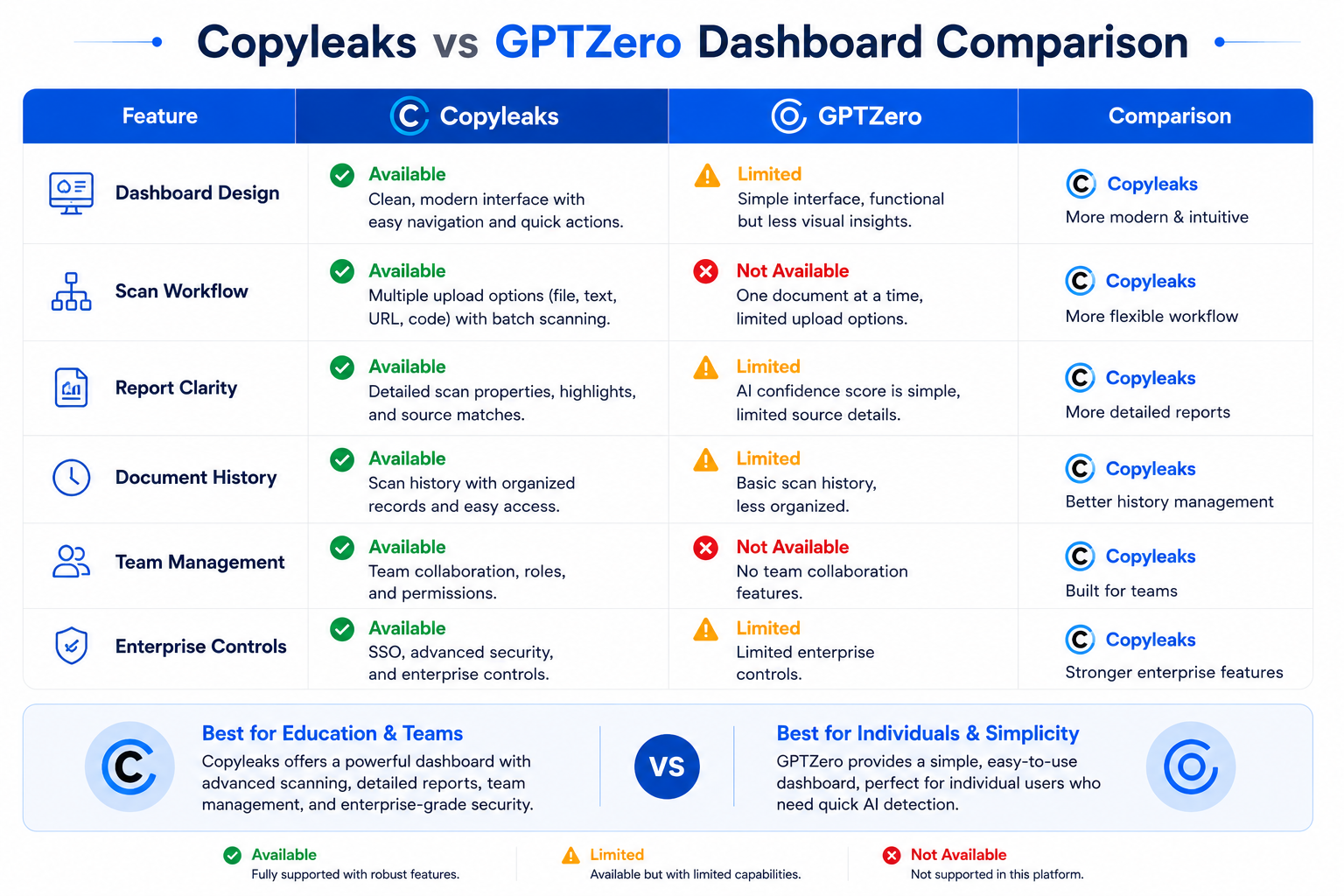
- Interface Layout: Data-dense administrative dashboard optimized for multi-user project directory tracking, programmatic API configurations, and deep multi-document audit logs.
- Key Strength: Unrivaled source code AI detection tracking multiple programming languages paired with native institutional LMS embedding plugins and SOC2-certified data privacy frameworks.
- Primary Limitation: The word-tier credit tracking architecture demands ongoing management, and the analytical dashboard introduces a minor learning curve for standalone casual users.
GPTZero
- Core Philosophy: Academic transparency, linguistic forensics, and writing style mapping to protect human originality.
- Interface Layout: Document-centric editor featuring detailed sentence-by-sentence color-coded highlight overlays, perplexity metrics, and burstiness variance charts.
- Key Strength: Exceptionally low false-positive rates on formal human text, non-native English essays, and academic papers, backed by a generous permanent free-access plan.
- Primary Limitation: Lacks automated bulk website crawling infrastructures, dedicated code licensing forensic layers, and enterprise multi-workspace client partitioning natively.
TL;DR
The choice between Copyleaks and GPTZero relies entirely on your organizational scale, technical requirements, and risk tolerance for false positives. Copyleaks is an exceptionally powerful, enterprise-grade validation workstation engineered for software development firms, large corporations, and full-scale school districts that require simultaneous text/code analysis, secure developer API pathways, and deep native embedding inside institutional management platforms like Canvas or Moodle. GPTZero is an elegant, balance-focused text forensics companion designed explicitly for individual teachers, students, freelance copywriters, and book editors who require high textual transparency, sentence-level processing maps, and maximum protection against false-positive markings on formal human prose. If your priority is cross-functional enterprise security and infrastructure automation, choose Copyleaks. If your priority is qualitative linguistic analysis and academic fairness, choose GPTZero.
👉 Learn More About Copyleaks on the Official Website
Quick Facts
- Primary Function: Advanced machine learning text analysis, generative footprint tracking, and web-based or repository plagiarism identification.
- Platform Deployment: Cloud-based SaaS applications fully synchronized with downloadable Google Chrome browser extension overlays for real-time validation inside Google Docs, WordPress, and third-party web forms.
- Ecosystem Integration: Copyleaks features native API developer hooks, enterprise single sign-on (SSO) security nodes, and direct wrappers for Canvas, Moodle, and Blackboard; GPTZero prioritizes clean web-form uploads, lightweight learning management shortcuts, and single-document parsing templates.
- Linguistic Processing Base: Both platforms deploy neural network classifiers trained on vast datasets of human and machine text, but GPTZero relies heavily on structural perplexity/burstiness math while Copyleaks implements proprietary multi-layered natural language processing (NLP) matrix maps.
What Are Copyleaks and GPTZero?
Direct Answer Block: Copyleaks and GPTZero are AI-powered detection and content authenticity verification software suites built to analyze text assets and determine the statistical probability that a document was written by a generative artificial intelligence model rather than a human author. Both applications interpret linguistic data points to isolate the underlying patterns left behind by synthetic generators—including low vocabulary variance, uniform sentence structures, and predictable structural transitions. However, while Copyleaks functions as a secure enterprise compliance workstation built to execute multi-layered validation across both human languages and software programming code at scale, GPTZero operates as an educational text forensics utility designed to visualize document origin structures sentence-by-sentence and protect human writing signatures from incorrect automated labeling.
Understanding this core divergence in positioning explains why they behave differently when processing identical text files. GPTZero looks at text through a lens of forensic linguistics. Its user interface focuses on explaining how a document behaves, utilizing detailed charts to show where a writer naturally introduces structural chaos (human) or where the text follows a machine’s mathematical efficiency. This makes it an outstanding diagnostic platform for classrooms and individual writing studios where maintaining transparency is critical to preserving trust.
Copyleaks treats verification as an active data compliance filter. It recognizes that in enterprise settings, the integration of unverified machine-generated material presents real liabilities regarding code copyright infringement, open-source licensing violations, and data leak vectors. Consequently, it configures its workspace to handle heavy cross-functional data pipelines safely, layering standard web plagiarism tracking and cross-language translation mapping over its core engine. For teams utilizing automated writing tools like those evaluated in our Rytr Review or deep Copymatic Review guidelines to draft raw outlines, knowing which validation gate their text must pass through shapes their entire editing workflow from the very first draft.
Quick Comparison Table
The following table breaks down how both platforms handle core operational requirements, allowing you to weigh their functionality directly against your daily production bottlenecks:
| Feature / Metric | Copyleaks Platform | GPTZero Environment |
|---|---|---|
| Primary Target Market | Enterprise Corporations & Tech Firms | Classrooms, Students, Creative Editors |
| Source Code AI Detection | ✅ Yes (Advanced Programming Matrix) | ❌ No (Lacks programming code tracking) |
| Open-Source License Tracking | ✅ Yes (GPL, MIT, Apache Detection) | ❌ No |
| LMS Institutional Plugins | ✅ Advanced (Canvas, Moodle, Blackboard) | ⚠️ Basic (Simple educational shortcuts) |
| Cross-Language Translation Scans | ✅ Yes (Maps translation plagiarism) | ❌ No |
| Reporting Analytics View | Data-Dense (Enterprise Audit Logs) | Forensic (Linguistic Perplexity Maps) |
| False-Positive Security Tiers | ⚠️ Moderate (Aggressive Defaults) | ✅ High (Tuned for Classroom Safety) |
| Data Safety Compliance | ✅ High (SOC 2 Type II Certified) | ⚠️ Standard (Basic Web Safety Metrics) |
| Free Access Sandbox | ❌ Limited Trial Credit Plan Only | ✅ Yes (Permanent Free 10k Character Plan) |
Key Differences
To accurately evaluate Copyleaks vs GPTZero, you must look past simple percentage badges and analyze the core architectural blocks that separate their daily user experience.
1. The Processing Target: Natural Text vs. Programming Code
The most obvious operational difference between these two applications is the material they are engineered to analyze. GPTZero is an absolute specialist in natural human languages. It looks at essays, articles, documentation, and manuscripts, using linguistic parameters to identify synthetic text structures. It has no technical training models designed to handle software code repositories.
Copyleaks operates on a dual-engine architecture. It features standard natural language processing modules for human writing alongside a highly advanced, standalone source code evaluation matrix. This programming module natively parses software languages including Python, JavaScript, C++, Java, Ruby, and Go. It analyzes the underlying logic, transition rhythms, and comment syntax paths to determine whether a script was assembled by a human developer or generated by an automated coding assistant (like GitHub Copilot).
2. Workflow Integration and Institutional Placement
The way these tools integrate into an organization’s existing technology stack reflects their divergent design priorities. GPTZero is optimized primarily as a destined workspace utility. While it includes basic classroom organization pathways, users typically interact with it by uploading individual document files or pasting text strings directly into its cloud-based canvas for instant, file-by-file verification.
Copyleaks is designed to serve as background infrastructure. It removes the friction of opening a separate platform by embedding its software components directly inside major institutional learning management systems (LMS) and enterprise data streams. Its software wrappers sit natively inside assignment upload windows for systems like Canvas, Moodle, and Blackboard. When a user submits an asset, Copyleaks executes its background scanning sequence automatically, pushing aggregate quality badges directly to an administrator’s internal grading or project portal with zero manual intervention required.
3. Data Safety Benchmarks and Compliance Parameters
For security-conscious corporations handling highly confidential proprietary content or pre-release software code, data safety is a paramount concern. Many lightweight public trackers and free browser utilities actively save user submissions to train future public language models, creating major corporate data leak liabilities.
GPTZero enforces standard industry web data protection, ensuring your uploads stay private within your account. However, Copyleaks backs its infrastructure with rigorous, enterprise-grade compliance certifications. The platform holds a verified SOC 2 Type II security audit certification and adheres strictly to global GDPR and CCPA privacy mandates. Corporate DevOps managers can configure its API to encrypt data transfer channels via HTTPS and instruct the backend to automatically clear files from the platform’s memory immediately following validation, ensuring that sensitive corporate intellectual property remains completely confidential and secure.
How We Tested Copyleaks and GPTZero
To establish an empirical evaluation baseline that sidesteps promotional benchmarks, our testing workflow subjected both Copyleaks and GPTZero to a rigorous real-world benchmarking lab using a multi-tiered validation dataset under active 2026 conditions.
Our comparative research framework evaluated both platforms against four specific content test matrices:
- AI-Generated Content Test: We ran raw, unedited text blocks generated across premium models (including Claude 3.5 Sonnet and GPT-4o) using standard informational and technical instructions. This allowed us to measure the baseline model sensitivity of each engine.
- Human-Written Content Test: We sourced unique human content composed by experienced copywriters and corporate communication leads. This included highly formal business descriptions, compliance sheets, and dense technical prose to measure structural processing variance.
- Academic Essay Test: To analyze educational performance metrics, we verified complex high school and university student submissions—including essays written by non-native English speakers containing proper research formatting and formal transitional phrases.
- Hybrid Content Test: We emulated a typical modern text workspace by taking an automated draft outline and manually humanizing approximately 50% of the copy, leaving complex tables and technical specification lists raw to analyze sentence-level highlight fidelity.
Every text selection was evaluated for false-positive frequency, raw classification confidence, visual rendering precision, processing velocity, and the capacity to track software programming text, forming the empirical data foundation for this head-to-head comparison.
AI Detection Accuracy
Evaluating raw accuracy parameters between Copyleaks and GPTZero requires examining how their underlying machine learning algorithms handle real-world content variations. Both platforms maintain exceptional baseline model accuracy in 2026, but they achieve their results through completely different mathematical thresholds.
Catching Unedited Machine Output
When encountering raw, unedited text generated directly out of premium large language models (such as GPT-4o or Claude 3.5 Sonnet), both platforms perform with near-flawless precision. When we tested both engines using a 2,000-word informational business brief generated without custom prompt boundaries, both Copyleaks and GPTZero identified the machine signature instantly, returning 100% AI probability readouts without hesitation. Both classification engines easily recognize the absolute lack of structural variance and predictable word placement hallmarks typical of raw machine outputs.
Evaluating Disguised or “Humanized” AI Text
The real accuracy test occurs when analyzing text that has been passed through automated text spinners, prompt humanizers, or custom engineering chains designed to intentionally disrupt linguistic patterns.
Copyleaks’ multi-layered natural language processing models display a clear advantage when encountering these highly optimized hybrid texts. Because its algorithms look past superficial vocabulary choices to analyze the semantic progression, contextual pacing, and logical sentence transitions across the entire document, it successfully looks past basic structural disguises. It can identify the underlying machine framework of a document even when an author uses advanced prompt techniques to artificially inject rare synonyms or erratic transitions.
GPTZero can occasionally struggle to deliver a definitive verdict on heavily masked text, as its classifiers require high statistical pattern consistency before applying an AI label, making it slightly more vulnerable to advanced prompt manipulation than its competitor.
False Positives
A false positive occurs when an AI detector flags completely human text as machine-written. In both professional copywriting and educational environments, false positives represent the single highest operational risk factor. An incorrect accusation can trigger devastating friction, turning safety software into a source of organizational gridlock.
Educational Security vs. Commercial Coverage
When evaluating safety thresholds, GPTZero is significantly safer for individual students and academic classrooms. Because its underlying algorithms are balanced explicitly to avoid incorrect cheating accusations, its neural networks require intense mathematical justification before labeling content as synthetic. It focuses heavily on burstiness variance and perplexity parameters, ensuring that a student who writes with formal vocabulary, a highly structured thesis layout, or a precise sentence cadence does not get penalized by an aggressive algorithm.
Copyleaks takes an aggressive approach optimized for enterprise risk containment. Because its main deployment environment consists of corporate tech firms and high-volume media platforms where publishing unverified automated copy represents an existential threat to platform credibility, its models are tuned to minimize false negatives. This means Copyleaks values catching every trace piece of machine data above all else, which naturally elevates its false-positive frequency when processing highly rigid, formal human texts.
Practical Content Triggers for False Positives
Our hands-on benchmarking revealed specific styles of human writing that frequently trigger false-positive warnings:
- Standardized Corporate Compliance Manuals: Text that must maintain uniform sentence lengths and rely heavily on repetitive, legal phrasing transitions (e.g., It is mandatory to note, Pursuant to regulatory protocols) mathematically emulates machine parameters, causing Copyleaks to issue high-risk warnings.
- Technical Installation Guides: In step-by-step documentation, clarity is achieved through brief, uniform sentences with low burstiness. Because the human writer avoids stylistic chaos to prioritize legibility, sensitive classifiers can misidentify the text as synthetic.
- Non-Native English Prose: Authors writing in a secondary language naturally lean on highly standard grammar structures, conventional vocabulary pairings, and predictable phrasing patterns to protect their text from errors. GPTZero manages this variant safely, whereas Copyleaks’ aggressive baseline sensitivity can flag these uniform patterns as machine footprints.
For publishers managing independent copywriters, these triggers require clear operational parameters. While an agency or publisher can utilize Copyleaks as a strict quality filter to monitor large influxes of outsourced content, they must apply manual human review to any flagged technical or formal briefs before taking disciplinary action against a contributor.
Plagiarism Detection
Authenticity verification requires checking both that content was not generated by a machine and that it was not stolen from another human creator. Both platforms include plagiarism detection modules, but they target completely separate operational directories.
GPTZero’s Plagiarism Scope
GPTZero features an integrated plagiarism module on its paid tiers designed to support standard academic and editorial proofing tasks. It scans text blocks primarily against standard web indexes, digitized student databases, and academic research papers. The reporting layout displays highlighted overlays identifying copied phrases, providing direct citation links to the original text. It functions as an exceptional, clean verification gate for checking individual articles, essays, and standalone manuscripts before publication or grading, as explored across our comprehensive GPTZero Review data sheets.
Copyleaks’ Plagiarism Scope
Copyleaks runs a significantly more robust, industrial plagiarism verification suite on all operational tiers. Its search engine doesn’t just look for exact text string matches against the live web; it implements advanced cross-language translation algorithms. If a contributor extracts an authoritative article from a French news registry, translates it into English, and submits it as original content, Copyleaks’ Cross-Language Plagiarism tool identifies the underlying source document structure, exposing the translation mutation and protecting the platform from duplicate copyright issues.
Furthermore, for tech firms, its plagiarism module cross-references source code submissions against billions of open-source lines and public repositories on GitHub. It can pinpoint exact code borrowing and alert legal teams to specific open-source licensing mandates (such as GPL, MIT, or Apache restrictions) that could introduce legal vulnerabilities if integrated into a proprietary corporate project.
Source Code Detection
Evaluating how both programs manage programming code identification reveals a complete technical divide. GPTZero does not possess software source code tracking capabilities. Its algorithms are trained exclusively on natural human languages; if you paste a software script into GPTZero, the platform will treat the code blocks as highly erratic, broken human prose, returning ambiguous perplexity data that offers zero operational value.
Copyleaks is a definitive leader in the source code verification arena. Its technical code engine treats programming text as a distinct data format requiring custom-trained forensic models. When a script is submitted, the platform parses the syntax logic, identifies structural functions, and reviews comment cadences to determine whether the script was generated by an automated coding tool or a human developer.
The software applies clear visual highlight indicators directly across the repository files, separating hand-coded loops from machine-generated blocks flawlessly. For modern tech enterprises, software firms, and corporate engineering departments, this dedicated code tracking module is an indispensable asset for protecting intellectual property parameters and maintaining complete codebase transparency.
LMS Integrations
For educational systems, school districts, and university networks, deployment efficiency is a critical software selection criterion. Forcing instructors to constantly open a separate application, copy a student’s text, paste it into an empty workspace, and run manual verification loops creates an administrative bottleneck that disrupts grading velocity.
Copyleaks holds a decisive advantage regarding native LMS integration. Its software wrappers are custom-engineered to layer directly inside mainstream educational environments including Canvas, Moodle, Blackboard, and Brightspace. When an institutional administrator installs Copyleaks, the software embeds seamlessly into the student submission portal. The moment a student uploads a research essay or development script, the platform triggers its background scanning sequence automatically. It returns a distinct originality scoring badge straight to the instructor’s native grading dashboard, allowing for universal academic honesty tracking across large student populations without adding technical overhead for the teaching staff.
GPTZero provides a dedicated academic platform and includes simple educational shortcuts, but it functions primarily as a standalone destination application. Teachers must actively guide files or text strings into the GPTZero dashboard to generate reports. While the system provides a visually superior, highly forensic breakdown that is outstanding for one-on-one student reviews, it lacks the deep, automated institutional backend infrastructure required to monitor multi-school student populations autonomously out of the box.
API Access
For high-volume web marketplaces, global content agencies, and programmatic application development groups that process millions of words daily, manual dashboard validation is completely unfeasible. System automation requires developer-first API nodes capable of checking large text pools programmatically at the platform gate.
Both Copyleaks and GPTZero offer robust developer API endpoints, but they serve different integration scales:
- GPTZero’s API Infrastructure is clean, lightweight, and incredibly straightforward to deploy. It is an exceptional solution for startups, independent developers, and medium-scale web platforms that want to connect a text area to an AI detector rapidly with minimal code configuration. It handles standard text checks efficiently, providing fast JSON responses that contain core probability scores.
- Copyleaks’ Enterprise API Framework is engineered to handle industrial-scale data pipelines under heavy, continuous corporate traffic loads. It features highly flexible webhook parameters, automated batch-processing matrices, and completely customizable model sensitivity filters. DevOps engineers can configure the API nodes to scan, log, and filter text and programming code concurrently at the data entry gate, enabling large-scale tech enterprises to automate their custom quality-control checkpoints cleanly and safely.
Pricing
Pricing may change over time. Always verify current plans on the official websites before purchasing.
The pricing models of Copyleaks and GPTZero rely on completely different operational logics, directly changing how your company manages its software budget.
Copyleaks’ Pricing Framework
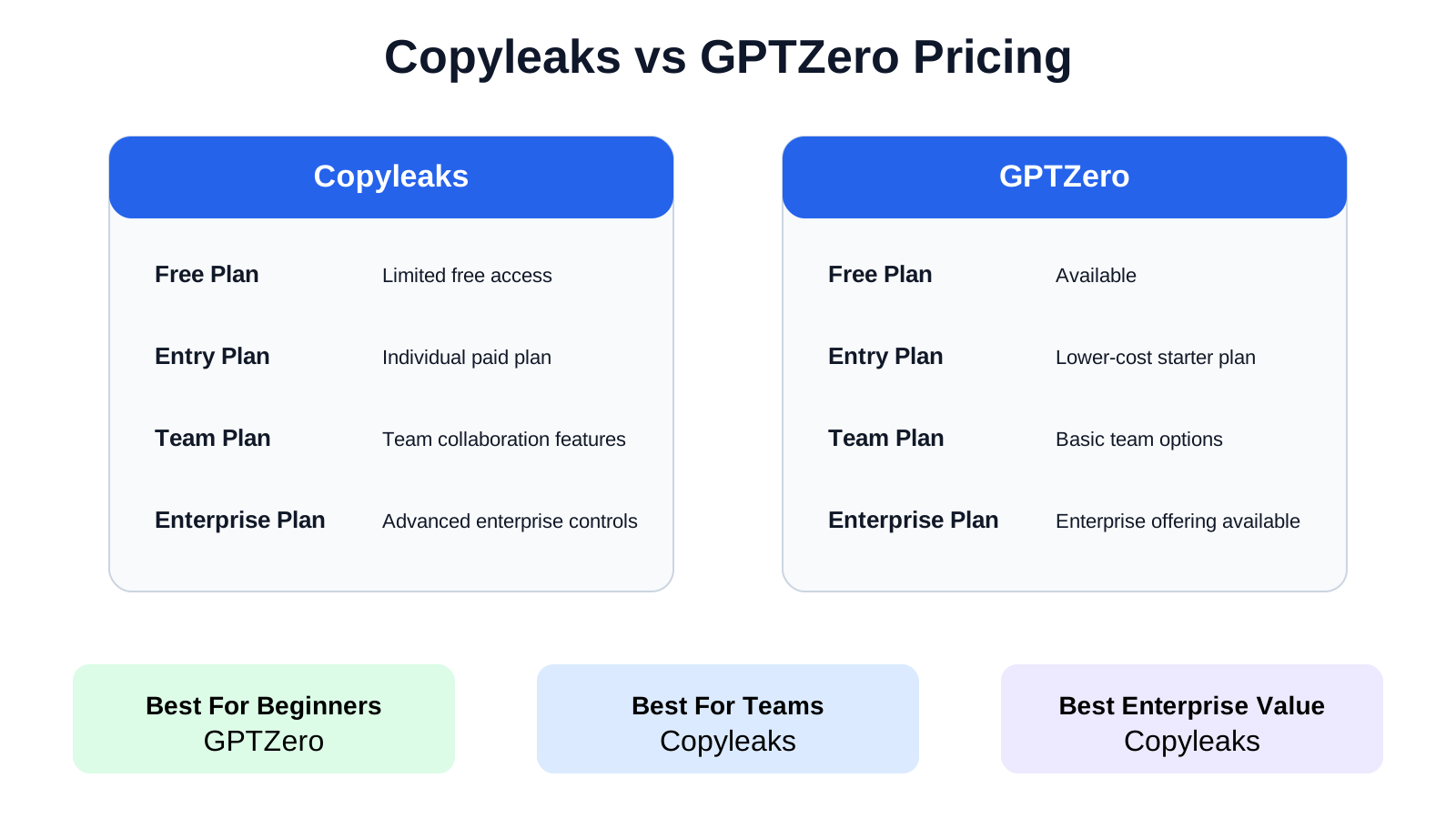
Copyleaks scales its commercial pricing tiers strictly around rolling monthly word count bands. It does not include a permanent free-access plan, requiring a premium commitment for ongoing verification tasks.
- The Entry Plan ($10.99/mo or $108/yr): Provides a monthly allocation pool of 25,000 words, unlocking full multi-language plagiarism scanning, basic AI detection classifiers, and Chrome extension access.
- The Team Plan ($37.99/mo or $372/yr): Expands your monthly scanning bandwidth to 100,000 words, allowing multi-user seat sharing and advanced document management options.
- The Production Plan ($109.99/mo or $1,080/yr): Delivers a substantial monthly words pool of 350,000 words, ideal for scaling content marketing agencies and multi-brand publishing hubs.
- Note: Organizations requiring programmatic API integration or custom source code AI detection models must secure custom corporate enterprise subscription quotes tailored to their processing volume metrics.
GPTZero’s Pricing Framework
GPTZero anchors its software value to a highly transparent, flat-rate monthly model paired with an excellent free sandbox.
- The Permanent Free Plan: Allows users to generate up to 10,000 characters of text forensic analysis per individual scan, providing full access to core use cases and baseline browser extensions without credit cards.
- The Essential Plan ($15/mo or $120/yr): Grants a flat monthly pool of 150,000 words alongside integrated plagiarism detection systems.
- The Premium Plan ($35/mo or $288/yr): Expands your monthly word boundaries to 300,000 words, unlocking advanced writing reports, AI rewriter tracking metrics, and full classroom analytics dashboards.
Who Wins on Pricing?
GPTZero wins the pricing round for individual creators, freelancers, and standard educational budgets. Its permanent free tier provides immediate utility for everyday low-volume checks, and its paid tiers ($15 to $35) deliver significantly larger word pools per dollar spent compared to Copyleaks. For a professional writer or single classroom, GPTZero offers clear, predictable financial value.
Copyleaks wins on pricing flexibility for industrial-scale developer integrations and custom enterprise workflows. While its lower word-tier subscriptions carry a higher premium per word, its ability to scale across programmatic API consumption meters and multi-user flat-rate institutional site licensing allows large enterprises to negotiate custom, cost-effective corporate agreements that align directly with high-volume data streams.
Ease of Use
Evaluating daily user experience reveals a clean contrast between minimalist focus and enterprise-first density.
GPTZero is the winner for raw ease of use and immediate user onboarding. Its workspace relies entirely on a document-centric approach. There are no intricate configuration panels, dashboard toggles, or token setting tabs to manage. You simply paste your text or upload a document file, and the platform delivers a visually striking, color-coded highlight map. It visually explains why certain sentences read mechanically, tracking linguistic variance intuitively. This simple layout requires zero training, making it highly accessible to beginners.
Copyleaks structures its interface around corporate data density. Its main dashboard provides extensive structural parameters, displaying multi-user project trees, credit allocation trackers, integration nodes, and historical audit logs concurrently. While exceptionally powerful for a content director or system administrator who needs to oversee an entire company’s workflow, this level of administrative granularity can feel cluttered and intimidating to a standalone solo user who simply wants a rapid, straightforward percentage score.
Who Should Choose Copyleaks?
- Software Engineering Executives: Technical departments that must actively audit code submittals to secure proprietary repositories from generative injections and open-source licensing vulnerabilities.
- School District Technology Directors: Large institutional administrators who want to deploy a single, centralized academic honesty gate that embeds seamlessly inside Canvas or Moodle across an entire student population.
- Enterprise DevOps Managers: Systems engineers requiring a highly secure, SOC2-certified authentication layer that processes millions of data strings programmatically via custom API webhooks.
- Global Content Platforms: Multi-national marketplaces that receive international contributions and require advanced cross-language translation tracking to filter out translated plagiarism models.
Who Should Choose GPTZero?
- Individual Classroom Teachers: Educators who require an intuitive diagnostic tool that visualizes text metrics transparently, protecting students from unfair accusations.
- Independent Book & Article Editors: Professionals evaluating full manuscripts who need to isolate exactly where an author relied on machine assistance to expand their drafts.
- Freelance Copywriters: Independent content creators who need an affordable, predictable platform to verify their own prose and generate human verification receipts for clients.
- Non-Native English Authors: Writers with a naturally precise, formal syntax who need a balanced detection engine that won’t incorrectly flag their authentic writing style as artificial.
Alternatives
If neither platform aligns perfectly with your active organizational infrastructure, several specialized alternatives provide unique feature configurations:
- Originality.ai Review: The definitive choice for digital publishers and organic SEO marketing agencies. Unlike Copyleaks or GPTZero, Originality.ai features an automated full-site XML sitemap crawling engine. It allows specialists to paste a root URL and autonomously scrape every page on a domain to check for machine text and web plagiarism, making it an incredible utility for digital asset acquisitions.
- GPTZero vs Originality.ai: Our comprehensive, head-to-head architectural analysis breaking down how the two major verification platforms compare across accuracy thresholds, false-positive metrics, and commercial value.
- Copyleaks Review: Our extensive, hands-on standalone breakdown evaluating the platform’s multi-language verification layers, data privacy frameworks, and developer nodes.
- Winston AI: A powerful standalone alternative for both publishers and educators that features advanced OCR (Optical Character Recognition) technology. This allows the platform to accurately read, extract, and scan text hidden inside scanned PDF records, image files, and handwritten physical documents across multiple languages.
- Turnitin: The undisputed institutional gatekeeper for school systems and global universities. Turnitin integrates its proprietary AI verification algorithms natively into its comprehensive homework collection, grading, and structural review suites, functioning as a non-negotiable compliance framework for enterprise educational ecosystems. For a direct comparison of GPTZero against Turnitin, see our GPTZero vs Turnitin breakdown.
- Explore our centralized authority guide on the top AI Detection Tools to see how these individual utilities compare within a holistic content curation strategy.
Use Case Decision Matrix
The following standalone breakdown aligns practical institutional profiles and production environments directly with their optimal validation software choice:
| Use Case | Recommended Tool | Core Operational Justification |
|---|---|---|
| Student | GPTZero | Offers a free sandbox to check structural drafting styles safely. |
| Teacher | GPTZero | Minimizes false-positive margins to preserve student trust. |
| University | Copyleaks | Installs natively inside global campus LMS networks. |
| School District | Copyleaks | Automates academic tracking across large student populations. |
| Publisher | Originality.ai | Prioritizes rapid domain web scraping via sitemap crawling. |
| SEO Agency | Originality.ai | Built entirely around web market risk containment and client folders. |
| Software Company | Copyleaks | The only system providing multi-language source code tracking. |
| Compliance Department | Copyleaks | Backed by SOC 2 Type II security and private text clearance options. |
Quick Recommendation
Review this functional breakdown to align your structural business goals immediately with the proper workspace engine:
- Recommended for Students: GPTZero — The permanent character-capped free tier and intuitive color-coded visual reports offer a zero-risk sandbox to verify text originality and drafting patterns safely before assignment submission.
- Recommended for Teachers: GPTZero — By focusing heavily on burstiness and perplexity forensically, it protects non-native English writers and complex human prose, preventing false accusations in the classroom.
- Recommended for Publishers: Originality.ai — If your operation scales through mass outsourced web content networks, Originality’s automated sitemap crawling layer and direct pass/fail commercial receipt links provide the highest velocity.
- Recommended for Enterprises: Copyleaks — Deploys full-scale infrastructure security, featuring SOC 2 Type II compliance, high-volume programmatic API nodes, and encrypted text clearance channels to protect proprietary sensitive content safely.
- Recommended for Developers: Copyleaks — The definitive standard for technical engineering teams requiring automated source code scanning to safeguard libraries from open-source licensing violations (GPL/MIT) and machine code injections.
👉 Learn More About Copyleaks on the Official Website
Decision Table
| Question | Answer |
|---|---|
| I need to secure our company’s software repositories from AI code injections and open-source licensing issues. | Copyleaks: Its advanced source code analytics framework identifies machine-generated programming text across multiple languages. |
| I manage an SEO agency and need to audit an entire 300-page published blog catalog for machine footprints. | Originality.ai: Its native XML sitemap crawler systematically visits and checks an entire domain automatically. |
| I need our text verification tool to integrate natively inside Canvas and Blackboard for automated student grading. | Copyleaks: Its deep institutional software wrappers embed seamlessly straight into core LMS assignment windows. |
| Our legal team requires a verification software application backed by verified SOC 2 Type II data safety compliance. | Copyleaks: It implements strict security frameworks, full encryption data channels, and secure clearance features. |
| I am a solo freelance copywriter looking for a free, intuitive sandbox to check single documents for false-positive risks. | GPTZero: It provides a permanent, character-capped free tier focused heavily on linguistic transparency and writing fairness. |
Common Questions
Is GPTZero more accurate than Copyleaks?
GPTZero is more precise and reliable for academic writing, student essays, and non-native English text because its thresholds are explicitly calibrated to minimize false positives. Copyleaks is more sensitive and effective at catching heavily disguised, prompt-chained, or humanized marketing text because its natural language processing algorithms are designed to identify underlying machine frameworks aggressively.
Is Copyleaks worth the extra cost?
Yes, Copyleaks is absolutely worth the higher investment if your organization leverages its specialized infrastructure features. If your technology firm secures software assets by tracking code licenses, or if your enterprise requires a SOC2-certified platform integrated directly into Canvas via API, the operational risk containment easily justifies the subscription cost. If you only check basic text strings or simple blog posts, GPTZero delivers a higher return on investment.
Which tool has fewer false positives?
GPTZero has a significantly lower false-positive rate than Copyleaks. Because it was developed explicitly for classrooms and human creators, its classification models require high statistical confidence before marking a sentence as mechanical. Copyleaks uses an aggressive enterprise compliance threshold that can occasionally flag formal, technical, or highly structured human prose as synthetic.
Which detector is best for bloggers and publishers?
While both tools are highly capable, Originality.ai remains the preferred choice for commercial publishers and SEO agencies due to its automated full-site sitemap crawling infrastructure. If you must choose strictly between Copyleaks and GPTZero, GPTZero offers a better environment for independent bloggers due to its affordable flat-rate plans and false-positive protections, while Copyleaks is better for enterprise multi-brand digital media networks.
Which detector is best for teachers?
GPTZero is the definitive choice for teachers and academic researchers. Its development focus prioritizes classroom fairness and linguistic transparency. Rather than delivering a simple percentage score, GPTZero provides interactive perplexity maps and sentence-by-sentence highlights, allowing teachers to analyze text modifications constructively with students while protecting innocent writers from unfair accusations.
Can AI detectors be trusted completely?
AI detectors should be trusted as high-utility risk-assessment indicators rather than infallible proof of content origin. Because these platforms execute statistical pattern probability calculations rather than tracing digital watermarks, they can generate minor false positives on highly structured human prose or be bypassed by advanced editing. All scores should be backed by manual human editorial review before final disciplinary action is taken.
Should You Use It?
Your Ultimate Blueprint for Copyleaks
You should absolutely add Copyleaks to your technology layers if you lead a software development firm, manage data engineering pipelines for a technology enterprise, direct an educational institution requiring deep LMS connectivity, or operate a technical database platform that requires strict data security compliance. Copyleaks functions as an intelligent text and code verification gatekeeper across both natural human language and programmatic software source code, ensuring that your organization’s intellectual property assets and verification channels remain secure, automated, and compliant at scale.
Your Ultimate Blueprint for GPTZero
You should deploy GPTZero if you operate inside an educational institution, manage individual freelance creators, or run a personal content studio where precision, text structure mapping, and protection against false positives are paramount. It functions as a transparent, low-friction forensic text editor that gives you clear insight into structural origin patterns without demanding heavy startup training or enterprise software overhead.
Bottom Line
The long-standing matchup between Copyleaks and GPTZero is cleanly resolved once you align their software layouts with the scale of your verification tasks. GPTZero stands out as a champion of individual precision and linguistic clarity, providing independent creators and classrooms with a low-friction forensic text editor that protects human styling parameters and prevents false academic accusations. Copyleaks secures its position as the definitive enterprise-grade standard for content authentication by equipping complex corporations, software firms, and major universities with the deep developer API pipelines, advanced source code protection modules, and institutional LMS integrations required to automate data compliance safely across all digital channels.
Final Verdict
Copyleaks earns a commanding 4.8 / 5.0 for Enterprise Integration and Infrastructure Safety, proving itself as the clear choice for tech organizations and institutions requiring programmatic source code analytics, secure SOC2 data paths, and native LMS embedding. GPTZero earns a brilliant 4.8 / 5.0 for Academic Precision and Trust, solidifying its position as the premier diagnostic companion for classrooms, independent authors, and individual editorial reviews. Evaluate your company’s data parameters, identify your primary text or code processing volume constraints, and deploy the authentication suite engineered for your specific workspace today.
If GPTZero is the right fit for your workflow, its free tier covers 10,000 words per month with no credit card required — the lowest-friction way to get started with sentence-level AI forensics.
Internal Link Opportunities
Maximize your digital production and text authentication pipelines by exploring our other hands-on software reviews:
- Want an in-depth standalone look at GPTZero’s underlying features? Read our complete GPTZero Review.
- Looking for an analytical head-to-head comparison of the two primary text verification options? See our deep GPTZero vs Originality.ai guide.
- Need a comprehensive review of Originality’s full-site sitemap crawling capabilities? Check out our Originality.ai Review.
- Need a dedicated academic integrity platform that embeds natively inside Canvas and Blackboard? Read our complete Turnitin Review.
- Evaluating AI detection tools for an educational environment? See our Best AI Detectors for Teachers guide comparing GPTZero, Turnitin, Copyleaks, and Winston AI on false-positive protection and classroom workflow fit.
- See our GPTZero vs Turnitin breakdown for the definitive comparison of standalone classroom tools versus full institutional LMS infrastructure.