Best AI Detectors for Teachers (2026): An Analytical Guide to Classroom Authenticity Tools
Best AI Detectors for Teachers (2026): An Analytical Guide to Classroom Authenticity Tools
The rapid rise of generative artificial intelligence has permanently changed secondary and higher education. Large language models can now draft coherent essays, compile research briefs, and solve complex programmatic tasks in a matter of seconds. As a result, educators face a major challenge in evaluating traditional academic work.
Heading into 2026, the primary question for teachers is no longer whether generative AI is present in the classroom. Instead, the focus has shifted to how educators can accurately evaluate student authorship while preserving a collaborative, trust-based learning environment.
The adoption of AI writing tools has driven the development of a corresponding software sector: AI detection and text analysis tools. However, selecting an appropriate verification suite for a school is vastly different from picking a commercial SEO tool.
While web publishers prioritize aggressive filtering to secure search engine rankings, educators operate under strict ethical mandates. An incorrect plagiarism or AI accusation can severely impact a student’s confidence, complicate academic progression, and create institutional liabilities.
This analytical guide evaluates the leading text verification engines through an educational lens. Based on public documentation, product analyses, and technical feature profiles available at publication time, we break down the operational strengths, false-positive protection layers, pricing, and system workflows of the top software options.
Our objective is to equip independent instructors, school board administrators, and university technology directors with the insights required to select a platform tailored to their unique academic needs.
Quick Recommendation Guide
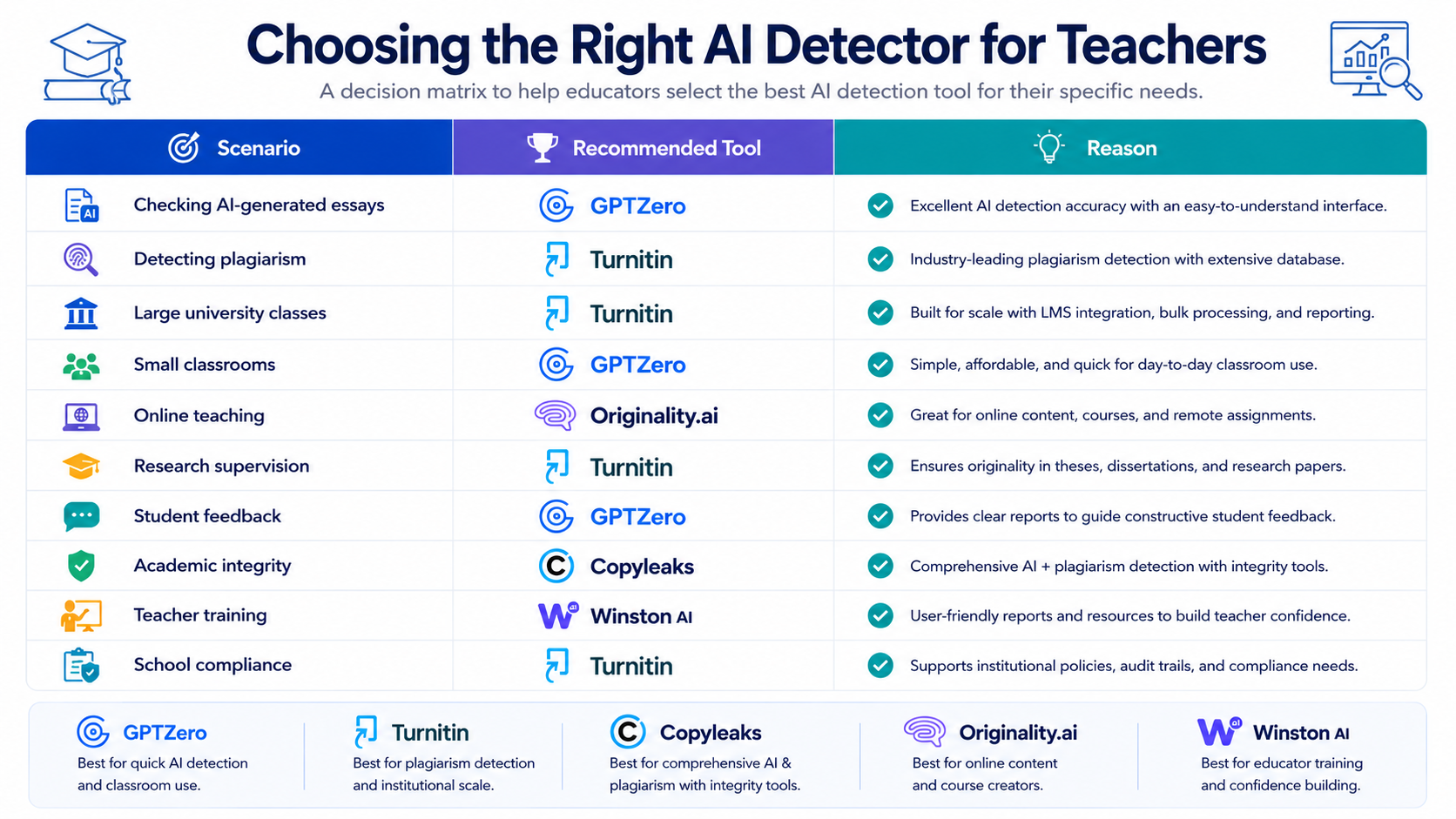
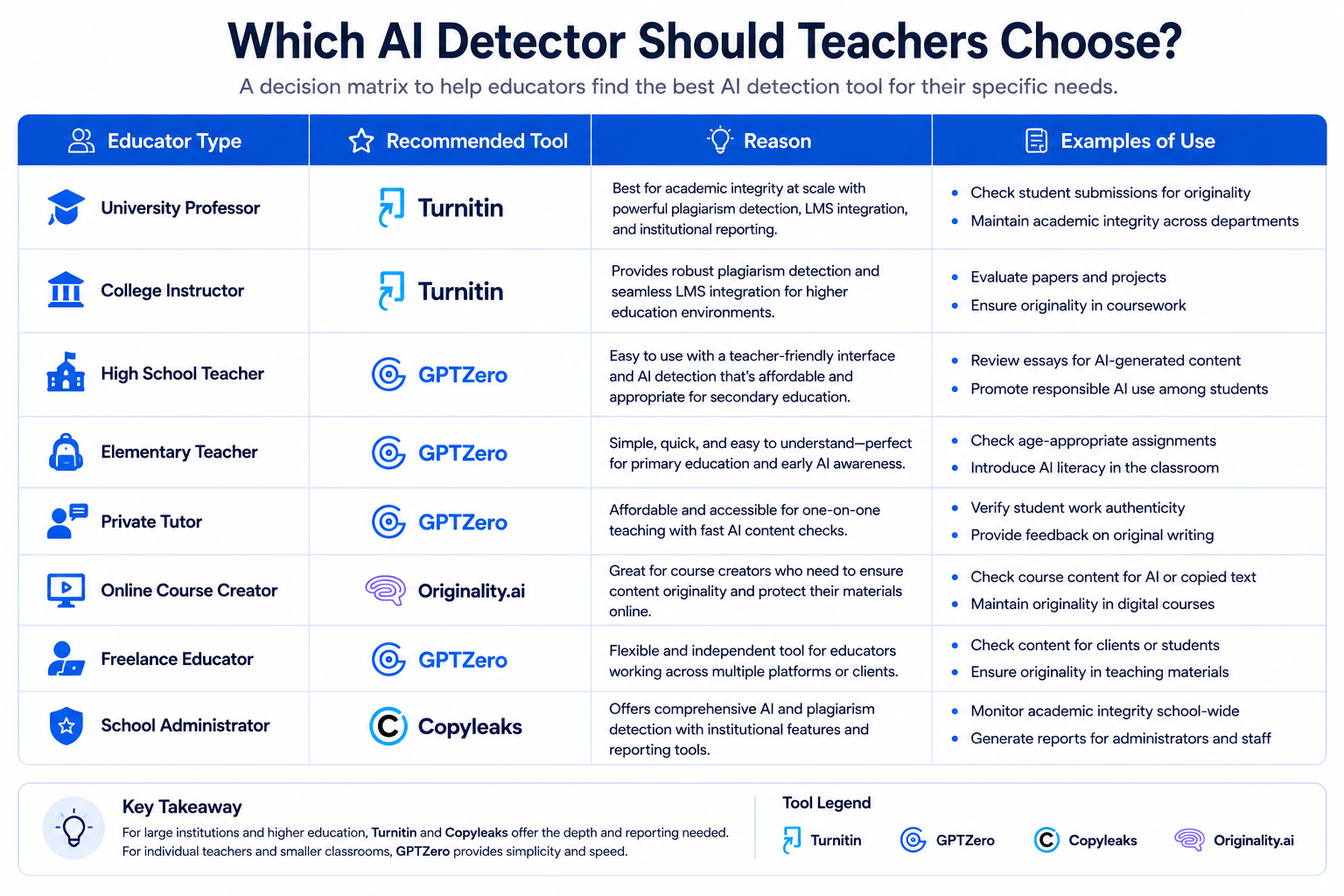
If you need to make a decision quickly, use this roadmap to match your role with the most appropriate tool:
- Individual Teacher or K-12 Instructor: GPTZero — Recommended for on-demand scanning, featuring robust false-positive protections and an accessible free tier.
- University or Large School District: Turnitin — Recommended for institutional, campus-wide deployment integrated directly into existing LMS grading workflows.
- Computer Science or Engineering Department: Copyleaks — Recommended for departments requiring dual validation of both natural language text and software programming code.
- SEO Content Publisher or Media Team: Originality.ai — Recommended for high-volume automated website crawling, bulk sitemap scanning, and commercial risk mitigation.
TL;DR
The choice of an optimal AI detection framework for educators relies entirely on institutional scale, deployment infrastructure, and user access. GPTZero stands out as a highly practical independent utility for individual teachers, K-12 instructors, and standalone writing coordinators. Its structural design prioritizes false-positive mitigation, detailed sentence-level mapping, and accessible retail pricing models.
For campus-wide enterprise deployment, Turnitin is commonly utilized by large universities and unified school districts. It provides native embedding capabilities inside learning management system (LMS) speed-graders and maintains an extensive cross-referencing archive of non-public historical student submissions.
For technical computer science departments requiring software code verification alongside natural text tracking, Copyleaks provides a necessary dual-engine framework capable of analyzing complex programming languages natively.
👉 Try GPTZero Today →
Recommended for individual teachers, tutors, and K-12 instructors who need immediate, reliable document scanning with visual sentence highlights and a permanent free tier.
Quick Facts
- Primary Academic Goal: Differentiating natural student prose from machine-generated text while maintaining low false-positive rates to safeguard student well-being.
- Core Detection Mechanics: Most platforms employ deep neural networks trained on datasets of human and machine text. They map semantic predictability patterns through metrics known as perplexity and burstiness.
- How It’s Used: Options range from lightweight standalone web-form uploads and Google Chrome browser extensions to complex integrations that embed directly into native classroom grading portals.
- Data Privacy Compliance: Educational tools must align with legislative mandates such as FERPA and GDPR to protect student intellectual property and sensitive academic records from commercial model training.
- Purchasing Differences: The marketplace is sharply split. There are accessible retail SaaS models featuring transparent monthly menus, and closed institutional site licenses requiring enterprise purchasing workflows based on Full-Time Equivalent (FTE) student populations.
What Are the Best AI Detectors for Teachers?
Direct Answer Block: The best AI detectors for teachers are advanced natural language processing (NLP) applications calibrated specifically to evaluate student writing and estimate the statistical probability of machine generation while actively protecting authentic human prose from false accusations.
In an educational environment, the ideal system must possess tuned verification thresholds that accommodate the precise syntax of non-native English speakers. It should integrate seamlessly into existing classroom workflows (such as Canvas, Moodle, or Google Classroom) and provide transparent visual mapping rather than non-descriptive binary scores. Based on available operational parameters, GPTZero is a commonly preferred standalone choice for individual teachers and small content teams due to its forensic transparency and focus on student protection. Turnitin remains the standard framework for university-wide, automated institutional deployments.
How We Evaluated These Tools
To construct an objective comparison that prioritizes educational fairness over aggressive commercial filtering, we analyze the structural functionality of each software platform. This evaluation is based on six core parameters derived from realistic classroom performance data, public documentation, and institutional case studies available at publication time:
- False-Positive Mitigation Strategy: The design parameters built into the platform’s algorithm to protect authentic human writing. This is especially important for formal essays or copy written by international students whose native language is not English.
- Visual Diagnostic Transparency: The system’s ability to explain why an asset has been flagged, utilizing sentence-level highlight overlays and structural charts rather than relying on ambiguous holistic percentage scores.
- LMS Integration Depth: The availability of software wrappers and native plugins that embed the engine directly into Canvas, Blackboard, Moodle, or Google Classroom to automate auditing without disrupting grading schedules.
- Plagiarism Matching Infrastructure: The scope of the underlying reference database. We assess whether the platform can cross-reference submissions against gated academic journals, active web indexes, and private peer-to-peer student repositories.
- Data Security & Privacy: The platform’s commitment to educational data safety regulations (such as FERPA and GDPR). This ensures student assets are processed via encrypted channels and shielded from unauthorized commercial AI training.
- Procurement Accessibility: The financial feasibility of the system for varying educational budgets. We track whether independent tutors can access the technology via standard retail channels or if it is restricted behind long-term enterprise licensing boundaries.
Educational Infrastructure Evaluation Matrix
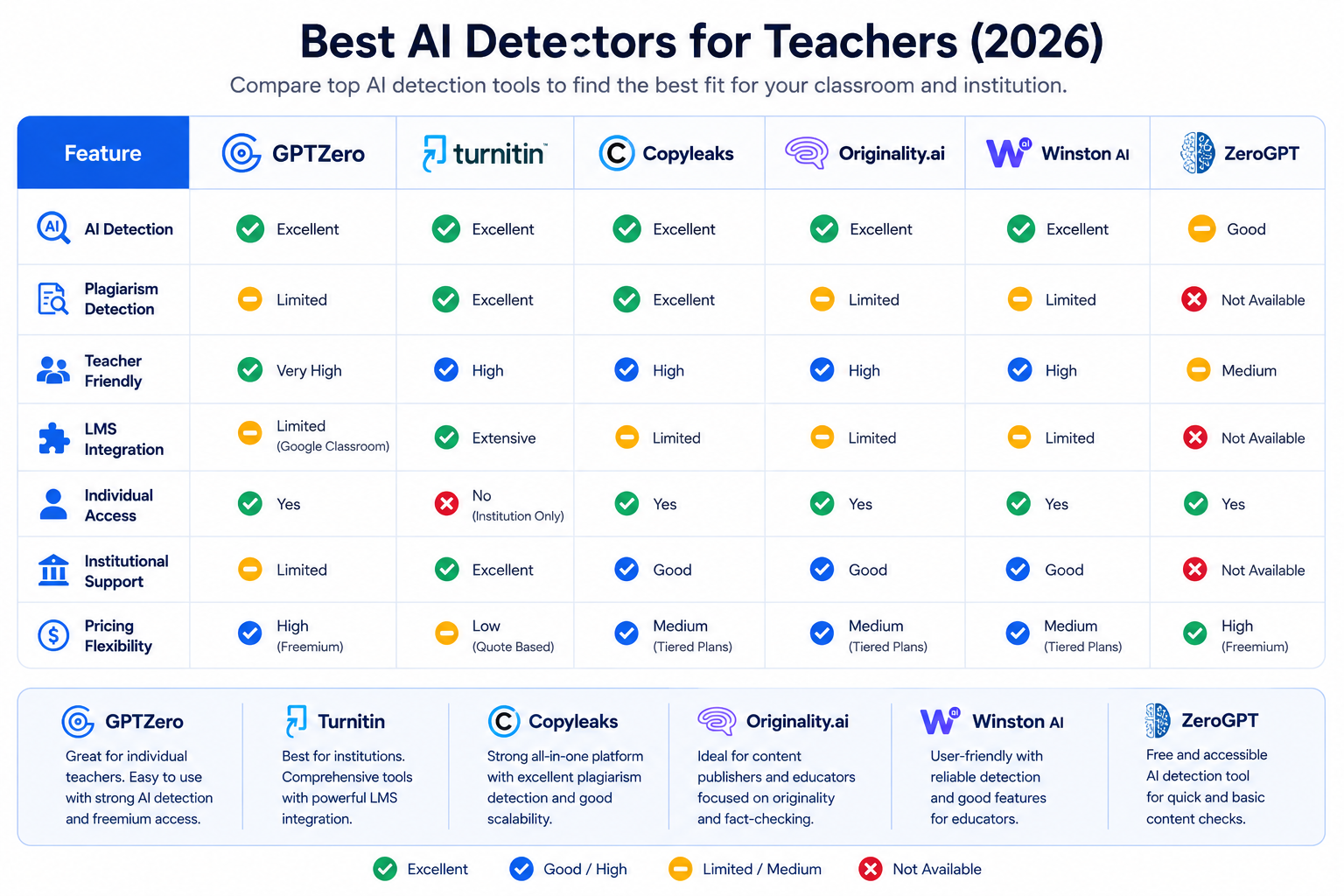
The following analytical matrix summarizes how the major software applications perform across these critical operational pillars based on technical feature mapping and publicly available documentation:
| Evaluation Criterion | GPTZero | Turnitin | Copyleaks | Originality.ai | Winston AI | ZeroGPT |
|---|---|---|---|---|---|---|
| False-Positive Mitigation | Excellent | Very Good | Good | Limited | Very Good | Limited |
| Visual Diagnostic Mapping | Excellent | Good | Very Good | Limited | Very Good | Limited |
| LMS Workflow Integration | Good | Excellent | Very Good | Limited | Good | Limited |
| Plagiarism Database Scope | Good | Excellent | Very Good | Very Good | Good | Limited |
| Data Safety & Privacy | Very Good | Excellent | Excellent | Limited | Very Good | Limited |
| Retail Menus Accessibility | Excellent | Limited | Very Good | Very Good | Excellent | Excellent |
| Primary Design Target | Classroom | Campus | Enterprise | SEO/Web | Tutor | Casual |
Category Winners
Recommended for General Classroom Use: GPTZero
GPTZero is designed specifically to reduce false positives in educational environments. Developed with a mandate to preserve academic transparency, its classification thresholds require high statistical confidence before applying a machine label.
By focusing heavily on the structural principles of perplexity and burstiness, it differentiates the robotic consistency of AI from the varied, eccentric rhythms of human writing. Its clean reporting canvas maps document modifications sentence-by-sentence. This ensures that verification functions as a formative learning tool to discuss with students, rather than a purely punitive grading gate.
Recommended for Universities: Turnitin
For comprehensive, institutional-scale deployment across an entire campus network, Turnitin remains a primary choice. Universities process thousands of complex documents concurrently across separate departments. This requires centralized administrative visibility and automated background processing.
Turnitin accomplishes this through its extensive procurement framework and deep native LTI integrations. Critically, it is backed by an extensive institutional academic archive, which helps identify peer-to-peer copying that commercial engines typically cannot see.
Recommended for Individual Teachers: GPTZero
Independent tutors, standalone language instructors, and individual teachers operating outside of centralized school-wide IT funding require an agile tool with immediate activation. Because Turnitin generally restricts single-user retail purchasing, GPTZero fills this operational gap perfectly.
Its permanent free tier and predictable flat-rate monthly plans allow independent teachers to audit borderline assignments on demand. This provides advanced text forensics without requiring multi-department administrative approval or expensive enterprise buy-in.
Recommended for K-12 Schools: Winston AI
Winston AI serves as a practical utility for primary and intermediate school environments where student submissions frequently bypass digital text inputs entirely. Equipped with Optical Character Recognition (OCR) technology, Winston AI can extract, parse, and scan text hidden inside scanned PDF records, cell phone snapshots of worksheets, and physical handwritten documents.
This functionality allows K-12 teachers to monitor authenticity parameters across physical classroom papers and digital submissions concurrently through an intuitive, easy-to-use dashboard.
Recommended for Plagiarism Detection: Turnitin
Authenticity validation requires checking both that content was not generated by a machine and that it was not stolen from another human creator. Turnitin runs a highly comprehensive plagiarism verification network.
Beyond matching text strings against the active web index and gated academic journals, its system compares submissions against historical student uploads spanning decades. It also deploys sophisticated cross-language translation algorithms, mapping semantic logic across over 30 global languages to expose translation-based plagiarism patterns cleanly.
Recommended for Classroom Workflow: Turnitin
When it comes to speed-grading efficiency, Turnitin removes manual friction by remaining completely invisible to daily student activities. Rather than forcing an instructor to constantly toggle tabs, manage token consumption sheets, or copy text into external dashboards, Turnitin embeds straight inside tools like Canvas SpeedGrader or Blackboard Learn.
The moment an assignment is uploaded, the background check triggers programmatically. It then pushes a distinct colored originality badge directly inside the teacher’s native grading portfolio, allowing the grading workflow to proceed without interruption.
Detailed Reviews
Evaluating the specific software environments available to educators requires looking past simple accuracy claims to analyze how their underlying classifiers treat student text in the real world.
1. GPTZero
GPTZero is a highly sophisticated, accessible text analysis utility optimized to support classroom instruction, writing transparency, and student protection.
Detailed Forensic Layout & Transparency
GPTZero avoids oversimplified, non-descriptive holistic scores. When a student assignment is pasted into its text editor, the platform runs a deep structural diagnostic sequence. It parses the document sentence-by-sentence, overlaying detailed color-coded highlights that separate human phrases from potential machine text and hybrid edits.
The accompanying dashboard displays interactive linguistic histograms charting the precise perplexity metrics (the mathematical predictability of word combinations) and burstiness scores (the structural variance in sentence length).
This forensic transparency allows an instructor to see exactly where an essay transitions from natural human thought into rigid, machine-spun summaries. It serves as an invaluable tool for conducting constructive, face-to-face writing reviews with students, allowing teachers to point to specific sentences rather than relying on a generalized percentage.
Safety Thresholds and False-Positive Protections
The defining characteristic of GPTZero within the educational market is its deliberate design path prioritizing student safety. Because an incorrect cheating accusation can negatively impact a student’s academic confidence, GPTZero’s underlying algorithms are calibrated to favor the author. It demands a high level of mathematical pattern consistency before applying an AI marker.
This protective engineering accommodates the naturally formal prose styles, rigid transitions, and precise vocabulary patterns common among non-native English speakers or highly structured academic researchers. By recognizing these patterns as human, it drastically reduces false-positive friction. For a deeper analysis of this structural approach, review our detailed GPTZero Review.
Purchasing Accessibility
GPTZero provides high financial transparency and flexibility for educators. It maintains a generous permanent free tier that allows individual teachers to execute baseline checks without credit card commitments. Its paid tiers grant substantial word pools, lightweight learning platform shortcuts, and advanced rewriter tracking metrics without forcing users into expensive, multi-year institutional enterprise negotiations.
2. Turnitin
Turnitin is an enterprise-grade institutional academic integrity ecosystem engineered to enforce system-wide compliance across massive educational networks.
Systemic Integration and Invisible Automation
Turnitin approaches verification as a foundational infrastructure layer. Utilizing advanced LTI standards, the application embeds natively straight into the core architecture of prominent learning management platforms including Canvas, Blackboard, Moodle, and Brightspace.
It eliminates the administrative bottleneck of manual checking. Teachers simply create an assignment inside their school’s native portal, and Turnitin programmatically audits every upload in the background. It populates aggregate similarity badges directly inside the institutional gradebook speed-grader view, streamlining workflows for professors grading hundreds of papers.
Database Dominance and Plagiarism Frameworks
The true operational anchor of Turnitin is its proprietary reference archive accumulated over decades of educational deployment. The software cross-references every submittal against an extensive institutional academic archive, alongside paywalled scientific clearinghouses and active web directories.
This matching index allows Turnitin to isolate peer-to-peer copying across separate school districts, terms, and countries that standard commercial web scrapers cannot access. This makes it a common framework for higher education degree validation. For an in-depth breakdown of this enterprise architecture, see our Turnitin Review.
Institutional Purchasing Isolation
The primary limitation of Turnitin is its lack of retail accessibility. Turnitin does not operate an open consumer storefront. This means individual teachers, independent freelancers, and students generally cannot purchase direct personal accounts.
The platform is distributed via custom-quoted annual enterprise contracts based on institutional Full-Time Equivalent (FTE) student enrollment parameters. This requires district-wide or university-wide procurement approval, locking out smaller operations.
3. Copyleaks
Copyleaks is an intensive enterprise-grade data-protection and text verification workstation. It is designed to support cross-functional compliance across both natural human text and software programming source code.
Specialized Source Code AI Forensic Matrix
While most classroom-focused applications limit their neural network training models strictly to natural human languages, Copyleaks features a standalone computer science forensic engine. This module natively parses multiple software programming languages, including Python, JavaScript, C++, Java, and Go.
It evaluates code structure, algorithmic logic, and comment rhythms to determine if a script was composed by a student or generated by an automated coding assistant (such as GitHub Copilot). For technical universities and engineering departments, this code protection matrix is highly practical for maintaining codebase originality. Explore this further in our deep Copyleaks Review.
All-In-One Enterprise Compliance Capabilities
For large institutional content spaces, Copyleaks consolidates multiple diagnostic vectors into a single automated processing pass. It tracks standard text plagiarism, flags machine text variations, and deploys cross-language translation mapping to identify content copied and translated from international web sources.
Backed by a verified SOC 2 Type II data safety certification and global GDPR compliance protocols, it ensures student proprietary assets are processed securely via encrypted channels. Options exist to clear text from long-term memory logs to prevent AI model training leaks.
The Token Management Friction
Copyleaks distributes its premium capabilities through a rolling word-count token subscription structure. While highly flexible for multi-user developer spaces, this system can introduce minor administrative friction in standard classroom settings.
Instructors must monitor word allocations. Running multi-layered scans (combining text AI tracking with code plagiarism verification) consumes credits quickly, requiring consistent monthly budget optimization.
4. Originality.ai
Originality.ai is a commercial risk mitigation and web portfolio auditing utility engineered primarily for search engine optimization (SEO) networks and digital asset buyers.
Commercial Sensitivity for Web Content
Originality.ai is built from the ground up to protect web property owners from automated filler text that could trigger search visibility penalties. Its machine learning models are calibrated to be highly sensitive, prioritizing the containment of machine text footprints above all else.
When encountering unedited or prompt-humanized marketing copy, its classifiers identify generative patterns with high speed. It delivers direct percentage readouts and public verification links that serve as digital receipt verification for content buyers, as noted in our Originality.ai Review.
The Elevated False-Positive Risk for Education
Because Originality.ai focuses on catching every piece of AI content, it accepts a higher false-positive rate. This makes its classification thresholds poorly suited for an educational environment.
When parsing highly structured human text, formal technical guides, or essays written by non-native English speakers who rely on standard transition formulas, Originality.ai often delivers elevated AI risk flags. Treating these commercial scores as definitive grading metrics introduces severe false-accusation liabilities in a classroom setting.
Native Bulk Sitemap Crawling Extensions
The defining technical advantage of Originality.ai is its automated XML sitemap website scraper. A user can paste a root domain link, and the system autonomously crawls and scores every published page on the site for AI text and plagiarism.
While this is an invaluable tool for executing immediate due diligence on an acquired web property, it offers virtually zero utility for an instructor reviewing a stack of student terminal essays inside an LMS ecosystem. This contrast is detailed across our comparison of GPTZero vs Originality.ai.
5. Winston AI
Winston AI is an agile, user-friendly text analysis application designed specifically to support K-12 instructors, parent-teacher partnerships, and independent writing coaches.
High-Fidelity Optical Character Recognition (OCR)
A persistent logistical challenge for primary and secondary school teachers is processing documents that bypass digital text editors entirely. Younger students frequently draft responses by hand on worksheets or submit printed homework pages via physical image captures.
Winston AI resolves this bottleneck through its integration of Optical Character Recognition (OCR) technology. The engine reads, extracts, and digitizes text hidden inside cell phone photos, scanned PDFs, and handwritten image files, running standard authenticity and plagiarism reviews over physical assets cleanly.
Intuitive Dashboard and Simplified Reporting
Winston AI provides a streamlined user interface that avoids data-dense enterprise dashboards. It delivers an immediate, accessible aggregate originality score accompanied by clear, non-technical phrase highlights.
It includes a digital document organizer that allows teachers to group student submissions cleanly by class periods, assignment titles, or semester terms without requiring backend IT deployment or deep technical training.
Enterprise Scale Restrictions
While highly effective for localized classroom monitoring, Winston AI lacks the deep administrative infrastructure needed to govern large university networks. It does not provide the automated, campus-wide site licensing capabilities, full-site sitemap crawling pipelines, or advanced authorship metadata tracking engines required to monitor contract cheating across massive institutional deployments.
6. ZeroGPT
ZeroGPT is a lightweight, ad-hoc public web utility engineered for rapid, casual single-document text checks. It should not be confused with the forensic architecture of GPTZero.
Immediate, Barrier-Free Text Checking
ZeroGPT functions as a basic text forensics environment. Its primary advantage is its frictionless accessibility. Users navigate to a clear public website, paste a short text block into a basic form field, and receive an instant output score without creating a profile, validating email addresses, or managing monthly software credit allocations. For a teacher needing a quick, secondary check on a suspicious paragraph, it provides instant access.
High Volatility and False-Positive Risks
The fundamental limitation of ZeroGPT is its algorithmic instability. Because its basic classifiers rely on rigid pattern matching without advanced linguistic forensics (such as multi-tiered perplexity analysis), its performance metrics display volatility based on available data.
It can occasionally deliver false negatives on lightly edited machine text while generating disruptive false positives on completely human prose, non-native English transition phrases, and standard legal definitions. Furthermore, the public web interface is crowded with display advertisements, and the platform lacks team project directories, LMS integration capabilities, plagiarism indicators, and secure data privacy safeguards.
Decision Table
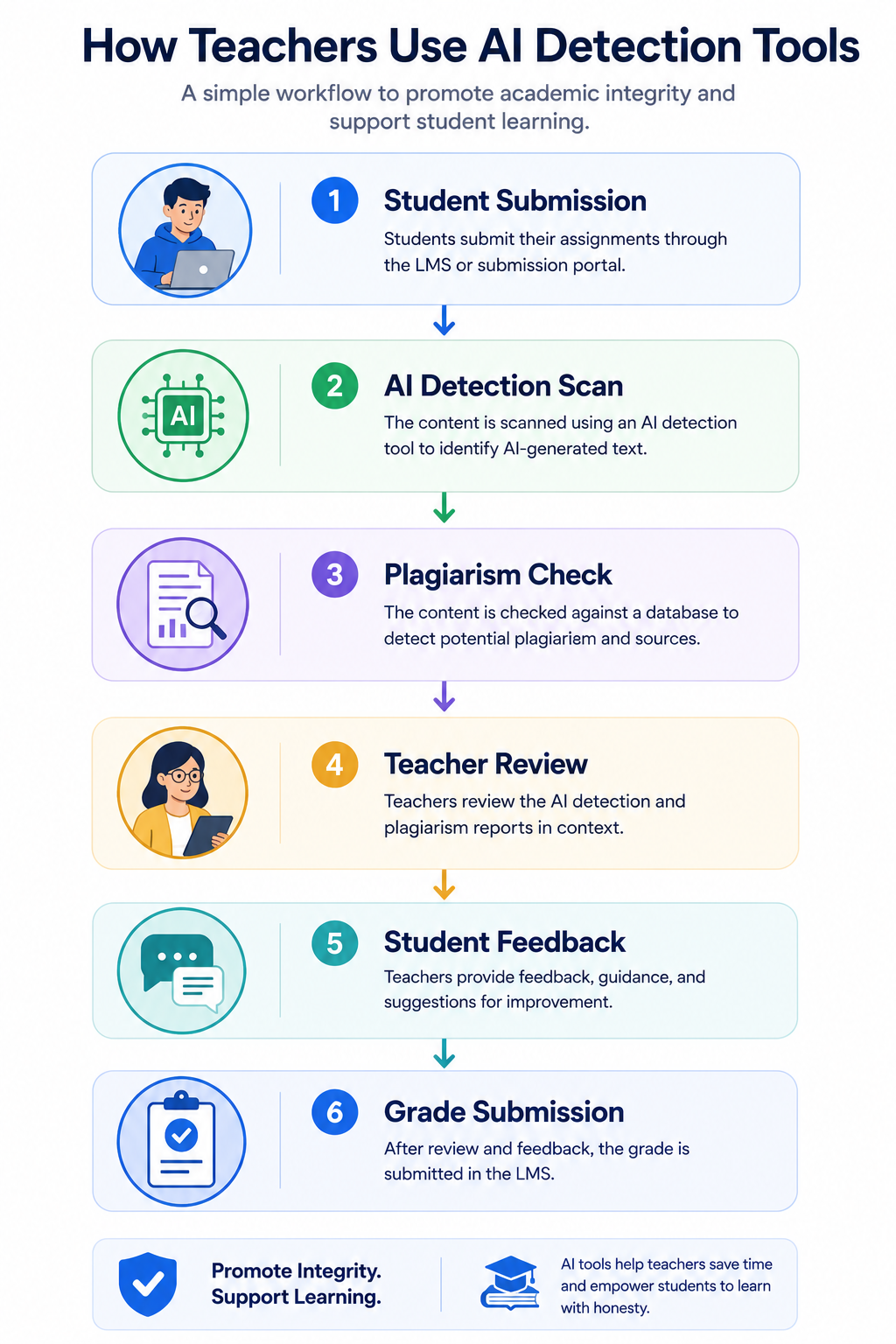
To resolve software evaluation paralysis immediately, map your specific educational use case to the verified platform paths below:
| Question Parameter | Recommended Platform Pathway |
|---|---|
| 1. I need to verify student research papers against an archive of historical student submissions. What tool should I use? | Turnitin: It holds an extensive, multi-decade repository containing historical, non-public student uploads. |
| 2. I am an independent tutor looking for a free, intuitive sandbox to verify individual assignments. Can I buy Turnitin? | No. Turnitin restricts individual retail purchasing. You should utilize GPTZero’s permanent free tier or flat-rate plans. |
| 3. Our computer science class needs to check student Python scripts for AI code generation. What tool fits? | Copyleaks: Its specialized programming engine parses syntax logic patterns cleanly across major code formats (Python, JavaScript, C++). |
| 4. I need a tool that can extract and scan text directly from cell phone photos of handwritten homework. What works? | Winston AI: Its integrated Optical Character Recognition (OCR) digitizes and processes text from images. |
| 5. We require an AI detector that integrates directly into Canvas SpeedGrader to display scores automatically. What tool wins? | Turnitin: Its enterprise LTI compliance wrappers embed smoothly, providing automated background processing for instructors. |
| 6. I need to protect international non-native English students from false AI cheating accusations. Which tool is safer? | GPTZero: Its classification thresholds prioritize student safety, requiring high mathematical confidence to apply an AI flag. |
| 7. I manage a high-volume SEO agency and need to audit an entire 400-page published website. What is the best tool? | Originality.ai: It contains an automated XML sitemap web scraper that crawls full live domains autonomously. |
| 8. Our board requires a tool backed by verified SOC 2 Type II data safety compliance to ensure student files stay private. | Copyleaks: It matches strict enterprise data governance protocols, offering secure, encrypted text clearance features. |
| 9. I want a platform that can trace cross-language translation plagiarism from foreign internet sources. What works? | Turnitin or Copyleaks: Both deploy advanced cross-language translation mapping tools to scan across global language subsets. |
| 10. I need to check an isolated paragraph immediately without creating an account or registering a profile. What fits? | ZeroGPT: It provides immediate public web-form uploads, though its high scoring volatility requires caution for grading. |
Common Questions
1. Is GPTZero more accurate than Turnitin for teachers?
Both platforms display strong performance within their intended environments based on public benchmarks. Turnitin is highly proficient at capturing machine text within standard student essays because its custom classifiers are trained explicitly on extensive datasets of human student writing variations. GPTZero is often preferred for qualitative classroom forensics because its interface visualizes perplexity and burstiness changes sentence-by-sentence. This gives educators a clear window into document construction while providing excellent protection against false positives on non-native English prose.
2. Can students buy private Turnitin accounts to test their essays?
Generally, no. Turnitin restricts individual direct consumer access and storefront purchasing to prevent automated text optimization loops. Access is governed exclusively by enterprise site licensing contracts managed directly by verified educational institutions and school boards. Students can only view their originality profiles if their specific course instructor enables that visibility setting within the institutional LMS assignment workspace.
3. Is it safe to use unauthorized online “Turnitin brokers”?
No, utilizing third-party online brokers that offer to run individual papers through Turnitin via shared or compromised institutional keys is highly unsafe. These unauthorized platforms frequently scrape submitted text, selling the files to essay mills or indexing them into unverified databases. When the official school instructor runs the final scan inside the university LMS, the student’s document will trigger a high Plagiarism match against their own scraped draft, resulting in automated failure and disciplinary reviews.
4. Do AI detectors generate false positives on student writing?
Yes. AI detectors run on mathematical pattern probability calculations rather than absolute digital watermarks, meaning they can mistake unique human writing rhythms for machine text. Highly formal essays, technical descriptions, and prose written by non-native English speakers who naturally lean on standard transition phrases frequently trigger false positives on sensitive commercial-grade classifiers. Instructors should treat scores as general indicators rather than absolute proof of misconduct.
5. How do perplexity and burstiness impact classroom AI detection?
Perplexity measures the mathematical predictability of word choices within a text string, while burstiness tracks the structural variance in sentence length and formatting across a complete document. Human writers naturally construct text with structural chaos—mixing brief, punchy phrases with complex clauses and using unexpected synonyms. Generative AI models produce text with uniform sentence lengths and highly predictable word paths (low perplexity and low burstiness), allowing forensic engines to isolate machine signatures.
6. Can AI detection tools identify content processed through “humanizers”?
Professional-grade forensic engines continuously update their machine learning classifiers to identify the structural signatures left behind by automated text humanizers and rewriters. While basic pattern checkers can be bypassed, advanced semantic processing software evaluates document progression holistically, tracking machine frameworks even when vocabulary has been surface-scrubbed.
7. Does Turnitin track contract cheating or ghostwriting?
Yes, Turnitin offers a specialized administrative module known as Authorship forensics engineered specifically to track contract cheating. The system evaluates a student’s historical metadata, tracking structural typing patterns, vocabulary complexity levels, and document properties across multiple semesters. If a new submittal departs radically from the student’s established writing style profile, the software alerts administrators to a potential ghostwriting intervention.
8. Are student essays safe from commercial model training when scanned?
When utilizing enterprise-grade, education-first utilities like Turnitin, GPTZero (on paid tiers), or Copyleaks, student data privacy is strictly protected in alignment with FERPA and GDPR regulations. The platforms process documents via encrypted data channels and allow administrators to block files from being committed to public memory logs, ensuring student intellectual property is completely shielded from commercial AI training pools.
9. Should teachers rely only on AI detectors when grading?
No, AI detection should support—not replace—professional academic judgment. Because AI detectors calculate statistical probabilities rather than identifying hardcoded watermarks, they are prone to occasional false positives, especially when evaluating highly formal or non-native English writing. An elevated AI score should serve as an entry point for an educational dialogue rather than automated proof of cheating. Instructors should review historical student drafts and conduct quick oral follow-ups if structural anomalies appear to verify a student’s understanding of the material.
Should You Use an AI Detector?
The decision to incorporate an AI detection utility into your teaching workflow should align with your specific institutional scale and pedagogical goals.
If your primary objective is to maintain text-level visibility across individual submissions, guide students through writing revisions constructively, and protect non-native English essay structures from false automated flags, incorporating a standalone tool like GPTZero provides a clear, actionable foundation. It serves as an informative assistant for independent instructors, tutors, and small departments.
For university administrators or district tech leaders, utilizing an enterprise framework like Turnitin is generally required to govern academic honesty across thousands of concurrent users. However, if your pipeline consists of checking programmatic repositories or bulk published web links, you should step away from classroom software and deploy specialized technical workstations like Copyleaks for source code verification, or Originality.ai for large-scale sitemap crawling.
Bottom Line
The implementation of AI detection software within the modern educational ecosystem requires shifting from punitive gatekeeping to transparent, formative text analysis. GPTZero stands out as a practical choice for localized classroom management, providing individual teachers, freelance tutors, and writing centers with an accessible forensic workstation. It is designed to reduce false-positive risks, map text transitions sentence-by-sentence, and preserve student-instructor trust.
Turnitin maintains its position as a baseline standard for comprehensive institutional compliance. It equips global universities and unified school districts with extensive historical reference repositories and native learning management system integrations required to automate quality control safely at scale.
👉 Try GPTZero Today →
Recommended for independent educators who need an accurate, student-friendly AI detector that minimizes false positives.
Final Verdict
The selection of an optimal text verification tool requires matching software strengths directly with your active educational scale. For individual educators, standalone writing coaches, and K-12 school rooms, GPTZero delivers the necessary false-positive mitigation, document transparency, and budgeting accessibility to protect student growth safely.
For large university campuses and integrated district-wide networks, Turnitin provides the required backend infrastructure automation, deep LMS gradebook plugins, and repository depth to enforce institutional compliance universally.
Identify your primary organizational parameters—individual classroom flexibility versus system-wide network automation—and deploy the specialized text verification framework engineered to protect your academic space.
Internal Link Opportunities
Maximize your digital production and text authentication pipelines by exploring our other hands-on software reviews across the Zotopie content network:
- GPTZero Review: Read this comprehensive guide to understand how linguistic perplexity mapping works. It is highly recommended for independent writers, freelance editors, and individual educators who need a qualitative text mapping tool but cannot access enterprise institutional licensing.
- Turnitin Review: Review our extensive, standalone breakdown evaluating the platform’s proprietary repositories, data privacy frameworks, and Feedback Studio grader tools. This is an essential read for university IT directors and academic administrators evaluating systemic LMS integrations.
- Copyleaks Review: Read this technical breakdown if you are a software engineering firm or corporate compliance department. It explains how Copyleaks detects AI in software source code across multiple programming languages and manages proprietary corporate text securely.
- Originality.ai Review: Read this detailed review if you run a digital publishing operation or SEO agency. We explore how its automated bulk XML sitemap crawling works to protect large web portfolios from search engine visibility penalties.
- GPTZero vs Turnitin: Read this head-to-head comparison if you are an educational platform coordinator weighing whether to invest in individual public SaaS subscriptions or transition your full network to centralized enterprise FTE site contracts.
- GPTZero vs Originality.ai: Dive into the operational differences between protective academic safety thresholds and aggressive commercial SEO content filtering algorithms.
- Best AI Detection Tools: See our full authority hub ranking the market’s top verification applications. This guide organizes the leading software strictly by specific industry use cases, helping you compare all major tools within a single holistic content curation strategy.
Backfill Recommendations
To further expand our topical authority in the AI Detection cluster, Zotopie should prioritize creating the following content assets:
- Winston AI vs GPTZero: A head-to-head comparison evaluating how Winston’s handwriting OCR engine matches up against GPTZero’s detailed linguistic perplexity charts for independent tutors.
- Turnitin vs Copyleaks (Academic Edition): A specialized comparison targeting university IT directors deciding between Turnitin’s extensive paper archive and Copyleaks’ source-code detection matrix for computer science departments.
- How to Bypass AI Detectors (And Why It Harms Content Strategy): An informational guide analyzing how prompt-chaining and humanizers manipulate text rhythms, paired with a strategic argument on why heavily optimizing text to beat detectors ultimately degrades reading quality and search engine visibility.