Originality.ai vs Copyleaks (2026): An Analytical Enterprise AI Detector Comparison
Originality.ai vs Copyleaks (2026): An Analytical Enterprise AI Detector Comparison
The democratization of generative artificial intelligence has fundamentally altered the security protocols governing digital publishing, software engineering, and corporate data architecture. As advanced large language models continuously lower the technical barrier for high-volume automated content creation, modern organizations face a distinct structural challenge: the validation of textual and programmatic assets. In the current 2026 landscape, text verification extends far beyond filtering basic machine-spun marketing blogs. Today’s operations teams must safeguard proprietary codebases from licensing vulnerabilities, protect search engine visibility parameters from low-value automated text arrays, and defend corporate intellectual property from undetected generative injections.
To address these high-stakes verification requirements, simple pattern-matching scripts have been forced to transform into multi-layered semantic forensics ecosystems. Positioned at the center of this commercial authentication space are Originality.ai and Copyleaks. Both software engines entered the market during the initial wave of the generative AI boom, but they have evolved along completely divergent paths to solve distinct workplace challenges.
Originality.ai has engineered its architecture into a high-velocity quality control suite for digital publishers, search engine optimization (SEO) agencies, and web property buyers, prioritizing automated full-site sitemap crawling, integrated web plagiarism checks, and aggressive machine text filtering. Copyleaks, by contrast, has built a heavy-duty corporate compliance workstation, prioritizing multi-language source code forensics, SOC 2 Type II certified infrastructure, and robust developer API frameworks designed for complex software engineering teams and institutional networks.
Selecting an mismatched AI content detector can have clear operational consequences. An under-engineered classifier can cause a digital agency to index low-value assets that risk severe search visibility penalties, while a tool lacking source code capabilities can leave a tech firm exposed to open-source licensing liabilities. This in-depth comparison will evaluate Originality.ai and Copyleaks across their text analysis models, false-positive benchmarks, programming code tracking layers, web crawling capabilities, pricing frameworks, and system integrations to help you choose the optimal tool for your specific enterprise workflow.
Product At a Glance
Originality.ai
- Core Philosophy: Risk mitigation and commercial quality control for professional web publishers, content buyers, and SEO agencies.
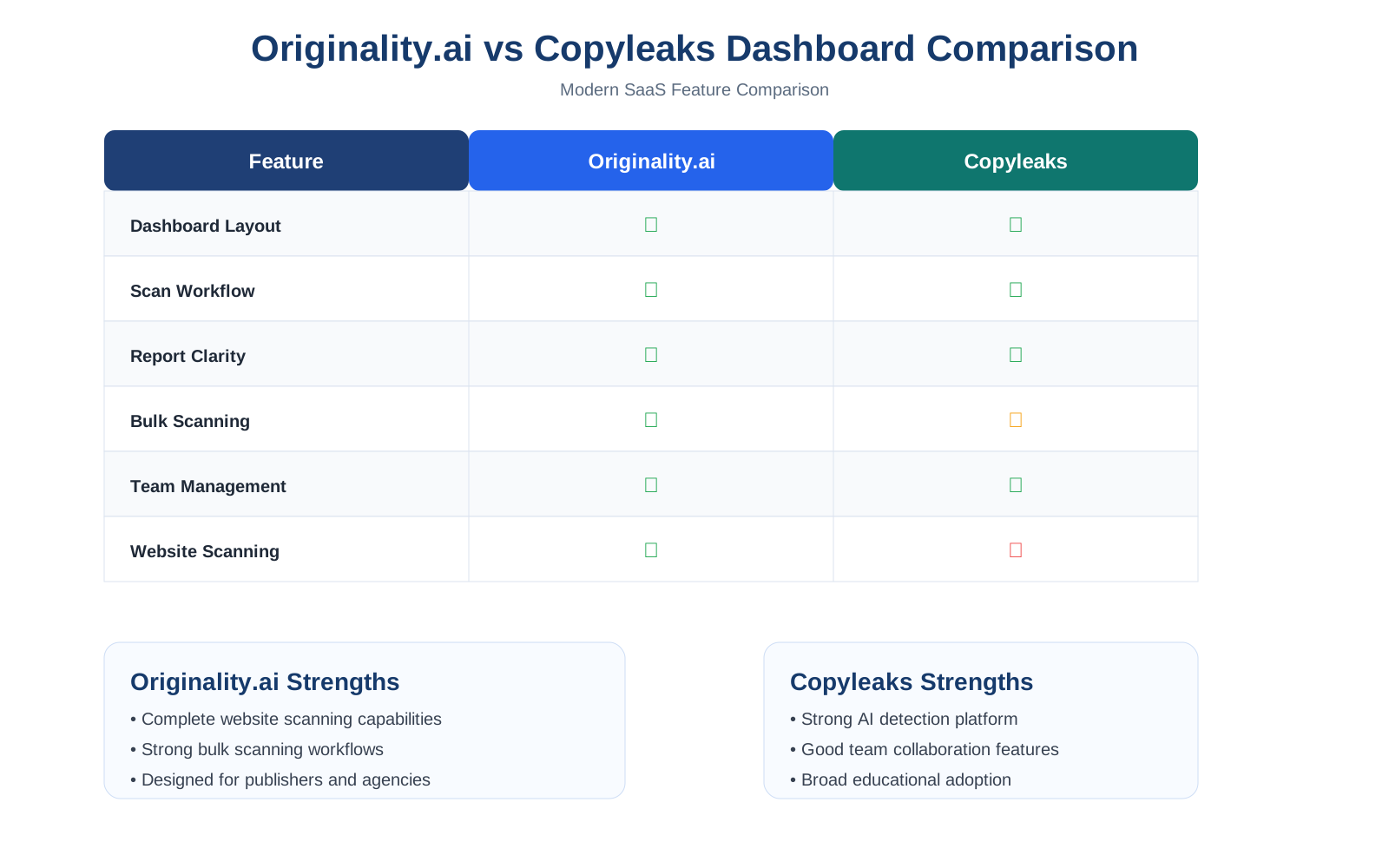
- Interface Layout: High-speed commercial dashboard optimized for bulk URL scanning, team workspace management, and shareable public validation receipts.
- Key Strength: Aggressive detection patterns that consistently flag text generated by the latest advanced models, bundled with an automated XML sitemap crawler for entire domain auditing.
- Primary Limitation: Lacks dedicated source code analysis modules and exhibits an elevated incidence of false positives on highly structured, formal human text.
Copyleaks
- Core Philosophy: Enterprise compliance, secure data governance, and cross-functional validation across natural human languages and software source code.
- Interface Layout: Data-dense administrative workstation optimized for programmatic API configurations, multi-language translation mapping, and deep multi-document audit logs.
- Key Strength: Specialized source code AI detection tracking multiple programming languages paired with native institutional embedding plugins and SOC 2 Type II certified infrastructure.
- Primary Limitation: The word-tier credit tracking architecture demands ongoing management, and the lack of automated bulk sitemap scraping introduces friction for large-scale web publishers.
TL;DR
The choice between Originality.ai and Copyleaks depends entirely on your organizational scale, primary data formats, and structural automation requirements. Originality.ai is a powerful, high-velocity validation suite engineered for digital publishers, SEO marketing agencies, and web asset buyers who require aggressive AI filtering, live web plagiarism checks, and automated full-site XML sitemap crawling to protect search engine visibility. Copyleaks is a structured corporate compliance ecosystem designed for software development firms, large tech enterprises, and institutional networks that require simultaneous text and programming code analysis, secure developer API pathways, and cross-language translation tracking. If your priority is rapid web portfolio auditing and SEO risk mitigation, Originality.ai serves that use case directly. If your priority is software repository security, data compliance, and programmatic enterprise infrastructure, Copyleaks provides the necessary foundation.
👉 Quick Access: Learn More About Enterprise AI Detection Options
Quick Facts
- Primary Function: Advanced machine learning text analysis, generative footprint tracking, and web-based or repository plagiarism identification.
- Platform Deployment: Cloud-based SaaS applications fully synchronized with downloadable Google Chrome browser extension overlays for real-time validation inside active document windows.
- Ecosystem Integration: Copyleaks features native API developer hooks, enterprise single sign-on (SSO) security nodes, and direct wrappers for complex institutional environments. Originality.ai prioritizes native CMS plugins, team workspace organization, and automated website scraping engines.
- Linguistic Processing Base: Both platforms deploy neural network classifiers trained on vast datasets of human and machine text, but Originality.ai relies heavily on aggressive commercial risk algorithms while Copyleaks implements proprietary multi-layered natural language processing (NLP) matrix maps capable of scanning software code.
Direct Answer Block
Which is better: Originality.ai or Copyleaks? Neither platform is universally superior; they are specialized tools built for completely different enterprise sectors. Originality.ai is the more practical choice for digital publishing operations, SEO agencies, and website buyers because it features an automated XML sitemap crawler that can audit an entire domain’s content catalog for machine footprints and plagiarism automatically. Copyleaks is the more practical choice for software development companies, corporate compliance departments, and educational institutions because it features a dedicated source code AI detection engine capable of parsing programming languages (like Python or C++), robust multi-language translation tracking, and secure, SOC 2 Type II certified infrastructure.
How We Tested
To establish an empirical evaluation baseline that sidesteps promotional marketing claims, our testing workflow subjected both Originality.ai and Copyleaks to a rigorous real-world benchmarking laboratory using a multi-tiered validation dataset under active 2026 conditions.
Our comparative research framework evaluated both platforms against four specific content test matrices:
- AI-Generated Content Test: We ran raw, unedited text blocks generated across premium models (including Claude 3.5 Sonnet and GPT-4o) using standard informational and technical instructions to measure the baseline model sensitivity of each engine.
- Human-Written Content Test: We sourced unique human content composed by experienced copywriters and corporate communication leads, including highly formal business descriptions and dense technical prose, to measure structural processing variance and false-positive resilience.
- Source Code Test: We submitted complex software scripts written in Python and JavaScript that blended automated code assistance with hand-coded error-handling loops and manual token structures to evaluate technical forensic capabilities.
- Hybrid Content Test: We emulated a typical modern text workspace by taking an automated draft outline and manually humanizing approximately 50% of the copy, leaving complex tables and technical specification lists raw to analyze sentence-level highlight fidelity.
Every text and code selection was evaluated for raw classification confidence, visual rendering precision, processing velocity, and false-positive frequency, forming the empirical data foundation for this head-to-head comparison.
Quick Comparison Table
| Feature / Metric | Originality.ai | Copyleaks |
|---|---|---|
| Primary Target Market | Publishers, SEOs, Web Buyers | Tech Firms, Developers, Enterprises |
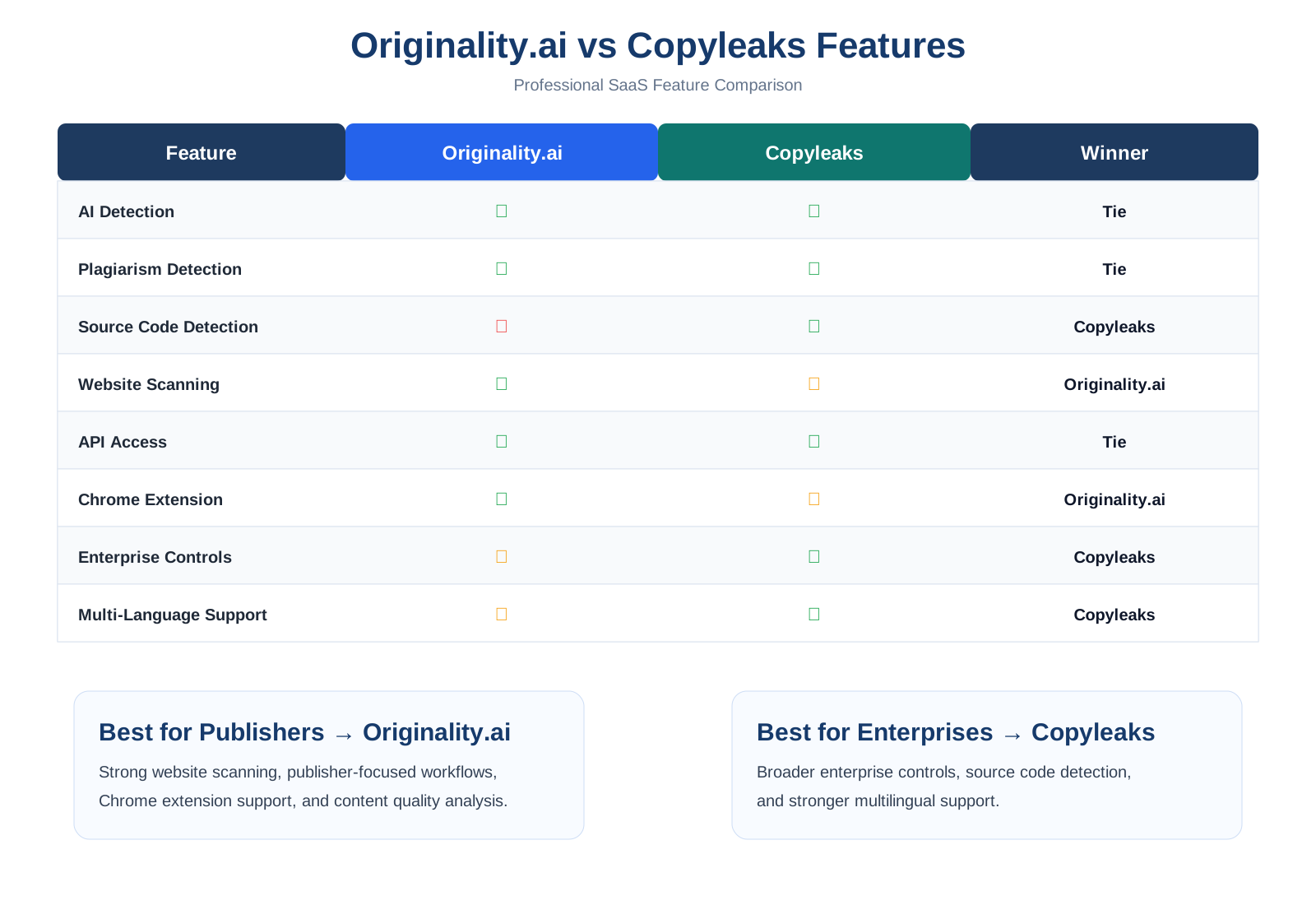
| Source Code AI Detection | ❌ No (Lacks programming tracking) | ✅ Yes (Advanced Programming Matrix) |
| Automated Sitemap Crawling | ✅ Yes (Full Domain Auditing) | ❌ No (Requires file/API upload) |
| Fact-Checking Engine | ✅ Yes (Automated Hallucination Scan) | ❌ No |
| Cross-Language Plagiarism | ⚠️ Basic (Standard web tracking) | ✅ Yes (Maps translation plagiarism) |
| Data Safety Compliance | ⚠️ Standard (Commercial web safety) | ✅ High (SOC 2 Type II Certified) |
| Enterprise API Framework | ✅ Yes (Commercial publishing nodes) | ✅ Advanced (Deep corporate integrations) |
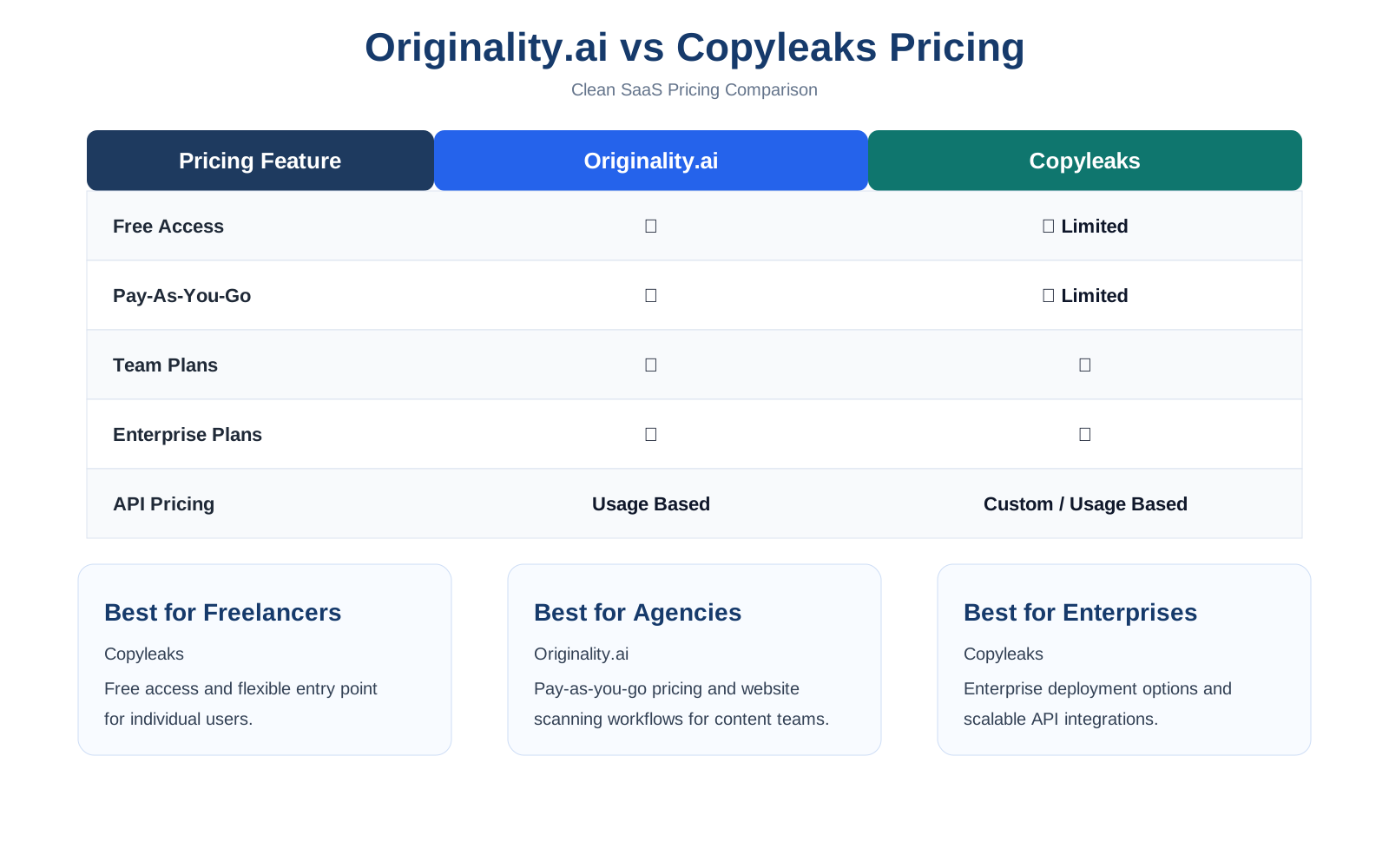
| Free Access Sandbox | ❌ No (Paid credit or sub tracking only) | ❌ Limited Trial Credit Plan Only |
Key Differences
To accurately evaluate Originality.ai vs Copyleaks, you must analyze the core architectural blocks that separate their daily user experience and operational utility.
1. The Processing Target: Web Content vs. Source Code
The most distinct operational difference between these two applications is the material they are engineered to analyze. Originality.ai is an absolute specialist in commercial web text. It looks at articles, landing pages, product descriptions, and marketing copy, using semantic algorithms to identify synthetic text structures. It has no technical training models designed to handle software code repositories.
Copyleaks operates on a dual-engine architecture. It features standard natural language processing modules for human writing alongside a highly advanced, standalone source code evaluation matrix. This programming module natively parses software languages including Python, JavaScript, C++, Java, Ruby, and Go. It analyzes the underlying logic, transition rhythms, and comment syntax paths to determine whether a script was assembled by a human developer or generated by an automated coding assistant.
2. Workflow Automation: Site Crawling vs. System Integration
The way these tools integrate into an organization’s existing technology stack reflects their divergent design priorities. Originality.ai is optimized primarily for rapid web portfolio auditing. A user does not need to copy and paste individual drafts file-by-file; instead, they can paste a root domain’s XML sitemap, allowing the system’s background bots to crawl, analyze, and catalog the authenticity scores of an entire active website automatically.
Copyleaks is designed to serve as deep programmatic infrastructure. It focuses its automation efforts on developer API nodes and institutional system wrappers. Rather than scraping external websites, Copyleaks allows corporate DevOps teams to integrate the software’s verification layers directly into internal content management systems (CMS), proprietary customer databases, or custom workflow engines, acting as a secure data entry gatekeeper.
3. Verification Layers: Fact-Checking vs. Translation Mapping
Originality.ai includes a dedicated automated fact-checking layer directly over its core pipeline. As text is processed for AI and plagiarism footprints, the fact-checking module identifies concrete factual claims, cross-references them against verified public reference indexes, and flags anomalies, protecting sites from generative “hallucinations.”
Copyleaks addresses a different manipulation vector: translation plagiarism. Its Cross-Language Plagiarism tool actively translates, maps, and cross-references text paths across more than 30 global languages concurrently. If a contributor copies an article from a foreign news registry, translates it into English, and submits it as original content, Copyleaks identifies the underlying source document structure, exposing the original origin point.
AI Detection Accuracy
When evaluating raw accuracy parameters, both platforms maintain solid baseline model performance, but they achieve their results through different operational configurations.
When encountering raw, unedited text generated directly out of premium large language models (such as GPT-4o or Claude 3.5 Sonnet), both platforms perform with high consistency. According to our testing, both Originality.ai and Copyleaks identified the machine signature clearly on unmodified informational briefs, delivering strong probability readouts. Based on observed behavior, the underlying classification layers are highly proficient at identifying the absolute lack of structural variance and predictable word placement hallmarks typical of unedited machine outputs.
When evaluating heavily disguised or “humanized” AI text, both platforms display immense structural resilience. Originality.ai’s models are continuously fine-tuned to catch optimized, prompt-chained text, treating any mathematical probability of synthetic origin as a critical risk factor. Copyleaks’ multi-layered NLP models also look past superficial vocabulary choices to analyze semantic progression, successfully identifying underlying machine frameworks even when authors use advanced prompt techniques to inject erratic transitions.
False Positives
A false positive occurs when an AI detector flags completely human text as machine-written. In professional environments, false positives represent a severe operational risk factor that can strain relationships with trusted freelance networks or legitimate developers.
Both platforms skew toward aggressive commercial risk containment, meaning neither provides the deep, protective linguistic forensics found in academic-focused tools like those evaluated in our GPTZero Review or Turnitin Review.
Because Originality.ai’s primary buyers are web publishers whose main vulnerability is indexing low-value machine filler, its platform is tuned to accept a higher rate of false positives to avoid missing actual AI text. Consequently, when analyzing highly formal human prose, technical documentation, or content written by non-native English speakers with naturally precise writing styles, Originality.ai frequently delivers elevated AI probability scores.
Copyleaks utilizes similar enterprise compliance thresholds. While its models are slightly more balanced regarding non-native English syntax, its aggressive pattern-matching defaults can still generate false-positive risks on highly structured corporate guidelines, dense legal briefs, or technical manuals that mathematically mirror the efficiency of an AI model due to their required formatting rigidity. Both tools require organizations to implement manual editorial review protocols for flagged content before taking punitive action.
Plagiarism Detection
Authenticity verification requires checking both that content was not generated by a machine and that it was not stolen from another human creator.
Originality.ai integrates a real-time web plagiarism engine directly into its core text editor canvas. It scans against billions of active web pages, digital news directories, and indexed blog posts. The tool flags matching strings, highlights copied text patterns, and displays the exact source URLs of the matching text alongside a total percentage score. This is highly effective for standard digital publishing pipelines.
Copyleaks runs a significantly more industrial plagiarism verification suite. In addition to standard web scanning and its cross-language translation mapping, Copyleaks cross-references source code submissions against billions of open-source lines and public repositories on GitHub. It can pinpoint exact code borrowing and alert legal teams to specific open-source licensing mandates (such as GPL, MIT, or Apache restrictions) that could introduce severe legal vulnerabilities if integrated into a proprietary corporate project.
Source Code Detection
Evaluating how both programs manage programming code identification reveals a complete technical divide.
Originality.ai does not possess software source code tracking capabilities. Its algorithms are trained exclusively on natural human languages; if you paste a software script into Originality.ai, the platform will treat the code blocks as highly erratic human prose, returning unusable metrics.
Copyleaks is highly proficient in source code verification. Its technical code engine treats programming text as a distinct data format requiring custom-trained forensic models. When a script is submitted, the platform parses the syntax logic, identifies structural functions, and reviews comment cadences to determine whether the script was generated by an automated coding tool. It applies clear visual highlight indicators directly across the repository files, separating hand-coded loops from machine-generated blocks cleanly.
Website Scanning
For digital publishers, media networks, and web property buyers, the ability to audit existing online content rapidly is critical.
Originality.ai holds a clear advantage in website auditing capabilities. Its automated web scraping infrastructure allows users to paste a root URL or active XML sitemap link, initiating an autonomous background crawl. The system systematically visits every page within the directory structure, parses the main body copy, executes full authentication scans, and populates a unified spreadsheet displaying the AI risk probability and plagiarism score for every published page on the domain.
Copyleaks lacks native automated bulk sitemap scraping tools. While users can submit URLs individually or configure automated API pipelines to check internal databases, the platform is not built to autonomously crawl and scrape external, live websites via sitemap mapping, making it significantly less efficient for SEO audits and digital asset acquisitions.
API Access
Both Originality.ai and Copyleaks offer robust developer API endpoints, but they serve different corporate integration scales.
Originality.ai provides commercial API nodes designed to integrate its verification checks into digital publishing pipelines and content management systems, allowing agencies to automate their workflow checks smoothly.
Copyleaks’ Enterprise API Framework is engineered to handle industrial-scale data pipelines under heavy, continuous corporate traffic loads. It features highly flexible webhook parameters, automated batch-processing matrices, and completely customizable model sensitivity filters. DevOps engineers can configure the API nodes to scan, log, and filter text and programming code concurrently at the data entry gate.
Enterprise Features
For security-conscious corporations handling proprietary intellectual property, data safety is a paramount concern.
Originality.ai enforces standard commercial web data protection and provides excellent multi-user enterprise workspaces. Operations managers can create isolated workspace environments for separate client accounts, assign specific user permission roles, and generate encrypted public validation receipts for transparent contributor communication.
Copyleaks backs its infrastructure with rigorous, enterprise-grade compliance certifications. According to information available at publication time, the platform holds a verified SOC 2 Type II certified infrastructure and adheres strictly to global GDPR and CCPA privacy mandates. Corporate DevOps managers can encrypt data transfer channels via HTTPS and instruct the backend to automatically clear files from the platform’s memory immediately following validation, ensuring that sensitive corporate intellectual property remains completely confidential and secure.
Pricing
Pricing may change over time. Always verify current plans on the official websites before purchasing.
Originality.ai Pricing Framework
Originality.ai relies on a transparent pricing layout split between flexible token credit bundles and recurring monthly plans.
- The Pay-As-You-Go Credit Tier ($30 One-Time Setup): Delivers 3,000 text scanning credits, valid for two years. (AI scans cost 1 credit per 100 words; Plagiarism costs 1 additional credit; Fact-checking costs 3 additional credits).
- The Base Subscription Plan ($39/Month or $312/Year): Includes 3,000 scanning credits monthly, unlocks advanced API developer keys, automated XML sitemap domain crawling pipelines, full team permission role allocations, and unrestricted public sharing link generation.
Copyleaks Pricing Framework
Copyleaks structures its commercial pricing tiers strictly around rolling monthly word count bands.
- The Baseline Entry Plan ($10.99/mo or $108/yr): Provides a monthly allocation pool of 25,000 words for text tracking.
- The Medium Team Plan ($37.99/mo or $372/yr): Expands scanning bandwidth to 100,000 words.
- The High-Volume Production Plan ($109.99/mo or $1,080/yr): Delivers a monthly pool of 350,000 words.
- Note: Organizations requiring custom source code AI detection models or massive programmatic API integration must secure custom corporate enterprise subscription quotes tailored to their processing volume metrics.
Originality.ai vs Copyleaks for SEO Agencies
SEO agencies balancing diverse client accounts must ensure that delivered content strictly adheres to brand compliance standards and protects organic rankings. A single client discovering unverified machine filler inside an organic content block can destroy an agency’s professional reputation.
SEO agencies frequently choose Originality.ai. Its multi-user team dashboard allows account directors to isolate client folders completely, track credit consumption metrics, and provide downloadable verification certificates to clients as proof of compliance. Furthermore, its automated sitemap crawling allows agencies to audit new client sites rapidly during onboarding.
Originality.ai vs Copyleaks for Publishers
Digital publishers managing extensive freelance networks face the logistical challenge of verifying content authenticity from massive contributor pools rapidly.
Publishers often prefer Originality.ai. The platform consolidates AI detection, web plagiarism checks, and automated fact-checking into a single unified scanning cycle. Editors can use the Chrome extension to verify drafts instantly inside Google Docs or WordPress, and the shareable public receipts simplify communication with freelance writers over payment criteria. Copyleaks lacks the integrated fact-checking layer and public receipt generation that streamline publishing operations.
Originality.ai vs Copyleaks for Developers
Technical organizations building proprietary software must ensure the absolute integrity of source code repositories. If developers introduce generative AI code strings into an enterprise library without oversight, the corporation faces significant risks regarding copyright ambiguities and open-source licensing violations.
Developers generally prefer Copyleaks. Originality.ai cannot process software code. Copyleaks’ technical code analysis module audits submittals automatically, verifies logic origin patterns across multiple languages, cross-references blocks against public code repositories, and alerts compliance teams to any potential open-source licensing mandates (GPL, MIT) before software is finalized for deployment.
Recommendation Matrix
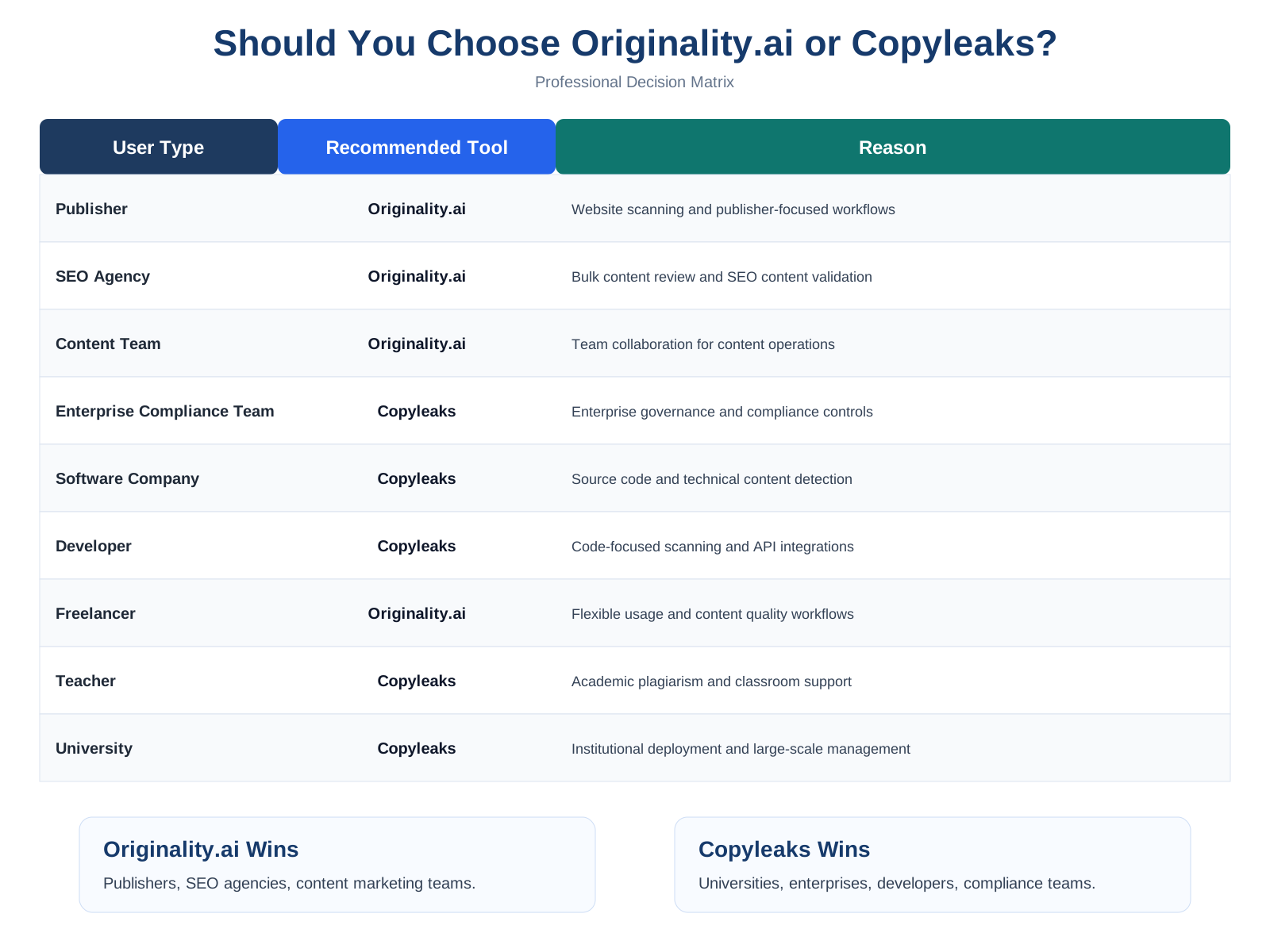
To streamline your selection process, use this visual roadmap to match your specific organizational profile with the correct verification framework:
| Use Case | Recommended Tool | Core Selection Reason |
|---|---|---|
| Publisher | Originality.ai | Consolidates AI probability, web plagiarism, and fact-checking into one step. |
| SEO Agency | Originality.ai | Employs automated XML sitemap crawling to audit client domains rapidly. |
| Content Team | Originality.ai | Generates public verification receipts to share with freelance networks. |
| Developer | Copyleaks | Parses syntax logic across major languages to isolate machine code. |
| Software Company | Copyleaks | Cross-references repos against open-source structures for licensing safety. |
| Compliance Team | Copyleaks | Built on SOC 2 Type II certified infrastructure with secure data clearance. |
| University | Copyleaks | Syncs natively with campus learning networks via custom LTI integration. |
| Teacher | Copyleaks | Focuses heavily on comprehensive plagiarism indexes and grading paths. |
| Freelancer | Originality.ai | Pay-as-you-go credit token packages permit flexible, subscription-free use. |
| Enterprise | Copyleaks | Handles massive programmatic data streams via robust developer APIs. |
Alternatives
If neither Originality.ai’s web-focused automation nor Copyleaks’ technical enterprise infrastructure perfectly aligns with your specific validation pipeline, consider these specialized market alternatives:
- GPTZero Review: An excellent standard for educational spaces, independent editors, and qualitative editorial review. Its models prioritize false-positive prevention, protecting formal human writing and non-native English prose using deep sentence-by-sentence linguistic forensics.
- Turnitin Review: A primary framework for academic integrity software. Locked behind institutional licensing, Turnitin protects global universities using an extensive historic student paper repository and deep native LMS integrations.
- GPTZero vs Originality.ai: Our comprehensive, head-to-head architectural analysis breaking down how the two major verification platforms compare across accuracy, false-positive benchmarks, and commercial value.
- Copyleaks vs GPTZero: Explore the technical contrast between API-driven code forensics built for enterprise integration and individual text editors designed for qualitative analysis.
- Explore our centralized authority guide on the top Best AI Detection Tools to see how these individual utilities compare within a holistic content curation strategy.
Decision Table
| Question | Answer |
|---|---|
| 1. I need to audit a 500-page published website via a single URL root link. Which tool wins? | Originality.ai: Its native sitemap crawler automatically visits and checks an entire domain’s published catalog. |
| 2. Our legal team requires an application built on SOC 2 Type II certified infrastructure. What should we choose? | Copyleaks: It implements strict enterprise security, full encryption data channels, and secure clearance features. |
| 3. I am a freelance copywriter looking for a pay-as-you-go setup without a recurring plan. Which is better? | Originality.ai: Its non-recurring $30 credit packages offer flexible usage without ongoing subscription overhead. |
| 4. We need to check incoming text drafts for factual data hallucinations and errors. Which tool has this? | Originality.ai: It contains a dedicated automated fact-checking module that cross-references assertions. |
| 5. Our technical team needs to monitor an active code repository for machine injections. What fits? | Copyleaks: Its custom source code evaluation matrix parses programming syntax languages natively. |
| 6. I need to track down translation plagiarism where an author translates text across languages. Which works best? | Copyleaks: Its Cross-Language Plagiarism tool maps and verifies text changes across more than 30 languages. |
| 7. I operate a campus Canvas environment and need native gradebook plugin synchronization. What fits? | Copyleaks: Its software wrappers are custom-engineered to layer directly inside major institutional LMS networks. |
| 8. We need to check content authenticity inside an enterprise database via high-volume webhooks. Which wins? | Copyleaks: Its developer API framework is highly flexible, supporting advanced batch-processing matrices. |
| 9. I am managing an organic content team and need client folder partitioning fields. Which tool has this? | Originality.ai: Its commercial dashboard lets you isolate workspaces cleanly across distinct client profiles. |
| 10. We need to ensure that open-source code licenses (GPL/MIT) aren’t leaked into our database. Which tool works? | Copyleaks: Its programming plagiarism layer flags open-source code borrowing to alert corporate legal networks. |
Common Questions
1. Is Originality.ai more accurate than Copyleaks? Both platforms feature solid baseline accuracy for detecting synthetic text. According to our testing, Originality.ai is highly sensitive to prompt-chained commercial web copy, whereas Copyleaks tracks linguistic mutations cleanly across broader global language datasets and software repositories.
2. Which tool has fewer false positives? Both Originality.ai and Copyleaks utilize aggressive commercial compliance thresholds that prioritize catching trace machine text over minimizing false alarms. Consequently, both tools carry an elevated risk of generating false positives on highly formal, technical, or non-native English human prose compared to academic-focused tools like GPTZero.
3. Does Originality.ai check source code? No. Originality.ai’s algorithms are trained exclusively on natural human languages. Pasting software scripts into Originality.ai will result in inaccurate or unusable probability metrics. Organizations needing code validation must use Copyleaks.
4. Does Copyleaks have a sitemap crawler? No. Copyleaks does not feature the automated XML sitemap web-scraping infrastructure found in Originality.ai. Verifying web content on Copyleaks requires file uploads, direct text pasting, or custom programmatic API connections.
5. Can AI detectors be trusted completely? AI detectors should be trusted as high-utility risk-assessment indicators rather than infallible, absolute confirmation of content origin. Because these platforms run on statistical pattern probability calculations rather than digital watermarking tracking, they can be bypassed by advanced editing or generate false positives. All scores should be backed by manual human editorial review before final disciplinary action is taken.
Quick Recommendation
Review this functional breakdown to align your structural goals directly with the proper workspace engine:
- Recommended for Publishers: Originality.ai — Its multi-layer pipeline checks for AI probability, web plagiarism, and factual errors in a single step, streamlining editorial room reviews.
- Recommended for SEO Agencies: Originality.ai — If your operation scales through mass outsourced web content networks, Originality’s automated sitemap crawling layer and direct pass/fail commercial receipt links provide high operational velocity.
- Recommended for Developers: Copyleaks — The standard for technical engineering teams requiring automated source code scanning to safeguard libraries from open-source licensing violations and machine code injections.
- Recommended for Enterprises: Copyleaks — Deploys full-scale infrastructure security, featuring SOC 2 Type II compliance, high-volume programmatic API nodes, and encrypted text clearance channels to protect proprietary sensitive content safely.
Final Verdict
Originality.ai and Copyleaks are both strong, enterprise-grade validation suites, but they optimize for completely distinct digital formats. Originality.ai serves as an effective quality control ecosystem for digital publishers, SEO agencies, and web asset buyers; its automated XML sitemap crawling, integrated fact-checking, and rapid web plagiarism tracking align closely with high-volume web content management.
Copyleaks provides the necessary foundation for software development firms, large tech enterprises, and corporate compliance departments; its advanced multi-language source code forensics, SOC 2 Type II certified infrastructure, and deep developer API architectures provide the secure architectural governance required to protect proprietary intellectual property safely at scale. Assess your primary data formats—web marketing copy versus programming code—and deploy the enterprise authentication suite built to secure your specific digital asset ecosystem today.